To accept payments at a car dealership, you need more than a card terminal at the sales desk. Dealership transactions often involve larger ticket sizes, deposits made days before delivery, financing steps that change the amount due, trade-in coordination, title and registration timing, compliance requirements, and customers who expect both speed and flexibility.
What looks like one payment on the surface is often a chain of connected transactions that has to be handled accurately across departments.
That complexity shows up everywhere in dealership operations. A shopper might place an online reservation, pay a down payment in the showroom, sign finance documents in the business office, then come back later for service work or accessory purchases.
Another customer may want to pay remotely by bank transfer, while a service customer needs a text-to-pay link after hours. Each scenario has different risks, processing costs, documentation needs, and customer-service expectations.
That is why car dealership payment processing is not just about accepting money. It is about building a dependable workflow for vehicle sales, service repairs, parts orders, deposits, refunds, and follow-up payments without creating confusion for staff or friction for customers.
The right approach helps the dealership get paid efficiently, reduce fraud exposure, keep records organized, and make the buying experience feel smoother from first deposit to final receipt.
In practical terms, to accept payments at a car dealership means having the systems, policies, and staff processes to handle payments securely across sales, service, parts, online reservations, finance office transactions, and remote interactions.
It means offering payment options that fit how customers actually want to pay, while also protecting the business from chargebacks, misapplied funds, duplicate transactions, and avoidable delays.
What it really means to accept payments at a car dealership
When most people think about dealership payments, they picture a buyer paying for a vehicle. In reality, how car dealerships accept payments is much broader.
Payment acceptance touches nearly every revenue stream in the store, and each one can have different timing, ticket sizes, and approval steps.
A dealership may collect a small hold for a vehicle reservation, a larger deposit to secure an incoming unit, a down payment tied to financing, a full cash purchase, or a balance due after a lender funds the deal. Outside the sales floor, the service department collects payments for diagnostics, labor, parts, warranties, and maintenance packages.
The parts counter may process walk-in card sales, special-order deposits, and commercial account purchases. Some stores also handle recurring or scheduled payments for maintenance plans, subscription-style products, or internal financing arrangements where permitted.
This matters because dealership payment systems cannot be built around a single transaction type. A service advisor taking a $480 repair payment does not have the same needs as a finance manager finalizing a five-figure down payment.
Likewise, a parts manager shipping special-order parts to a fleet account needs different workflows than a receptionist taking a deposit over the phone.
A strong payment strategy accounts for all of the following:
- In-person transactions at the showroom, service lane, and parts counter
- Remote payments by phone, email link, text message, or online portal
- Deposits, partial payments, and split tenders
- Down payments connected to financing paperwork
- High-ticket transactions that may require stronger verification
- Refunds, credits, and transaction adjustments
- Payment records that must reconcile cleanly with accounting and deal jackets
The goal is not simply to offer more ways to pay. It is to make every department able to collect funds in a way that is secure, well-documented, and easy for the customer to understand.
Payments in vehicle sales are often multi-step, not one-step
Vehicle sales are rarely a simple “tap and done” transaction. A buyer may reserve a vehicle online, visit the dealership to test drive it, place a deposit while waiting on financing approval, and then make a down payment at delivery.
Even in a cash deal, the store may receive funds in stages because the customer needs to move money between accounts, obtain a cashier’s check, or send a wire.
That means payment processing for car dealers has to support staged payment events with clear tracking. Staff should always know whether a deposit is refundable, whether it applies to the final purchase price, whether the payment has settled, and whether the customer has already received a receipt showing the payment purpose.
If those details are not documented clearly, confusion spreads quickly between sales, finance, and accounting.
For example, suppose a customer pays a reservation deposit online and then later changes to a different vehicle. If the dealership cannot easily locate the original payment, note the conditions attached to it, and apply or refund it correctly, the transaction becomes a customer-service problem.
The issue is not just operational inconvenience. It can also create dispute risk if the customer believes the dealership mishandled their money.
Payment acceptance extends well beyond the showroom floor
Many dealerships focus heavily on sales desk workflows and underinvest in service and parts payment systems. That creates a fragmented experience. Customers do not think in departmental silos.
They expect the same convenience whether they are buying a vehicle, approving repairs, ordering accessories, or paying a deductible.
Service transactions, for example, often involve estimated approvals, supplemental repairs, insurance coordination, after-hours pickup, and card-not-present payments. Parts departments deal with special orders, backordered items, commercial accounts, and prepayment requirements. These are not edge cases. They are routine parts of dealership operations.
A dealership that wants strong automotive payment solutions should think of payment acceptance as a storewide capability. Every department needs tools that fit its own workflow while still feeding into a unified reconciliation and reporting process.
That may include integrated terminals at fixed stations, mobile devices for service advisors, online payment links for remote approvals, and accounting visibility across all tender types.
This broader view makes it easier to serve customers consistently and reduces the burden on staff who otherwise end up improvising around gaps in the system.
The most common auto dealer payment methods and where each one fits
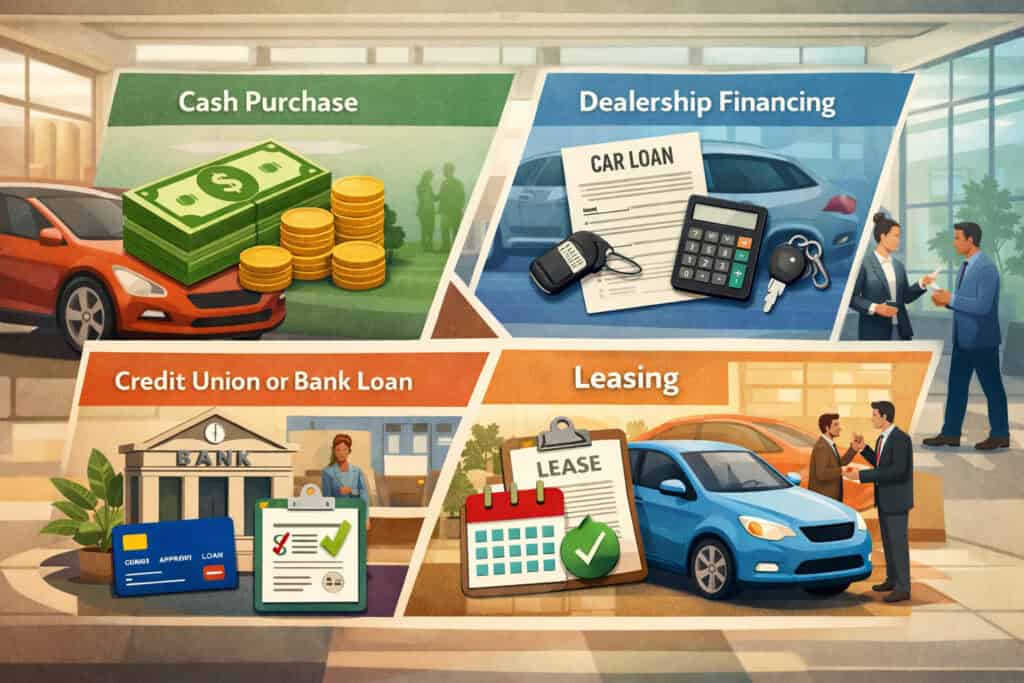
There is no single best payment method for every dealership transaction. The right mix depends on ticket size, department, risk tolerance, customer preferences, processing costs, and how quickly the dealership needs confirmed funds. Most stores benefit from offering several auto dealer payment methods while setting clear policies around limits and verification.
At a minimum, most dealerships need to handle card payments, bank-based payments, checks, digital invoices, and finance-related transactions. In-person and remote acceptance both matter. A customer may want to use a debit card for a service repair, ACH for a down payment, a cashier’s check for a vehicle purchase, and a text-to-pay link for an accessory order.
The key is not just availability. It is matching each method to the type of transaction where it makes operational and financial sense. Smaller tickets may favor card speed and convenience. Larger tickets often call for bank transfers or checks with additional verification.
Remote transactions require stronger controls than face-to-face payments. The dealership’s policies should reflect those realities.
Here is a practical comparison of common dealership payment options.
| Payment Method | Best Use Cases | Main Advantages | Main Limitations | Risk Considerations |
| Credit cards | Deposits, service repairs, parts sales, small down payments | Fast, familiar, easy receipts, good for in-person and remote use | Processing costs can be higher; some stores cap usage for large amounts | Chargebacks, card-not-present fraud, dispute claims |
| Debit cards | Service, parts, moderate in-person payments | Familiar, immediate authorization, often preferred by customers | Daily bank limits may block larger transactions | Some fraud and dispute exposure remains |
| ACH / bank transfer | Down payments, larger balances, fleet invoices, remote payments | Good for higher amounts, lower cost than cards in many cases | Not always instant; returns can happen; setup matters | Account verification and authorization are critical |
| Cashier’s check | Vehicle purchases, large balances due | Common for high-value purchases, familiar to buyers | Can require verification; risk of counterfeit instruments | Funds verification before release is important |
| Wire transfer | Full purchases, out-of-area deals, high-dollar payments | Strong for large-value transactions, widely accepted | Bank fees, cut-off times, manual confirmation steps | Confirm sender details and posted funds |
| Digital invoices / payment links | Service approvals, deposits, parts orders, remote balances | Convenient, supports remote payments, creates clear records | May encourage keyed or card-not-present payments | Use secure links and customer verification |
| Mobile wallets | Service lane, parts counter, accessory sales | Fast and convenient in person | Less common for very large tickets | Lower friction but still needs proper device security |
| Financing-related payments | Vehicle sales, F&I office, structured deal closing | Aligns with standard deal flow and lender coordination | Timing depends on lender documents and funding | Documentation and amount accuracy matter |
Card payments are convenient, but large-ticket policies matter
Credit and debit cards are often the most flexible tools in car dealership payment solutions because customers already understand how to use them. They work well for service repairs, parts purchases, deposits, and many down payments. They also support remote acceptance through secure invoices, tokenized card-on-file workflows, and payment links.
That said, large-ticket card acceptance requires policy discipline. Some dealerships allow cards only up to a certain amount on vehicle purchases because processing costs rise with ticket size and dispute exposure can become more serious.
A five-figure card payment can be convenient for the customer, but it also creates potential problems if the transaction is later challenged or if the cardholder claims the amount was not authorized.
Card acceptance works best when the dealership defines where cards fit in the process. For example, a store may permit cards for deposits and moderate down payments, while requiring ACH, wire, or verified funds for larger balances.
What matters most is consistency. If one salesperson promises unrestricted card acceptance while the finance office follows a different rule, the customer experience suffers immediately.
Useful controls for card payments include:
- Clear maximum amounts by department or transaction type
- Signed authorization for larger card-not-present transactions
- AVS and CVV checks for remote card payments
- Receipt descriptions that show what the payment covered
- Documentation tying the payment to the repair order or vehicle deal
For a deeper look at dealership-specific processing considerations, this guide on payment processing for auto dealerships can help frame the operational side of card acceptance.
ACH, wires, and checks are often better for higher-value transactions
For larger amounts, many dealerships lean on bank-based payments rather than cards. ACH transfers, wire transfers, and cashier’s checks are common because they better fit the economics and risk profile of high-ticket vehicle sales.
They can also be easier to document in finance workflows where the amount due changes after lender approvals, trade values, warranty products, or taxes are finalized.
ACH can be especially useful for deposits, scheduled payments, fleet invoices, and remote transactions when the dealership has a secure authorization process in place. It is often more cost-effective than cards, though it is not risk-free.
Returns, invalid account details, and unauthorized claims can still happen. That is why ACH should include explicit customer consent, verified account details, and a process for tracking when funds are truly available.
Wire transfers are often the strongest option for larger one-time payments, especially when the customer is remote or the amount is substantial. They are common in out-of-area purchases, but staff should never rely only on a screenshot or verbal claim that the wire was sent. Funds confirmation procedures matter.
Cashier’s checks remain common because many buyers are comfortable using them. But they are not automatic proof of good funds. Staff should have a verification workflow before releasing a vehicle or finalizing paperwork based on the check alone.
How payment processing changes across sales, service, parts, and follow-up billing
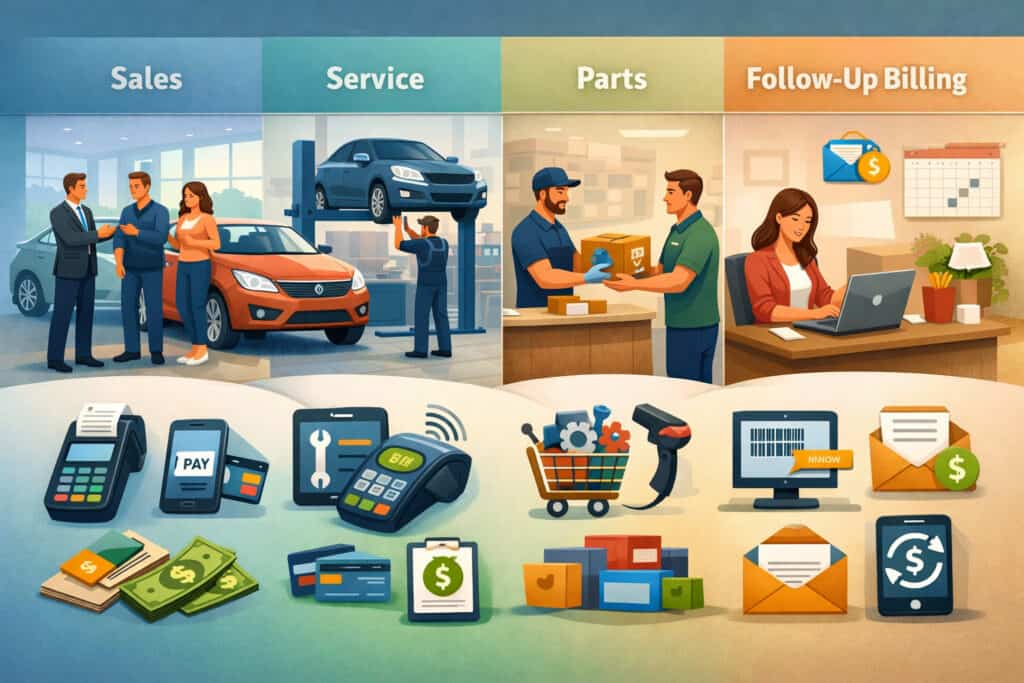
Dealership payment systems should reflect the fact that each department operates differently. Vehicle sales, service, parts, and scheduled billing are all forms of payment acceptance, but they do not follow the same rhythm. Ticket size, timing, refund patterns, and customer expectations vary more than many operators realize.
That is why many payment headaches come from forcing one workflow onto every department. A terminal setup that works at the service cashier may not fit the sales floor. A parts special-order deposit process may not make sense in the finance office. The better approach is to standardize core controls while tailoring the payment experience to each use case.
Vehicle sales transactions are often document-heavy and multi-step. Service transactions are faster, more frequent, and often dependent on estimated changes. Parts payments may require deposits on backordered inventory.
Recurring or scheduled payments need consent, reminders, and predictable recordkeeping. Each workflow needs the right tools and the right handoff points between staff members.
Vehicle sales payment workflows require precision and coordination
In vehicle sales, the payment itself is only one part of a larger closing process. Sales staff, F&I, accounting, and sometimes lender partners all influence the final amount due. That means the dealership finance and payment workflow has to be accurate, visible, and well-coordinated.
Common vehicle sales payment events include:
- Reservation or hold deposits
- Down payments at signing
- Additional funds due after lender stipulations
- Full payment for cash deals
- Accessory or protection product charges
- Refunds if a deal unwinds or terms change
Every one of those events should connect back to the customer file and the deal structure. If the down payment amount changes after trade evaluation or lender approval, the dealership must avoid duplicate charges, overcollection, or vague receipts that do not match the contract. That is especially important when multiple tenders are used, such as part card and part ACH.
Another challenge is timing. A customer may arrive ready to take delivery before every payment issue is fully settled. The dealership should have rules for when payment is considered complete enough to release the vehicle and what types of funds require additional confirmation. Clear internal rules reduce pressure on frontline staff to make inconsistent exceptions.
Service and parts payments need speed, flexibility, and strong records
Service and parts departments process different types of payments than vehicle sales. Tickets are usually lower, transaction volume is higher, and customers often want quick, flexible options.
At the same time, these departments see a lot of payment variation: deposits for special-order parts, approvals for added repairs, deductible collections, after-hours pickup, and commercial account billing.
This is where modern car dealership payment solutions can make a meaningful difference. Service advisors benefit from mobile acceptance, text-to-pay, stored payment credentials handled securely, and digital invoices that let customers approve work without coming back to the counter. Parts teams need ways to take deposits cleanly and match them to inventory or orders.
The risk in service and parts is not always the ticket amount. It is the temptation to use manual workarounds. Writing card numbers on paper, texting partial account details, or taking vague verbal authorizations over the phone creates unnecessary exposure. A secure remote payment tool is far better than an improvised process, even for smaller amounts.
If your store is reviewing front-counter tools, this overview of point-of-sale systems for automotive businesses is useful for thinking through what payment-enabled systems should support operationally.
Secure dealership payment processing for large payments and remote acceptance
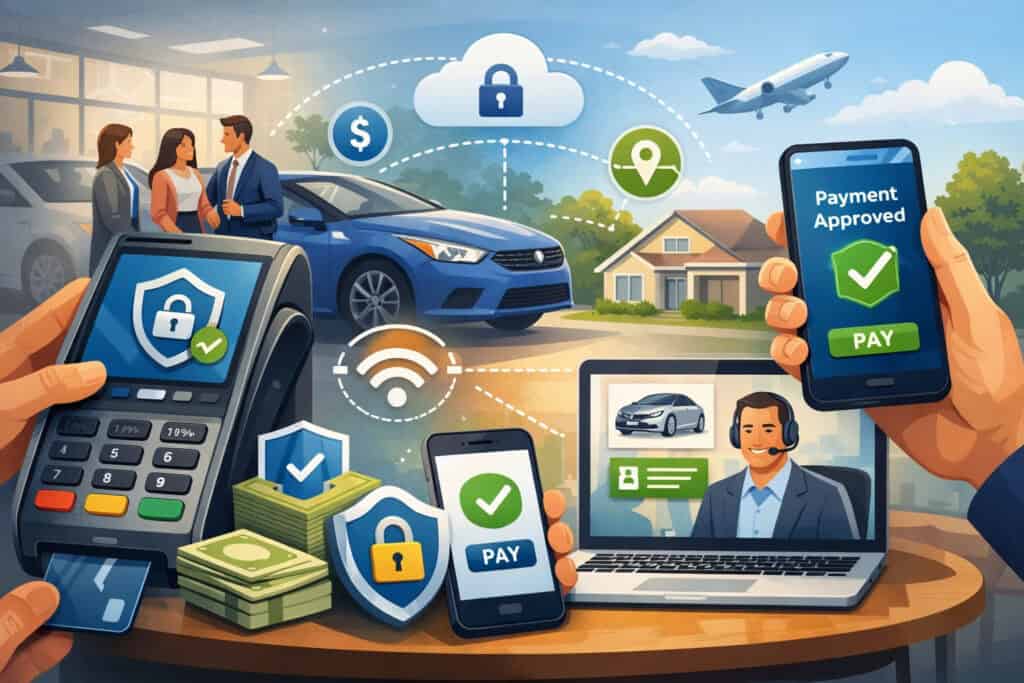
Secure dealership payment processing matters in every department, but risk rises quickly when amounts get larger or the customer is not physically present. Vehicle down payments, remote deposits, fleet invoices, and phone-based transactions all create opportunities for fraud, disputes, or simple human error if controls are weak.
A dealership does not need to make payment acceptance difficult to make it safer. In most cases, better security comes from clear rules, secure tools, and strong documentation rather than extra friction for every customer. The goal is to create layers of protection that fit the transaction type.
High-risk payment situations at dealerships often include:
- Card-not-present deposits taken by phone
- Large down payments on cards
- Out-of-area vehicle purchases
- ACH payments without proper authorization records
- Texted or emailed payment information handled manually
- Refund requests to a different card or account than the original payment source
- “Rush” requests where staff feel pressured to skip verification
The stronger the amount or the urgency, the more important it is to slow the process down just enough to verify details. Fast payment acceptance is useful. Unverified payment acceptance is expensive.
Payment limits, account verification, and chargeback controls
One of the most important decisions a dealership can make is where to set payment limits by method. That does not mean every location needs the same thresholds, but every location does need policies that reflect its average ticket, fraud history, and margin structure.
For example, a dealership may accept cards freely for service and parts, cap card usage for vehicle down payments, and require ACH or wire for larger balances.
Another store may allow larger card payments only when the cardholder is present with matching identification and signed paperwork. The right answer depends on the business model, but no answer is a problem.
Verification controls for larger payments may include:
- Matching the payer name to deal documents where appropriate
- Reviewing identification for in-person larger transactions
- Verifying bank account ownership or authorization for ACH
- Confirming wire receipt with the bank before release
- Using secure invoice links instead of manually keyed transactions when possible
- Keeping signed agreements, estimates, and receipts connected to the payment record
Chargeback prevention deserves special attention with dealership payments because disputes can become costly quickly. When a customer disputes a deposit, a repair charge, or an add-on product, the dealership needs documents that clearly show what was authorized and delivered. General receipts are not enough on their own.
This is where policies around estimates, signatures, disclosures, and payment descriptions matter. Dealerships that want to reduce dispute exposure should also review practical guidance on chargeback prevention in auto sales and services.
Secure remote payments require better tools, not more improvisation
Remote payment volume has increased across many dealership operations. Customers expect to reserve a vehicle online, pay a service invoice from their phone, approve a repair while at work, or handle a deposit without driving back to the store. That convenience is valuable, but only if the dealership uses tools designed for remote acceptance.
Good remote workflows often include emailed invoices, secure payment links, text-to-pay, and online portals. These methods are much safer than asking customers to read card details over the phone to an employee who writes them down or enters them later.
They also create cleaner records because the customer can see the amount due, the purpose of the payment, and the confirmation once paid.
Card-on-file workflows can also be helpful, especially in service, but they should rely on secure tokenization rather than staff storing actual card details. Customers should understand what is being stored, what it may be used for, and when authorization is required before charging it again.
Customer experience matters just as much as payment acceptance itself
A dealership can technically accept payments and still create a poor customer experience. Customers notice when payment options are limited, receipts are confusing, deposit rules are unclear, or staff give inconsistent explanations about what is due and when. Those moments can damage trust even when the rest of the buying or service experience goes well.
How car dealerships accept payments affects perception in several ways. First, it influences convenience. A buyer who is ready to leave a deposit expects a smooth process, not a debate about which tender types the store will allow.
Second, it affects confidence. Customers want to know where their money is going, especially when the amount is substantial. Third, it shapes post-sale satisfaction. If the receipt is incomplete or the customer is unsure whether a deposit was applied correctly, anxiety starts immediately.
The best dealership payment solutions support customer experience by making the payment feel clear, secure, and predictable. That means giving customers appropriate choices while setting policies upfront so there are fewer surprises in the business office or at the cashier desk.
Convenience, transparency, and confirmation reduce friction
Customers do not expect every payment method to be accepted for every transaction, but they do expect the dealership to explain the options clearly. A simple explanation at the right time prevents a lot of frustration later.
For vehicle sales, that may mean telling the customer early in the process which methods are accepted for deposits, down payments, and final balance.
For service, it may mean offering an approval and payment option by text or email if the customer will not be present at pickup. For parts, it may mean clarifying whether special-order items require prepayment and how refunds work if the part is returned or no longer needed.
Transparency should cover:
- Which payment methods are accepted
- Any payment limits by method
- Whether a deposit is refundable
- When the payment will be applied to the final balance
- When funds must be verified before release
- How the customer will receive confirmation and receipts
Customers also value speed after payment. A good confirmation experience includes an immediate receipt, a visible record of what the payment covered, and a clear next step. If the customer paid a deposit, the receipt should say that. If the payment closes the balance on a repair order, the receipt should make that obvious.
Financing coordination can make or break the payment experience
The finance office sits at the intersection of payment acceptance and deal structure. This is where customer expectations can either be confirmed or disrupted.
If the down payment amount changes unexpectedly, if prior deposits are not reflected correctly, or if the customer is unclear about what is being financed versus paid separately, tension rises fast.
That is why dealership finance and payment workflows should not be treated as separate conversations. The payment process needs to align with what the customer signed and what the finance manager explained.
If the customer is paying for taxes, accessories, protection products, or a warranty outside the financed amount, those charges should be itemized clearly. Ambiguity invites disputes later.
Customers also appreciate flexibility when it is supported safely. A buyer may want to split a down payment across two methods or make part of it remotely before delivery.
If the dealership can accommodate that through documented, secure workflows, the experience usually improves. If staff have to patch together a manual solution, the dealership may create more risk than value.
Operational needs behind effective dealership payment systems
Customer-facing convenience matters, but dealership payment systems also have to work behind the scenes. If transactions are easy for customers but hard to reconcile, the dealership has simply moved the problem from the front end to the back office.
Strong payment processing for car dealers must support accounting accuracy, department visibility, and day-to-day staff workflows.
Operations teams usually care about questions such as:
- Can each payment be tied to the correct deal, repair order, or parts invoice?
- Are deposits easy to locate and apply later?
- Can refunds be issued correctly and documented?
- Do managers have reporting by department, tender type, and user?
- Does the system support both in-store and remote payment acceptance?
- Are payment records flowing cleanly into accounting and other internal systems?
These questions matter because dealerships handle volume, handoffs, and exceptions every day. Even a small mismatch between payment tools and workflow can create major administrative drag over time.
Integration, reconciliation, and reporting are not optional
The more departments a dealership has, the more valuable integration becomes. Payment information should ideally connect to core operational records rather than live in a disconnected side system that requires manual re-entry.
Whether a store uses a DMS, accounting platform, service management tool, or POS environment, the payment data needs to stay traceable.
Without good integration and reconciliation, common problems include:
- Deposits posted to the wrong customer or deal
- Duplicate entries when a payment is taken in one system and re-entered in another
- Delays in locating remote payments
- Time-consuming end-of-day balancing across departments
- Weak audit trails when a dispute or refund question appears later
Reporting also matters at the management level. Dealership operators should be able to see payment volume by department, payment mix by tender type, card-not-present exposure, refund patterns, and exception activity.
That visibility helps identify whether the store is relying too heavily on expensive or risky methods and whether certain workflows need tightening.
For teams comparing cost structures and risk-related fees, this resource on automotive merchant account fees can help clarify what operational patterns often affect payment costs.
Staff training is one of the most overlooked parts of secure payment processing
Even a strong payment platform can fail if employees do not understand how to use it consistently. Many dealership payment issues come from staff improvisation rather than technology failure.
Someone bypasses the secure payment link and keys a card manually. Someone else forgets to note that a deposit is refundable. Another employee accepts a check without following the store’s verification rule.
Training should cover more than button clicks. Employees need to understand:
- Which payment methods are allowed in each department
- When to use secure remote tools instead of manual entry
- How to explain payment policies clearly to customers
- What documentation is required for deposits and larger transactions
- When manager approval is needed
- What fraud warning signs should trigger caution
This training should be role-specific. Service advisors need different scenarios than finance managers. Parts staff need different guidance than showroom salespeople. But every employee who handles payments should know the store’s non-negotiables.
Common training scenarios might include a customer wanting to pay a deposit over the phone, a request to split a down payment across methods, a same-day refund demand, or an after-hours service pickup. When staff already know the policy, they are far less likely to create inconsistent exceptions under pressure.
How to choose the right car dealership payment solutions
Choosing car dealership payment solutions is not about chasing the longest feature list. It is about matching payment capabilities to the way the dealership actually operates.
A smaller independent store with limited remote volume may need something different than a larger rooftop with busy service lanes, online reservations, finance office complexity, and commercial parts accounts.
Start by looking at real payment behavior, not assumptions. What is the average ticket in each department? How often does the store take deposits remotely? What percentage of sales involve financing-related payment coordination? How many transactions happen after the customer has left the premises? How often do staff manually key payments because there is no better option?
These answers should shape the evaluation process. A dealership that mainly needs better service-lane flexibility may prioritize mobile acceptance and text-to-pay.
A store focused on vehicle sales may care more about high-ticket risk settings, deposit workflows, and finance-office documentation. A multi-department operation may need all of that plus better reconciliation.
Match solutions to store size, departments, risk level, and payment mix
A useful selection process usually starts with operational mapping. List every place the dealership accepts or should accept payments, then note the volume, average ticket, and risk profile of each one.
For example:
- Vehicle sales: deposits, down payments, full or partial purchases, remote buyer transactions
- Finance office: funded deal balancing, add-on products, split-tender down payments
- Service department: estimates, supplements, after-hours payments, card-on-file authorizations
- Parts department: special-order deposits, walk-in sales, commercial accounts
- Recurring or scheduled payments: maintenance plans, fleet accounts, internal billing arrangements where applicable
Once that map is clear, compare providers or systems based on practical needs:
- Support for both card-present and remote payments
- Secure invoice links and text-to-pay capability
- ACH or bank transfer options for higher-value transactions
- Strong reporting and user-level visibility
- Integration support for dealership operations
- Role-based permissions and audit trails
- Fraud controls appropriate for larger tickets
The point is not to find a perfect tool. It is to find one that reduces workarounds and supports the store’s most important payment scenarios reliably.
Use real dealership scenarios to pressure-test your options
A good way to evaluate dealership payment systems is to test them against actual situations that happen every week. If the system struggles in those scenarios, it will struggle in live use.
Consider these examples:
- Vehicle deposit: A customer wants to place a deposit from another city after a video walkaround. Can the dealership send a secure link quickly, document the deposit purpose clearly, and apply it to the final deal later without confusion?
- Down payment at delivery: A buyer wants to split the down payment between debit card and ACH after financing terms change. Can the staff process both smoothly and generate clean records for accounting?
- Service repair: A customer approves extra work by phone and wants to pay before pickup. Can the advisor send a secure payment request without writing down card details?
- Parts special order: A customer prepays for a hard-to-source item. Can the parts department show whether the deposit is refundable and tie it directly to the order?
- Fleet account: A commercial client wants digital invoices and bank-based payments with strong remittance records. Does the system support that cleanly?
- After-hours pickup: A service customer needs to settle the invoice after the cashier leaves. Is there a secure self-service or remote option that still creates immediate confirmation?
Common mistakes dealerships make with payment acceptance
Many dealerships do not have a payment problem because customers refuse to pay. They have a payment problem because the process is too narrow, too manual, too inconsistent, or too poorly documented. These issues are fixable, but only if management recognizes them as workflow problems rather than isolated employee mistakes.
One common mistake is offering too few payment options. When customers cannot pay in a way that fits the situation, staff often create one-off exceptions. Another is relying on unsecured manual workflows, especially for remote payments. A third is failing to explain policies around deposits, payment limits, or refunds until the last minute.
Dealerships also get into trouble when they underestimate how quickly dispute risk grows around large or unclear transactions. A missing signature, vague receipt, or misapplied deposit may seem minor on the day of sale, but it becomes serious when the customer questions the charge later.
Manual workarounds, unclear policies, and weak fraud controls create preventable problems
Manual workarounds usually start with good intentions. Someone wants to help the customer quickly, so they take a card number over the phone without using the secure link. Or they accept a large payment without following the verification process because the customer is in a hurry. Or they promise that a deposit is refundable without checking the store’s actual policy.
Those shortcuts create risks such as:
- Missing payment records
- Higher chargeback exposure
- Confusion over deposit application
- Duplicate charges or duplicate data entry
- Inconsistent treatment from one department to another
- Poor visibility for accounting and managers
Weak fraud controls can be especially costly when stores start expanding remote payment options. Text-to-pay, emailed invoices, and card-on-file workflows are valuable, but they must be governed properly.
If identity checks, authorization records, or refund controls are loose, the dealership can end up paying for convenience through losses and disputes.
Failing to communicate payment rules early leads to unnecessary friction
Customers usually handle payment limits and verification requirements well when they hear them early and clearly. They react much worse when the information appears late in the process.
A buyer who thought they could put the full down payment on a rewards card may be upset if the dealership announces a lower card limit only after the paperwork is ready. A service customer may be frustrated if they expected after-hours pickup but discover there is no remote payment option.
This is why payment policies should be part of the customer conversation, not buried in the back-office process. That includes:
- Deposit terms
- Accepted payment methods
- Large-ticket method restrictions
- Remote payment procedures
- Refund timing and process
- When funds must clear before release
Clarity protects both the customer experience and the dealership. It also reduces the chance that employees will feel pressured to bend rules because expectations were not set correctly.
A practical checklist to improve your dealership payment acceptance strategy
If you want to accept payments at a car dealership more efficiently, the best place to start is with a structured review. Many stores do not need a complete overhaul. They need a sharper understanding of where friction, risk, and manual work are showing up today.
Use the checklist below to review your current setup.
Dealership payment review checklist
Customer-facing experience
- Do customers have clear payment options for sales, service, and parts?
- Are deposit terms explained before money is collected?
- Can customers pay both in person and remotely when appropriate?
- Are receipts immediate, detailed, and easy to understand?
- Can customers confirm what a payment was for without calling back?
Operational workflow
- Are payments tied clearly to deals, repair orders, or parts invoices?
- Can staff locate and apply deposits without manual searching?
- Is end-of-day reconciliation manageable across departments?
- Are remote payments tracked as clearly as in-store payments?
- Do managers have reporting by department, method, and user?
Security and risk control
- Are there payment limits by transaction type or department?
- Are larger card, ACH, and wire payments verified consistently?
- Are staff using secure remote tools instead of manual workarounds?
- Is card-on-file handled through tokenized workflows rather than stored card details?
- Are refund controls strong enough to prevent errors or misuse?
Staff readiness
- Do employees know which payment methods are allowed where?
- Can they explain deposit, refund, and verification policies clearly?
- Do they know when approval is needed for exceptions?
- Have they been trained on fraud warning signs and documentation standards?
- Are policies applied consistently between sales, finance, service, and parts?
Technology fit
- Does the current setup support the dealership’s real payment mix?
- Can it handle deposits, split tenders, remote payments, and larger transactions?
- Does it reduce manual entry instead of creating more of it?
- Does it support future needs like more online reservations or higher service-lane mobility?
A checklist like this helps management move from general dissatisfaction to specific action items. Instead of saying “our payment process feels clunky,” the dealership can identify whether the real issue is remote service payments, deposit tracking, finance-office coordination, or inconsistent staff execution.
Frequently Asked Questions
What is the best payment method for a vehicle down payment?
The best payment method depends on the amount, the dealership’s policy, and how quickly confirmed funds are needed. Credit and debit cards can work well for deposits and smaller down payments because they are fast and familiar. For larger amounts, ACH transfers, wire transfers, or verified checks are often more practical because they may reduce processing costs and lower certain dispute risks.
Can a dealership accept full vehicle payments by credit card?
Some dealerships do accept full vehicle payments by credit card, but many set limits on how much can be charged. Processing costs, chargeback exposure, and high-ticket transaction risk often lead dealerships to allow cards for deposits or partial down payments while requiring ACH, wire transfer, or verified funds for the remaining balance.
How should dealerships handle refundable and nonrefundable deposits?
Dealerships should clearly document deposit terms before accepting payment. The receipt and payment record should show the amount, what the deposit is for, and whether it is refundable, transferable, or applied to the final purchase. Clear written terms help reduce misunderstandings and lower the risk of customer disputes later.
Are remote payments safe for dealerships?
Remote payments can be safe when dealerships use secure tools and clear verification procedures. Secure payment links, online invoices, text-to-pay, and tokenized card-on-file workflows are much safer than writing down card details or handling payment information manually. For larger transactions, identity verification and confirmation of available funds are especially important.
What payment options should service departments offer?
Most service departments should offer in-person card acceptance, secure remote payment links, digital invoices, and text-to-pay options for customers who approve repairs from a distance or need after-hours pickup. Depending on the business, ACH may also be helpful for larger repair invoices or fleet accounts.
Why do dealerships need different payment workflows for sales and service?
Sales and service transactions have different payment patterns. Vehicle sales often involve larger amounts, deposits, financing coordination, and fund verification. Service transactions are usually faster, more frequent, and more likely to involve estimate changes, remote approvals, and same-day payment requests. Separate workflows help each department operate more efficiently and accurately.
What are the biggest risks in car dealership payment processing?
Common risks include chargebacks, fraud in remote transactions, counterfeit checks, ACH returns, misapplied deposits, and poor documentation. Even smaller service and parts payments can create problems when manual processes are used. Strong policies, secure tools, and staff training help reduce these risks significantly.
How can a dealership know whether its current payment system is good enough?
A dealership’s payment system is likely working well if staff can accept payments securely, apply deposits correctly, reconcile transactions without extra manual work, and provide customers with clear receipts and confirmation. If employees rely on workarounds, struggle with remote payments, or give inconsistent answers about accepted payment methods, the system may need improvement.
Conclusion
To accept payments at a car dealership successfully, you need more than a way to run transactions. You need a payment strategy that fits the real way dealerships operate: deposits before delivery, down payments tied to financing, service approvals from a distance, parts prepayments, larger-ticket verification, and constant handoffs between departments.
The most effective approach balances convenience, security, and operational control. That means offering the right mix of payment options for auto dealerships, using secure tools for in-store and remote acceptance, setting clear limits and verification rules for larger payments, and making sure every payment is documented well enough to support customer service, accounting, and dispute defense.
It also means recognizing that vehicle sales, service, parts, and finance workflows are not identical and should not be treated as if they are.
When dealership owners, managers, finance teams, and operators step back and evaluate the full payment journey, they usually find the same truth: better payment acceptance is not only about getting paid faster.
It is about reducing confusion, improving the customer experience, protecting the store from avoidable risk, and giving staff a process they can follow with confidence.
If your goal is to accept payments at a car dealership more efficiently, start with the basics that matter most: clear policies, secure dealership payment processing, flexible but well-managed payment methods, and workflows that actually match how your store sells, services, and supports customers every day.