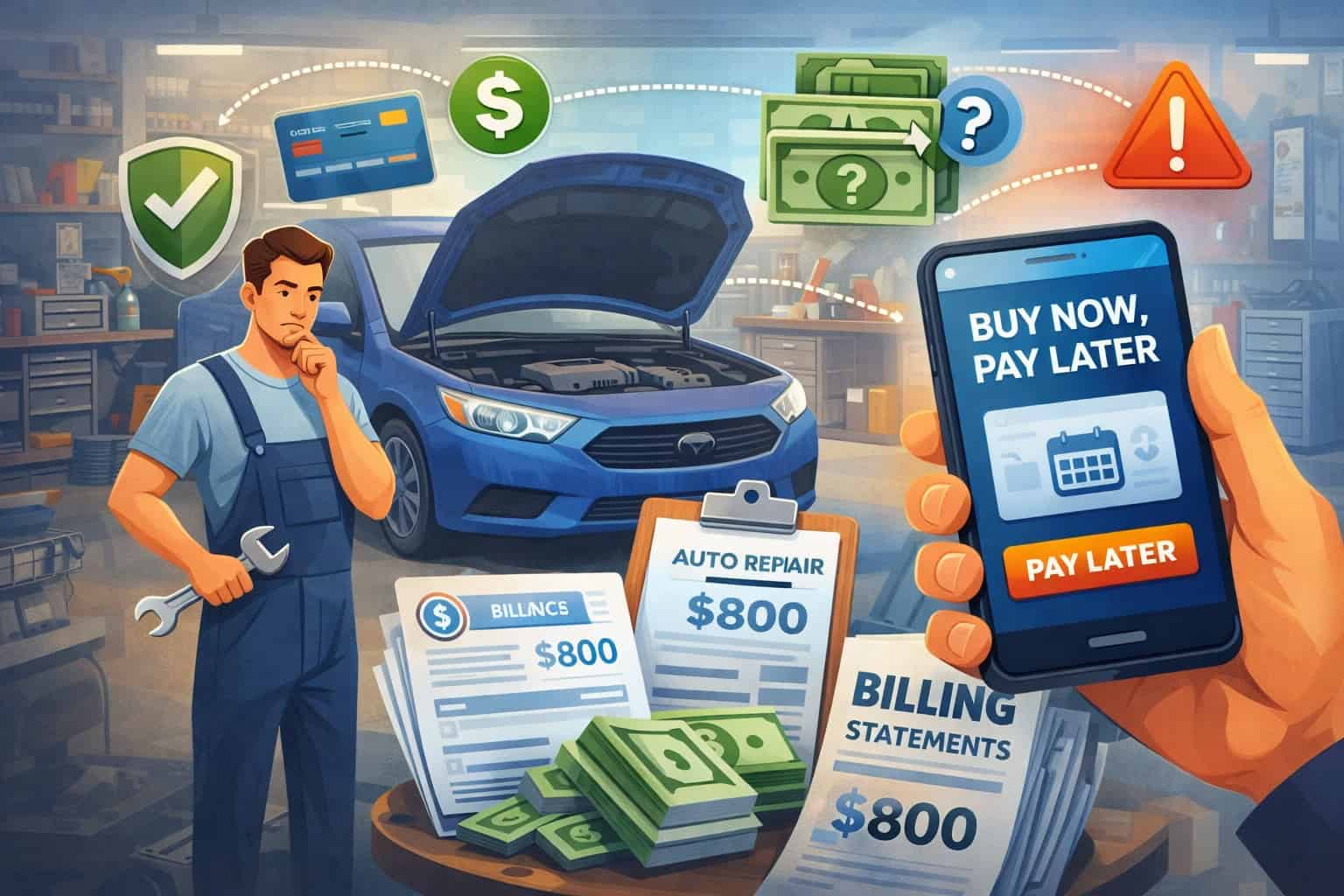
A sudden repair bill can derail a household budget fast. A failing transmission, brake job, suspension problem, or engine repair rarely shows up at a convenient time, and even routine maintenance can feel hard to manage when several expenses hit at once.
For repair shops, that creates a familiar problem at the counter: the car needs work now, but the customer is not ready to pay the full amount today.
That gap between approval and affordability is one reason BNPL for auto repairs is getting more attention. Buy now, pay later tools promise a simpler way to split repair costs into smaller payments, which may help customers move forward with urgent work instead of postponing it.
For shops, that can mean more approved estimates, fewer stalled jobs, and a better chance of getting paid without chasing balances.
But convenience does not eliminate risk. Buy now pay later for auto repair can help in the right situation, yet it can also create fee pressure, customer confusion, refund headaches, and operational issues if a shop adopts it without a plan.
What sounds easy at checkout can become messy later if staff are not trained, terms are not explained clearly, or the financing option does not fit the shop’s average ticket size and customer base.
This article takes a balanced look at how BNPL works in an automotive service setting, where it may deliver real value, and where it may create problems for shops and customers alike.
Whether you are comparing auto repair financing options for your business or trying to decide whether installment payments make sense for a repair bill, the goal is the same: understand the tradeoffs before you commit.
What BNPL for Auto Repairs Actually Means
BNPL for auto repairs refers to a payment option that lets a customer divide a repair or maintenance bill into smaller installments instead of paying the full total upfront.
In many cases, the customer applies during checkout, receives a quick approval or denial, and chooses a payment plan based on the provider’s terms. The shop is typically paid upfront by the financing platform, minus any merchant fee, while the customer repays the provider over time.
In an automotive setting, this is usually offered at the point of sale. A customer approves the repair estimate, the shop presents available payment choices, and BNPL becomes one of the ways to move forward.
Depending on the provider, the plan may involve a small number of equal payments, a longer repayment term, or a more traditional installment-style consumer loan wrapped into a faster checkout experience.
That sounds straightforward, but the details matter. Some BNPL programs are built for lower-ticket purchases and short repayment windows. Others are closer to point-of-sale financing for repairs, where larger jobs are financed through longer-term installment plans.
A brake repair for a few hundred dollars and an engine replacement costing several thousand dollars may both be presented as “pay over time,” but they may not be the same product behind the scenes.
This is why shops need to look past the marketing label. BNPL can include:
- Short-term installment plans with a fixed number of payments
- Longer repayment plans for larger automotive tickets
- Soft-credit-check or hard-credit-check approval models
- Interest-free promotions in some cases
- Interest-bearing loans in other cases
- Merchant-funded promotions where the shop pays more in fees for attractive customer terms
For customers, the main appeal is obvious: keep the vehicle on the road without draining cash all at once. For shops, the appeal is also clear: reduce the number of estimates that die because the customer cannot cover the total today.
But BNPL automotive services only work well when everyone understands what is being offered, how the provider gets paid, and what happens if the repair changes, the customer cancels, or a refund becomes necessary.
How BNPL Works at the Counter
In practice, the process usually starts after the repair estimate is presented. The service advisor explains the total, reviews the recommended work, and offers payment choices. If the customer cannot or does not want to pay the full amount immediately, BNPL may be presented as one of the available repair shop payment options.
The customer then applies through a tablet, text link, website, or integrated checkout system. Some approvals are almost instant. Others may require more identity verification or additional information.
If approved, the customer selects a payment plan and authorizes the transaction. The shop completes the job and receives payment from the provider based on the program structure.
From the customer’s perspective, this can feel faster and less intimidating than applying for a traditional loan. From the shop’s perspective, it can feel cleaner than managing a manual payment plan. But speed should not be confused with simplicity. Every shop that offers BNPL should understand the full payment flow:
- When funds are deposited
- What fees are deducted
- How canceled jobs are reversed
- Whether partial refunds are supported
- How disputes are handled
- Whether the payment provider or the shop communicates key repayment terms
A shop that skips these details may assume BNPL is just another card payment. It is not. It is closer to a financing workflow with customer-service and back-office implications attached.
BNPL vs. Traditional Financing for Repairs
Not every pay-over-time option should be treated as BNPL, even when the customer experiences it that way. Some products branded as BNPL are really simplified consumer loans. Others are closer to short-term deferred payments. That distinction matters because customer expectations often follow the label, not the legal structure.
Traditional repair financing often involves a more formal application, a broader credit review, a revolving credit line, or a medical-style financing model adapted to services.
These programs may be better suited to high-ticket jobs, but they can feel heavier and less convenient at the counter. BNPL, by contrast, is usually positioned as fast, modern, and easy to understand.
The advantage of BNPL is that it lowers friction. The risk is that lower friction can sometimes reduce understanding. A customer may focus on the payment amount and overlook the total obligation, late fee exposure, interest terms, or autopay requirements.
Shops should not assume that because a platform is easy to use, it is easy for customers to fully evaluate at the moment.
For that reason, many shops benefit from thinking in broader terms: not “Should we offer BNPL?” but “Which type of customer financing for auto repair shops best fits our customers, our average repair order, and our internal processes?” In some cases, BNPL is the right answer. In others, it should be one option among several, not the default solution.
Why BNPL for Auto Repairs Appeals to Customers and Shops

The strongest case for BNPL for auto repairs begins with urgency. Most vehicle repairs are not optional in the real-world sense. A household may be able to delay cosmetic work, but not failing brakes, a dead starter, unsafe tires, or a cooling system issue that risks bigger damage.
When transportation is tied to work, school, childcare, and daily responsibilities, delaying service can create costs far beyond the repair invoice itself.
That is why financing friction matters so much in automotive service. A customer may fully understand the need for the repair and still hesitate because paying the full amount at once is difficult.
BNPL can reduce that barrier by converting a painful lump-sum bill into more manageable installments. It does not make the repair cheaper, but it can make the timing more workable.
For repair shops, that timing shift can have a major impact. A service advisor who presents a well-documented estimate may still lose the job if the customer says, “I need to wait until payday.” In some cases, that means the work is postponed.
In others, it means the customer shops around, chooses only part of the recommended repair, or drives away in an unsafe vehicle. Offering installment payments for car repairs may increase the chance that needed work is approved while the vehicle is already in the bay.
This is especially relevant for shops that handle mid-ticket and high-ticket repairs. Tires, brakes, suspension, steering components, HVAC systems, electrical diagnostics, and transmission-related work often fall into a price range where the customer can afford the repair over time, but not all at once. That is the space where BNPL automotive services often gain traction.
At the same time, some shops like BNPL because it can improve the customer experience without forcing the business to become a lender. Instead of manually extending credit or holding vehicles while customers gather funds, the shop can present a structured third-party solution. That can create cleaner workflows than informal payment arrangements.
Why Customers Often Say Yes to Buy Now Pay Later for Auto Repair
The customer appeal is not hard to understand. Vehicle expenses tend to be unpredictable, emotionally stressful, and difficult to comparison-shop when the car is already disabled. A financing option that promises fast approval and fixed payments can feel like a practical lifeline, especially when the repair is tied to transportation, safety, or income.
Customers are often drawn to BNPL for reasons like these:
- The repair is urgent and cannot wait
- The total bill is larger than the cash available today
- They want to avoid putting the whole amount on a high-rate credit card
- They prefer predictable payments over a single large withdrawal
- They are already comfortable with installment-style checkout in other industries
- They may not qualify for more traditional financing or do not want a lengthy application
The emotional side matters too. Paying for a car repair rarely feels rewarding. Unlike a planned purchase, it usually follows a breakdown, warning light, strange noise, or failed inspection. That makes people more sensitive to pressure and more likely to focus on immediate affordability. A payment option that feels accessible and straightforward can reduce some of that stress.
Still, that convenience can become a problem if the customer is not given enough context. A person who hears “four easy payments” may not ask the right questions about autopay, missed-payment consequences, or how refunds work if the repair scope changes.
That is why shops should view customer acceptance as only part of the story. Approval is not the same as informed consent.
Why Shops See BNPL as a Sales and Operations Tool
For shops, BNPL is not only about customer convenience. It can also be a practical business tool that improves close rates, supports larger average repair orders, and reduces hesitation at checkout. When a customer can spread out the cost, they may be more likely to approve the full recommended repair instead of choosing the bare minimum.
That can affect several key performance areas:
- More approved estimates on needed repairs
- Fewer delayed jobs waiting on customer funds
- Higher average repair orders when full recommendations are accepted
- Less pressure to discount or “help out” with price cuts
- Fewer awkward conversations around partial payments or delayed pickup
- Better alignment with modern payment methods for auto repair and service shops
For shops already trying to improve collections and checkout efficiency, BNPL may also fit alongside broader payment modernization efforts, including digital invoices, text-to-pay, card-on-file practices, and integrated payment processing. It becomes part of a larger conversation about how customers want to pay, not just whether they can.
But there is a caution here. BNPL can boost approvals, yet it should not become a substitute for strong estimate presentation, pricing clarity, or customer trust. A weak inspection process, vague invoice, or confusing explanation will not be fixed by financing.
In fact, financing can make those weaknesses more dangerous, because disputes become more likely when customers feel rushed or misunderstood.
The Potential Benefits of BNPL for Auto Repair Shops
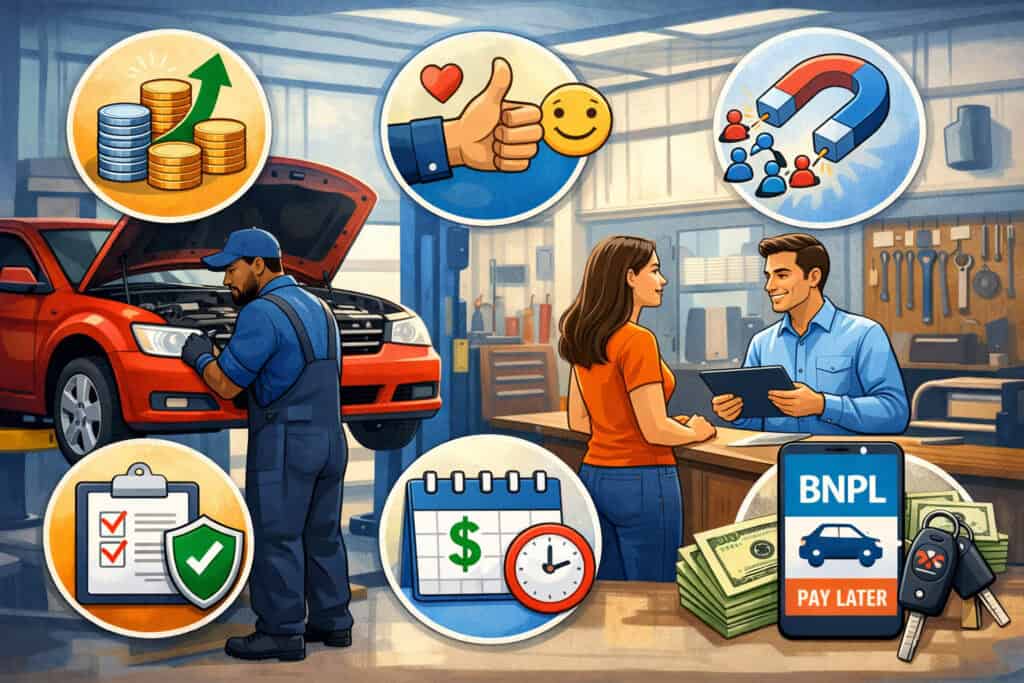
When used thoughtfully, BNPL for auto repairs can solve real business problems. The most obvious benefit is that it helps bridge the gap between a necessary repair and a customer’s immediate cash position. But from the shop’s point of view, the business advantages often go beyond simple affordability.
One of the biggest benefits is improved estimate conversion. A service advisor may do everything right during the inspection and presentation process, only to lose the sale because the customer cannot pay in full.
BNPL gives the shop another way to save that job without defaulting to a discount, reducing the scope of work, or trying to manage an informal payment promise.
Another potential upside is a larger average repair order. When customers are focused only on today’s out-of-pocket number, they may approve the minimum required fix instead of addressing related maintenance or recommended follow-up repairs.
Once the cost is broken into installments, the full repair plan may feel more achievable. For the customer, that can mean fewer repeat visits for the same unresolved issue. For the shop, it can mean stronger ticket value and more complete service outcomes.
BNPL can also reduce administrative strain in a specific way: the shop avoids becoming the lender. Many businesses want more flexible repair shop payment options, but they do not want to carry receivables, chase customers for balances, or deal with missed-payment collections. Third-party financing shifts much of that burden away from the shop.
There may also be a customer-service benefit. Shops that can present multiple payment paths often appear more accommodating and transparent. That does not mean every customer will use BNPL, but having it available can help people feel the shop understands real-world budget constraints. In a competitive market, flexibility can support trust when it is presented honestly.
Faster Approvals, Better Close Rates, and Fewer Delayed Jobs
The automotive service environment rewards speed. Once the estimate is approved, the job can move. Once approval stalls, the day becomes less predictable. Technicians wait, parts decisions get delayed, and the service desk may spend time following up on work that should already be in progress.
This is where BNPL can improve shop flow. Many providers are designed to deliver quick application decisions, which can help customers move from hesitation to approval while the need for the repair is still fresh.
That matters because delayed decisions often turn into lost jobs. A customer who leaves to “think about it” may never return, may delay the repair until the problem worsens, or may approve only part of the recommended work.
A smoother financing option may help with:
- Same-day approvals on urgent repairs
- Higher conversion on estimates that would otherwise stall
- Fewer vehicles left waiting on a payment decision
- Better utilization of labor and parts already scheduled
- Reduced pressure on advisors to negotiate price instead of value
This does not mean every financing-driven approval is a win. Shops still need to confirm that the payment product fits the repair size and that the customer understands the terms. But when the alternative is delaying needed work or watching the customer leave with an unsafe vehicle, the ability to offer a structured pay-over-time path can create real operational value.
Improved Customer Flexibility Without In-House Credit Risk
Many repair shop owners like the idea of helping customers pay over time, but they do not want to become a finance company. In-house payment plans may sound customer-friendly, yet they can create hard-to-manage risks.
Once the car leaves and the balance remains unpaid, the shop faces collection challenges, awkward follow-ups, and inconsistent enforcement. That is rarely a good use of staff time.
Third-party BNPL can offer a cleaner alternative. The provider handles customer repayment, while the shop typically receives funds according to the provider’s settlement terms. That structure may improve cash flow predictability compared with informal arrangements and reduces the chance of personal relationships driving poor credit decisions at the counter.
For many businesses, that makes BNPL a more scalable version of payment flexibility. It allows the shop to support customers without managing outstanding balances internally. It may also fit well alongside broader efforts to improve payment processing for automotive businesses and streamline checkout.
Still, the word “third-party” should not create false comfort. The shop may not carry the loan, but it still owns the customer relationship. If the customer feels confused, pressured, or misled, the reputational damage lands on the shop first.
That is why the best operators treat BNPL as a service tool that still requires active oversight, not a plug-and-play feature that can be ignored after setup.
The Potential Benefits of BNPL for Customers
The customer case for buy now pay later for auto repair is usually built around one word: access. When a repair bill arrives at the wrong time, financing may be the difference between fixing the vehicle and continuing to drive with a problem that gets worse.
In that sense, BNPL can support safety, mobility, and household stability in situations where delay carries real consequences.
For many customers, the biggest benefit is the ability to break a difficult expense into smaller, predictable payments. A single repair bill may feel impossible, while a series of scheduled payments may feel manageable.
That difference matters even for people with stable income. Timing can be the issue, not total affordability. Rent, utilities, childcare, insurance, and groceries may all be competing for cash at the moment the vehicle fails.
BNPL can also reduce immediate financial pressure. A customer who would otherwise empty an emergency fund, miss another bill, or skip the repair entirely may see installments as the most practical path forward.
In some cases, it may be preferable to using a general-purpose credit card, especially if the customer wants a fixed repayment schedule instead of a revolving balance that can linger for months.
There is also a psychological advantage to structure. A fixed installment plan can feel more disciplined and transparent than improvising with partial card payments, borrowed cash, and delayed obligations. That does not make BNPL risk-free, but it can give customers a clearer repayment path than many alternatives.
The key is that the financing should solve a timing problem, not create a deeper affordability problem. A repair that keeps the vehicle safe and operational may justify structured payments. A financing plan that strains future bills, hides costs, or encourages the customer to overextend is a different story.
Breaking Repair Bills Into Installments Can Prevent Costly Delays
One overlooked benefit of installment payments for car repairs is that they may help customers avoid the secondary costs of postponing service. Delaying a needed repair can lead to larger mechanical failures, towing bills, missed work, rideshare expenses, or safety risks that are far more expensive than the original invoice.
For example, a customer who delays brake service because the full cost feels out of reach may face rotor damage, reduced stopping performance, or a more expensive repair later.
A driver who ignores a cooling issue may end up with overheating damage that multiplies the total bill. In these situations, BNPL does not save money directly, but it may prevent delays from becoming even more expensive.
This is especially valuable when:
- The repair affects drivability or safety
- The vehicle is needed for daily commuting
- The customer relies on the car for income
- The job is too urgent to wait for the next paycheck
- The alternative is using unreliable transportation or missing obligations
That said, shops should avoid using urgency as a pressure tactic. The right approach is educational, not manipulative. Explain the repair, explain the consequences of delay, and then explain the available payment options. Customers should feel supported, not cornered into financing because they are stressed.
Predictability Can Be Better Than Full-Payment Shock
Not every customer who chooses BNPL is financially distressed. Some simply prefer predictability. Large unexpected bills create anxiety because they disrupt cash flow all at once. A fixed series of payments may fit more comfortably into the monthly budget, even if the customer technically could pay in full.
That predictability can be attractive to:
- Budget-conscious households that track monthly outflows carefully
- Younger customers more familiar with installment-based checkout
- Customers who want to preserve emergency savings for true emergencies
- Families juggling multiple vehicle and household expenses at the same time
- Customers comparing several auto repair financing options and looking for the least disruptive one
There is a meaningful difference between “I cannot pay this” and “I do not want this to hit my account all at once.” BNPL often appeals to both groups. The first sees it as a necessity. The second sees it as a cash-flow management tool.
Shops should recognize that difference because it shapes how financing is presented. A customer using BNPL for convenience may care more about payment timing and ease of use.
A customer using it out of financial strain may need more explanation and may be more vulnerable to confusion or future payment stress. Both deserve clear communication, not a one-size-fits-all script.
The Real Risks of BNPL for Auto Repairs
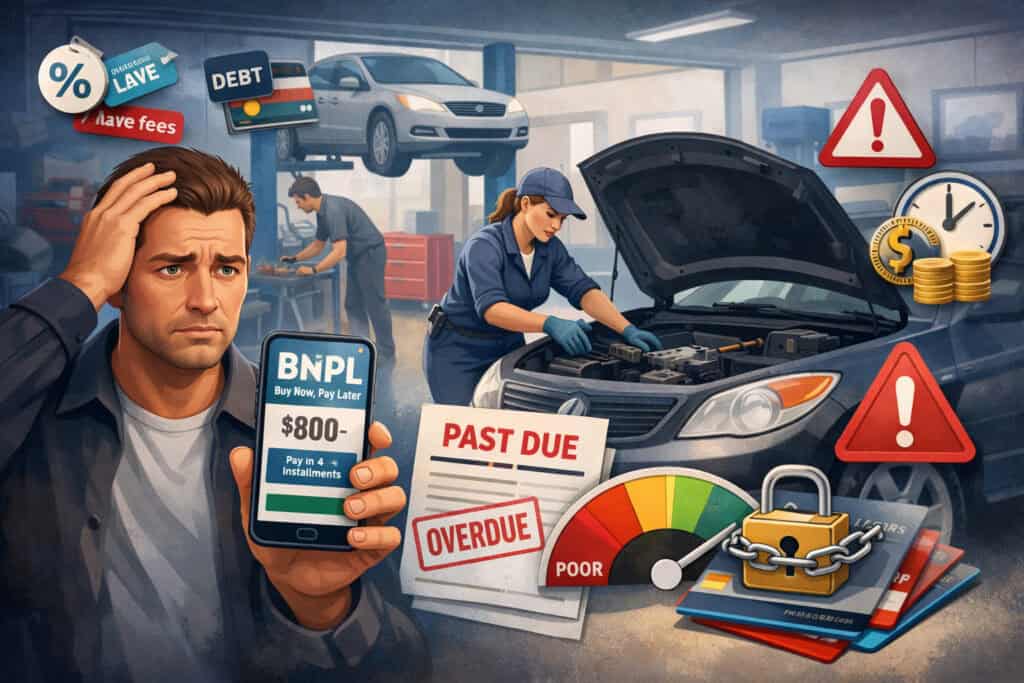
For all its convenience, BNPL for auto repairs is not automatically low risk. The most common mistake shops make is focusing only on the conversion upside while ignoring the operational and reputational tradeoffs.
A financing option can increase approvals and still damage margins, create confusion, or produce customer disputes if it is not managed carefully.
Merchant fees are one of the first risks shops notice. BNPL programs often cost more than standard card acceptance, especially when the provider is taking on installment repayment risk or offering attractive customer terms.
If the fee structure is not understood upfront, a shop may celebrate stronger close rates while giving away too much margin on already tight jobs.
Another risk is customer misunderstanding. Automotive service is already vulnerable to confusion because estimates can change, diagnostic work may uncover additional issues, and customers do not always distinguish between recommendations and requirements.
Add financing to that environment and the chances of miscommunication rise. A customer who says “I thought it was interest-free” or “I thought I could cancel easily” is not just a financing problem. It is a trust problem.
Shops also need to think about disputes and refund complexity. Unlike a simple over-the-counter purchase, auto repair often involves labor, installed parts, partial job completion, supplements, and changed repair scope.
If the transaction needs to be adjusted after BNPL approval, the workflow may be more complicated than a standard card refund. Some platforms handle partial reversals smoothly. Others may not fit well with real-world shop operations.
Approval limitations are another issue. Not every customer qualifies, and not every ticket fits the provider’s model. A shop that leans too heavily on BNPL may frustrate customers who are declined or approved for less than needed. That can create awkward counter conversations and false expectations if financing is presented too early or too confidently.
Merchant Fees, Margin Pressure, and the Cost of Convenience
The biggest business risk with BNPL is often economic. A program may increase approved work, but that does not automatically mean it improves profitability. Shops need to look closely at provider fees, settlement timing, promotional costs, and whether the financing option changes customer purchasing behavior enough to justify the added expense.
Questions worth asking include:
- What is the effective cost to the shop per financed transaction?
- Does the fee vary by plan length or promotion type?
- Are there additional platform, software, or integration charges?
- Is the fee sustainable across all repair categories?
- Does BNPL reduce discounting enough to offset the cost?
- Are refunds handled cleanly, or do fee losses remain?
For some shops, the economics work best on larger tickets where financing meaningfully increases approval rates. On lower-ticket maintenance work, the fee impact may be harder to justify. A shop that offers BNPL on every invoice without reviewing the margin effect may find that convenience is getting expensive.
This is why comparing financing costs with broader payment strategy matters. Educational resources on automotive merchant account fees and merchant account fees for auto repair shops can help operators think more clearly about how any payment method affects net revenue, not just gross sales.
Customer Confusion, Disputes, and Reputational Risk
The customer experience risk with BNPL is easy to underestimate. A shop may assume the financing provider is responsible for explaining terms, but customers usually associate the offer with the shop that presented it. If something goes wrong, the provider may be the lender, but the shop often becomes the first place the customer complains.
This risk grows when:
- The financing is introduced quickly at the end of a stressful conversation
- The customer focuses on payment size instead of full terms
- The estimate changes after approval
- The repair does not meet customer expectations
- Refunds or partial credits become necessary
- Staff use inconsistent language when describing financing
In automotive service, disputes are especially sensitive because customers are already making a trust-based decision on work they may not fully understand. If they later feel confused about financing terms, that confusion may blend with dissatisfaction about the repair itself.
The result can look a lot like chargeback behavior, even if the payment product is technically different from a card dispute.
That is why BNPL should be treated as part of the shop’s broader risk-control process, including documentation, estimate approval records, and chargeback prevention in the auto industry. The more clearly the repair, payment option, and authorization are documented, the lower the chance that financing confusion turns into a broader customer-service problem.
Operational Questions Shops Should Answer Before Offering BNPL
A shop should never launch BNPL simply because a provider’s sales pitch sounds easy. BNPL automotive services touch the service desk, the technician workflow, the invoice process, reconciliation, refunds, and customer communication. If those areas are not aligned, the financing option may create more friction than it removes.
The first operational question is simple: where in the customer journey will BNPL be introduced? If it only appears at the moment of checkout, staff may rush the explanation and customers may feel blindsided.
If it is presented too early, before the estimate is understood, it can distract from the actual repair decision. Many shops do best when financing is introduced after the work has been explained but before the customer feels forced into an all-or-nothing answer.
The next issue is staff training. Service advisors need to know enough about the product to present it accurately without overselling it. They should understand qualification basics, funding timing, plan differences, common customer questions, and what not to promise.
A sloppy explanation from a single advisor can create a bad review, a refund dispute, or a breakdown in trust that affects the whole team.
Shops also need a clear back-office process. How is the transaction recorded in the shop management system? How are provider deposits matched to repair orders? What happens if the repair total changes after approval? Can the system support partial refunds and supplements without manual confusion? These are not minor details. They determine whether BNPL is manageable at scale.
Communication should also be standardized. The same language should appear in estimates, invoice conversations, and any written financing disclosures the shop controls. Customers should not hear one explanation from the advisor and another from the final invoice clerk.
Staff Training, Estimate Presentation, and Checkout Workflow
The success of BNPL often comes down to execution at the counter. A good provider cannot fix weak process design inside the shop. If advisors feel uncertain, they may avoid offering financing when it would help, or present it in a way that causes misunderstandings.
Training should cover more than how to click through the application. Advisors should be prepared to answer questions such as:
- Is this a loan or a short-term installment plan?
- Will this affect my credit?
- When is the first payment due?
- What happens if the repair total changes?
- Can I pay it off early?
- What happens if I need a refund?
Just as important, staff need to know what not to say. They should not guess about credit impact, guarantee approval, or casually describe a plan as “free” unless that is clearly accurate under the provider’s terms.
They should also avoid using financing to rush the estimated conversation. A customer should never feel that financing is being used to distract from price or reduce scrutiny of the recommended work.
The estimated presentation itself should stay disciplined. First explain the diagnosis, required work, optional work, and total cost. Then present payment choices, including full payment and financing where appropriate. That sequencing keeps the shop focused on service transparency rather than sales pressure.
Refunds, Reconciliation, Integrations, and Back-Office Reality
The back-office side of BNPL deserves just as much attention as the customer-facing side. Many shops underestimate how much confusion can arise when payment providers, POS systems, shop management platforms, and accounting processes do not line up cleanly.
For example, a shop might receive provider payouts in a format that is hard to reconcile against daily repair orders. Or a supplement added after approval may require a second transaction that staff are not trained to process.
Or a partial refund may not map cleanly into the original financed agreement. These issues do not always show up during onboarding, but they surface quickly once real jobs start moving through the system.
Before offering BNPL, shops should evaluate:
- Whether the provider integrates with current systems
- How settlements appear in reports and bank deposits
- How canceled jobs are reversed
- How partial refunds and price adjustments are handled
- Whether advisor notes and customer approvals are preserved
- Whether accounting staff can reconcile financed jobs without manual guesswork
A provider that looks strong from a sales perspective can still be a poor operational fit. If the workflow is clumsy, staff may bypass it, customers may get inconsistent explanations, and the admin burden may outweigh the benefits. This is especially true in busy shops where the front desk already handles high call volume, estimate approvals, parts issues, and status updates.
BNPL vs. Other Auto Repair Financing Options
BNPL is only one piece of the broader auto repair financing options landscape. Shops and customers often use the term loosely, but different payment tools solve different problems. The best choice depends on repair size, urgency, customer credit profile, and how much complexity the shop is willing to manage.
A standard credit card remains the most common fallback for many repair bills. It is familiar, widely accepted, and easy to process. The downside is that it may expose the customer to high ongoing interest if the balance is not paid quickly. It also lacks the psychological structure of fixed installment plans, which some customers prefer.
In-house payment plans offer flexibility but can be risky for shops. They may work in limited, relationship-based situations, yet they create collection exposure and inconsistent decision-making. Most shops are better off avoiding them unless they have a disciplined policy and strong balance-control procedures.
Third-party installment lending can be better suited for large repairs. It may support higher ticket sizes and longer terms than a typical BNPL model, but it can also involve a heavier application flow and a less seamless checkout experience.
Deferred-interest programs may look attractive to customers at first, yet they can create major dissatisfaction if the balance is not paid within the promotional window.
The key point is this: BNPL should not be compared only to “doing nothing.” It should be compared to the full menu of customer financing for auto repair shops, including cards, ACH, deposits, partial payments, and more structured third-party lending.
| Payment Option | Best Fit | Main Advantage | Main Risk |
| BNPL for auto repairs | Small to mid-size urgent repairs, budget-sensitive customers | Faster approval and predictable installments | Merchant fees, customer confusion, refund complexity |
| Credit card | Customers with available credit who want immediate simplicity | Familiar and universally accepted | High revolving interest if balance lingers |
| In-house payment plan | Limited relationship-based exceptions | Flexible and personalized | Collection risk, inconsistent enforcement |
| Third-party installment lending | Higher-ticket repairs | Longer terms and larger approvals | More application friction |
| Deferred-interest financing | Customers confident they can pay within promo period | Attractive short-term offer | Retroactive-style shock if not paid as expected |
| ACH or bank transfer | Planned payments, deposits, lower processing-cost needs | Potential cost savings and direct movement of funds | Less convenient for some customers, weaker emergency appeal |
When BNPL Makes More Sense Than a Credit Card or In-House Plan
BNPL often shines when the repair bill is meaningful but not extreme, and when the customer needs a quick, structured option without the burden of a long application. It may be a better fit than a credit card when the customer wants fixed repayment discipline, or when the available card limit is not enough to cover the job comfortably.
Compared with in-house plans, BNPL usually wins on scalability and risk control. The shop gets a cleaner process, and the customer gets a formal repayment schedule. That makes BNPL especially attractive for shops that want flexibility without carrying receivables.
BNPL may be the better choice when:
- The repair is urgent and must be approved quickly
- The ticket is too large for comfortable same-day payment
- The customer wants fixed installments rather than revolving debt
- The shop wants to avoid informal collection exposure
- The average repair order is large enough to justify financing fees
That does not mean BNPL is always the cheapest or most consumer-friendly option. Sometimes a customer with a low-rate credit card or access to savings may be better off paying another way. The best shops recognize this and present financing as an option, not as the automatic “smart” choice for everyone.
When Other Financing Options May Be Better
There are plenty of cases where BNPL is not the best answer. Large engine or transmission jobs may be better served by a longer-term installment lender with higher approval capacity. Very small maintenance tickets may not justify the merchant cost.
Customers who are already overextended may need a more careful financial decision than a fast-click financing tool encourages.
Other options may be better when:
- The job is too expensive for the BNPL provider’s approval range
- The fee structure hurts shop margin on low-dollar repairs
- The customer needs longer repayment than BNPL offers
- Refunds and job changes are likely and common
- The customer would be better served by a more traditional financing path
- The shop’s systems are not ready to reconcile financed transactions cleanly
A shop that offers multiple paths often serves customers best. That may include card acceptance, digital invoicing, ACH, and one or more financing tools. The goal is not to push people into BNPL. The goal is to reduce payment friction while preserving clarity and trust.
Real-World Scenarios: Where BNPL Helps and Where It Can Backfire
The strengths and weaknesses of BNPL for mechanics become much clearer in real-life scenarios. In theory, installment payments sound broadly useful. In practice, the value depends on the type of repair, the customer’s financial situation, and the shop’s process discipline.
Consider an emergency brake repair for a household that needs the vehicle for work. The customer understands the urgency, trusts the inspection, and simply cannot absorb the full invoice in one day.
Here, BNPL can be a practical bridge. The job gets approved, the vehicle is made safe, and the customer avoids a dangerous delay.
Now consider a different situation: a larger repair estimate with diagnostic uncertainty, possible supplements, and a customer who is frustrated, tired, and not fully following the explanation.
In that setting, BNPL may increase the chance of approval, but it may also increase the chance of later complaints if the final total changes or the customer realizes the financing terms were not what they assumed.
The difference between those outcomes is not the financing product alone. It is the context, the communication, and the operational fit. Shops that use BNPL successfully tend to know exactly where it works for them and where it does not.
Scenario Examples That Show the Tradeoffs
Emergency repair scenario: A customer’s alternator fails unexpectedly. The vehicle is essential for commuting and school pickup. The repair bill is large enough to strain the monthly budget but small enough to fit a short installment plan.
BNPL likely helps here because the issue is urgent, the repair scope is clear, and the customer values fast approval.
- High-ticket job scenario: A transmission-related repair pushes well beyond what a short-term BNPL plan can comfortably support. The customer is approved only for part of the amount. In this case, a longer-term financing option may be more appropriate. Treating BNPL as the answer may create frustration and leave the service advisor scrambling.
- Repeat maintenance customer scenario: A loyal customer wants tires, alignment, and deferred maintenance bundled into one larger service visit. BNPL may increase approval of the full package because the customer already trusts the shop and sees the value in completing the work together rather than spreading it across multiple visits.
- Budget-sensitive household scenario: A customer accepts financing for a repair but later struggles with the payments because the decision was made under stress. The repair may still have been necessary, but if the customer did not fully understand the repayment terms, the shop may face dissatisfaction even though the vehicle problem was resolved.
- Younger customer scenario: A digitally comfortable customer prefers structured installments and responds well to text-based application flow. BNPL may feel natural and improve the checkout experience compared with a more traditional credit application process.
These examples show why there is no universal answer. BNPL can support access and approval, but it should be matched to the situation, not offered blindly.
Common Mistakes Shops Make With BNPL Automotive Services
Shops rarely fail with BNPL because the idea itself is bad. They fail because the rollout is loose, the economics are not reviewed, or the financing gets presented in ways that confuse customers. The same flexibility that makes BNPL attractive can also make it easy to misuse.
One common mistake is treating financing as a substitute for clear estimate presentation. If the customer does not understand the repair, the labor, the parts, or the recommended vs. optional work, breaking the total into smaller payments will not solve the trust problem.
It may actually make it worse by creating the impression that the shop is trying to “sell the payment” instead of the repair.
Another mistake is assuming all approvals are equal. Some providers approve only certain customers, ticket sizes, or term structures. A shop that advertises BNPL too aggressively may frustrate customers who are declined or only partially approved. Financing should be presented as available where qualified, not guaranteed.
Fee blindness is another recurring problem. Shops sometimes add BNPL because it sounds modern and customer-friendly, then discover later that it is compressing margin on jobs where the economics never worked. If the business does not track financed tickets separately, that problem can stay hidden for months.
Finally, many shops underestimate post-sale complexity. Refunds, supplements, split authorizations, and customer questions do not disappear after the initial application. If there is no ownership for those issues, the front desk ends up improvising, and inconsistency creates risk.
Four Mistakes That Cause the Most Trouble
Mistake 1: Poor customer communication
If advisors describe financing casually or inconsistently, confusion is almost guaranteed. The fix is scripting, training, and making sure the customer understands both the repair and the payment option.
Mistake 2: Ignoring fee impact
Every financed repair should be evaluated for profitability, not just top-line revenue. The stronger the financing use, the more important margin tracking becomes.
Mistake 3: Assuming financing solves affordability and trust at the same time
It solves timing problems, not trust problems. Shops still need good inspections, good documentation, and good estimated conversations.
Mistake 4: Launching without operational testing
Refunds, canceled jobs, supplements, and reconciliation need to be mapped before launch, not after the first customer issue appears.
Is BNPL Worth the Risk for Auto Repair Shops?
The honest answer is that BNPL for auto repairs is worth the risk for some shops, some customers, and some repair categories, but not for everyone and not in every form. It is not automatically a smart move simply because customers like flexible payments. Nor is it automatically too risky just because financing can create disputes and added cost.
A shop is more likely to benefit from BNPL if it regularly handles mid-size repair tickets, serves customers who value payment flexibility, and has enough process discipline to explain terms clearly and manage exceptions well.
Shops with strong estimate presentation, documented approvals, modern checkout flow, and clean reconciliation are usually better positioned to make BNPL work.
On the other hand, BNPL may be a weaker fit for businesses with very low average tickets, thin margins, inconsistent service-desk communication, frequent invoice changes, or no appetite for added administrative complexity. In those environments, the costs and confusion may outweigh the conversion benefits.
The business model matters too. A general repair shop with a mix of unexpected repairs and maintenance opportunities may find BNPL useful across selected ticket ranges.
A specialty shop handling mostly large-dollar work may be better served by more traditional installment lending. A quick-service environment may find that cards, ACH, and other fast payment methods cover most needs without adding another financing layer.
Customer base matters just as much. If your shop serves many households that need transportation immediately and appreciate structured payment flexibility, BNPL may support both approval rates and customer retention.
If your customers are mostly commercial fleets, warranty-driven jobs, or highly price-insensitive segments, the value may be limited.
A Practical Checklist for Deciding Whether BNPL Is a Smart Fit
Use this checklist before adopting BNPL automotive services:
- Is your average repair order high enough that financing meaningfully changes approval behavior?
- Do customers regularly delay or decline needed repairs because of upfront payment pressure?
- Can your advisors explain the financing clearly and consistently?
- Do you understand the provider’s merchant fees, funding process, and refund rules?
- Can your current systems reconcile financed transactions cleanly?
- Do you have a process for supplements, cancellations, and partial refunds?
- Does your shop already present estimates in a transparent, trust-building way?
- Are you prepared to track financed-ticket margin separately?
- Do you want to offer BNPL as one option among several, rather than as the default answer?
- Have you tested the provider against real shop scenarios, not just a demo?
If the answer to most of these questions is yes, BNPL may be a strong addition to your payment toolkit. If several answers are no, the shop may need to improve process basics before adding financing.
FAQs
Is BNPL for auto repairs the same as a loan?
Not always. Some BNPL products work like short-term installment plans, while others are structured more like consumer loans delivered through a fast checkout process. The difference matters because repayment terms, approval methods, and customer obligations can vary. Repair shops should understand the financing structure before presenting it to customers.
Does buy now pay later for auto repair help customers avoid interest?
Sometimes, but not in every case. Some BNPL providers offer no-interest promotional terms, while others may charge interest, late fees, or other costs depending on the plan and repayment terms. Customers should review the full terms carefully instead of assuming every BNPL option is interest-free.
Is BNPL better than using a credit card for car repairs?
It depends on the customer’s financial situation and repayment plan. BNPL may be better for someone who wants fixed installment payments and a defined payoff schedule. A credit card may be more practical for a customer who can pay off the balance quickly or already has favorable card terms. The best option is the one that helps manage the repair cost without creating more financial strain later.
What are the biggest risks for auto repair shops offering BNPL?
The main risks usually include merchant fees, customer confusion, refund complications, approval limitations, and added operational complexity. Shops also face reputational risk if customers do not fully understand the financing terms or if the repair invoice changes after financing has already been approved.
Can BNPL increase average repair orders?
Yes, it can. When customers can spread out the cost of a repair, they may be more willing to approve the full recommended service instead of choosing only the minimum work needed. However, larger repair orders only create real value if the shop still protects its margins and communicates the financing terms clearly.
Should every auto repair shop offer BNPL?
No. Some shops are a strong fit, especially those handling frequent urgent repairs and mid-range ticket sizes. Others may be better served by different auto repair financing options or by improving their current payment processes first. BNPL works best when it matches the shop’s customer base, workflow, average ticket size, and fee tolerance.
How should service advisors present BNPL to customers?
Service advisors should explain the repair first, the total cost second, and the available payment options third. BNPL should be presented as one payment choice, not as a way to distract from the actual repair bill. Advisors should also avoid promising guaranteed approval or describing financing terms they do not fully understand.
What ticket sizes are usually the best fit for BNPL automotive services?
That depends on the provider and the shop’s economics, but BNPL often works best when the repair bill is large enough to create payment friction without being so large that a longer-term loan clearly makes more sense. Many repair shops find the strongest use case in unexpected mid-ticket repairs rather than the smallest maintenance jobs or the largest rebuilds.
Final Take
BNPL for auto repairs can absolutely create real value. It can help customers approve urgent work sooner, reduce the pain of large unexpected bills, and give shops a practical way to offer payment flexibility without carrying in-house credit risk.
In the right environment, it may improve close rates, support larger repair orders, and reduce the number of jobs lost to timing rather than trust.
But it is not a free win. Buy now pay later for auto repair brings costs, communication responsibilities, and process demands that shops need to take seriously. Merchant fees can erode margin.
Customer confusion can damage trust. Refunds and supplements can become more complicated than expected. And financing will never fix weak estimate presentation or poor operational discipline.
The smartest way to approach BNPL automotive services is not as a trend to copy, but as a payment tool to evaluate carefully. Look at your average ticket size, customer behavior, staff readiness, system integration, and fee impact.
Compare BNPL against other repair shop payment options and broader customer financing for auto repair shops. Test the edge cases before rollout. Measure profitability, not just financed volume.
For customers, BNPL may be worth the risk when it helps solve a timing problem without creating a longer-term burden. For shops, it may be worth the risk when it supports needed repairs, fits the business model, and is managed with clear communication from estimate to final invoice.
In other words, BNPL is not inherently good or bad for automotive service. It is useful when the repair is necessary, the terms are understood, and the shop has the discipline to offer it responsibly. That is where the real value lives.