
Accept recurring payments for car loans well, and collections become more predictable, staff spend less time chasing balances, and borrowers have a clearer path to staying current.
For dealerships, finance managers, lenders, and operators handling installment-based financing, recurring billing is not just a convenience feature. It is a practical collections tool that supports cash flow, reduces avoidable delinquencies, and creates more consistency across the life of a loan.
Car loans are different from many other recurring billing arrangements because the payment relationship lasts for months or years, payment amounts may change in certain situations, and missed payments can trigger serious operational follow-up.
That means auto loan payment processing needs more than a simple “set it and forget it” subscription model. It needs a system that can schedule payments correctly, store authorizations, track changes, handle exceptions, and give both the business and the borrower visibility into what is due and when.
When recurring payments are set up carefully, they can reduce missed due dates, lower manual workload, improve reporting, and make it easier to manage weekly, bi-weekly, semimonthly, or monthly payment plans.
They can also support better customer experience by giving borrowers flexible ways to pay without having to remember every due date on their own.
This guide explains how to accept recurring payments for car loans in a practical, operations-focused way. It covers how recurring payment systems work, the payment methods most commonly used, the pros and drawbacks of each option, key workflows, risk controls, borrower experience considerations, common mistakes, and a practical checklist for implementation.
What recurring payments for car loans are and how they work in real operations
Recurring payments for car loans are prearranged payments collected on a repeating schedule to cover installment amounts owed under an auto finance agreement. Instead of asking a borrower to make a manual payment every cycle, the dealership or lender sets a schedule that automatically initiates a debit from an approved payment method on agreed dates.
In most cases, that means the borrower authorizes bank account debits, card payments, or another recurring payment arrangement when the loan is originated or shortly afterward.
In a real dealership or lender workflow, the process usually starts when the borrower signs loan documents and chooses a payment cadence. Some borrowers prefer monthly payments that align with a paycheck or bill cycle.
Others may need weekly or bi-weekly installment payment systems for car loans because smaller, more frequent payments are easier to manage. Once that payment schedule is established, the business collects the borrower’s authorization, payment details, and contact information for reminders and updates.
The recurring billing system then stores that plan and triggers payments automatically based on the loan rules. If a payment succeeds, the system posts it, updates the balance, and records the transaction.
If a payment fails because of insufficient funds, an expired card, or a closed account, the system should flag the issue immediately and begin the next step in the collections workflow.
This is where car loan recurring billing differs from simpler subscription billing. A car loan payment may need to be split, rescheduled, retried, waived in part under a formal agreement, or stopped after an early payoff.
The payment platform and operational process have to support those exceptions without creating confusion or gaps in the borrower’s account history.
The basic recurring payment flow for auto loans
At a practical level, loan payment automation usually follows a predictable sequence. The customer signs a finance agreement, selects a payment method, provides authorization for recurring debits, and receives confirmation of the schedule. After that, the payment system initiates each payment according to the stored instructions.
A strong auto finance payment processing workflow typically includes:
- Payment schedule setup
- Customer authorization capture
- Secure storage or tokenization of payment credentials
- Reminder notifications before due dates
- Automatic payment initiation on the scheduled date
- Real-time or near-real-time status updates
- Retry handling for failed payments
- Reporting for staff review
- Account update tools for changed payment methods or payoff events
Each of those steps matters. If any piece is missing, the business can end up relying on manual intervention, spreadsheet tracking, or one-off staff follow-up. That increases error rates and often makes collections less consistent.
Why recurring collections matter more for installment financing
Installment lending creates long-term payment relationships, which means small process issues can compound over time. One missed authorization form, one unmonitored failed payment, or one outdated card on file can create repeated collection problems for months. Because of that, recurring billing for dealerships needs to be operationally disciplined from the start.
Recurring payment systems help reduce friction in several ways. They lower the number of borrowers who forget to pay manually. They create a consistent payment trail. They make it easier to identify which accounts need attention. They also help staff prioritize true exceptions instead of spending time on every account, whether it is current or not.
For dealerships and lenders managing a large number of active contracts, consistency matters almost as much as payment speed.
When every account follows a documented billing process, managers can monitor collection performance, delinquency trends, and payment method outcomes with much more confidence. That is harder to do when payments are coming in through disconnected channels or handled manually.
Borrowers also benefit from predictability. When they know exactly when payments will be debited and can see their schedule clearly, disputes tend to decrease. That does not eliminate payment issues, but it reduces avoidable confusion.
Why auto loan payment processing is different from one-time payment acceptance
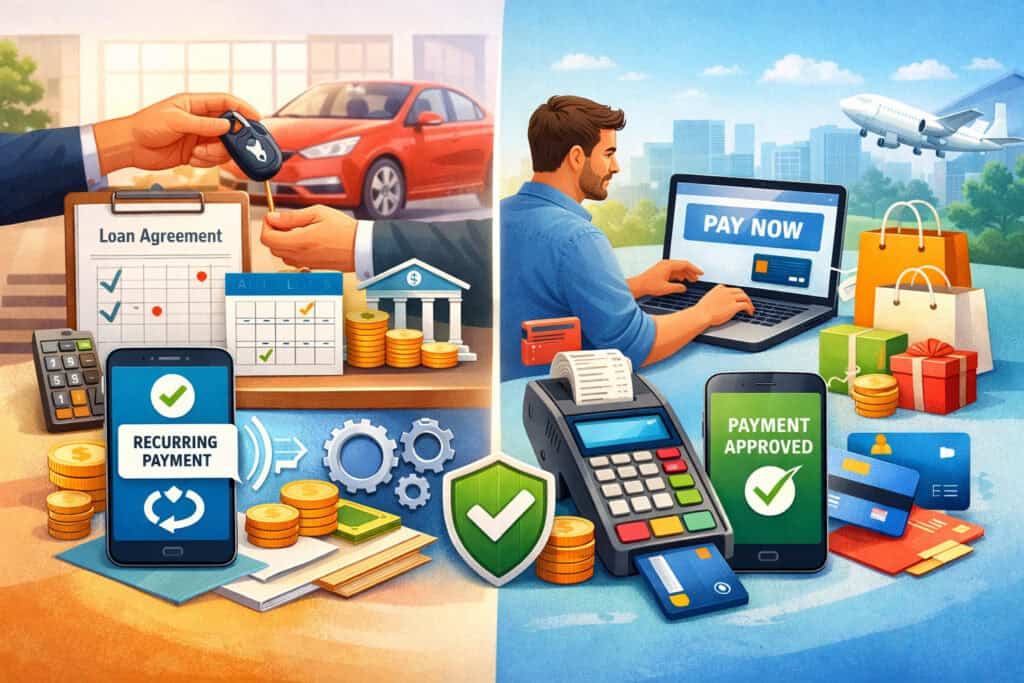
Auto loan payment processing is often misunderstood because it looks similar to ordinary payment acceptance on the surface. A customer pays, the business records the money, and the account is updated. But recurring transactions tied to a financed vehicle involve more moving parts than a one-time sale or service invoice.
A one-time transaction usually focuses on a single authorization and a single settlement event. A recurring car loan plan, by contrast, depends on scheduling rules, borrower consent, stored payment credentials, account-level tracking, and repeated execution over time. That means the business is not just processing payments. It is managing an ongoing payment relationship.
The biggest difference is that recurring auto finance payment processing needs to preserve the integrity of the payment plan across the full life of the contract.
The system has to know when the next payment is due, how much should be collected, what payment method should be charged, what happens if the payment fails, and how the account should be updated if the customer changes their bank account, card, or due date.
If the borrower makes an extra payment, partial payment, or payoff, the recurring plan may also need to be adjusted or stopped.
This is why businesses that accept recurring payments for car loans need more than a generic payment terminal or simple online checkout page. They need payment logic built around loan servicing realities, including exception handling and account history.
Scheduling, authorization, and account tracking create added complexity
Scheduling is one of the biggest operational differences between recurring and one-time transactions. The business must define the cadence correctly, especially if the borrower pays weekly, bi-weekly, or on a custom cycle. The timing of payments can affect collections consistency, customer satisfaction, and internal reporting.
Authorization is another major difference. One-time payments can rely on customer-present approval at the moment of the transaction. Recurring debits require prior consent that clearly explains what will be charged, when, and under what terms. The business should be able to show that authorization later if the borrower disputes the payment.
Tracking is equally important. A one-time payment can usually be confirmed with a receipt and a posted transaction. A recurring loan account needs a full timeline: when the recurring plan started, what method was approved, when each payment ran, why any payment failed, and what follow-up occurred. That record supports both customer service and risk management.
Without proper tracking, it becomes difficult to answer basic but important questions. Was the payment attempted on time? Was the amount correct? Did the borrower revoke authorization? Was the failure caused by insufficient funds, account closure, or expired credentials? Good systems answer those questions quickly.
Why manual collection processes break down over time
Some businesses begin with manual methods because they seem manageable at low volume. Staff call borrowers, send text reminders, take payments over the phone, and record everything in a spreadsheet or dealer management notes. That may work for a small portfolio in the short term, but it tends to become inconsistent as account counts grow.
Manual systems create several problems:
- Payment attempts may not happen on the same day each cycle
- Follow-up depends heavily on individual staff habits
- Account notes may be incomplete or hard to audit
- Missed or failed payments can go unnoticed
- Borrowers may get mixed messages from different team members
- Reporting becomes delayed or inaccurate
Over time, manual collection methods usually cost more in labor than people expect. They also introduce avoidable compliance and documentation risk, especially when staff are handling sensitive payment details directly.
Common payment methods used for recurring payments for car loans
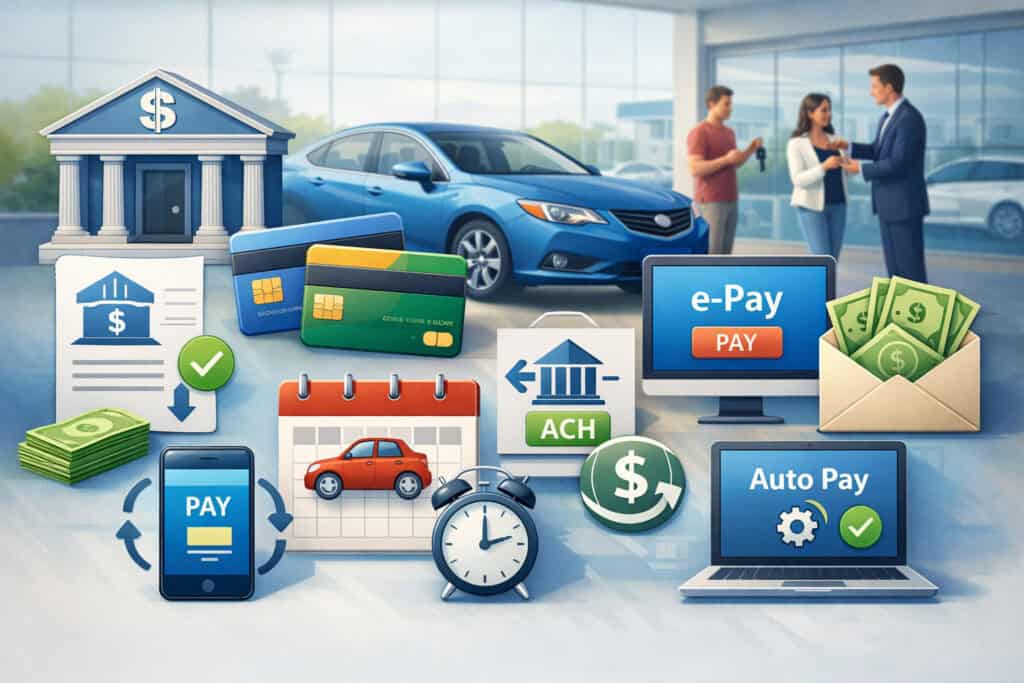
Businesses that accept recurring payments for car loans usually rely on a mix of bank-based and card-based payment methods. Each option has strengths, limitations, and practical use cases. The right mix depends on your customer base, average installment size, collection model, and tolerance for processing costs and operational risk.
The most common options include ACH recurring payments auto loans, debit card recurring billing, credit card recurring billing, online payment portals, and mobile-enabled payment experiences.
Some businesses also support manual backup channels such as same-day phone payments or text-to-pay links for borrowers who need to update a payment after a failure. Even when those tools are available, the main recurring plan should still be built around clear authorization and a structured schedule.
Many lenders and dealerships prefer to offer more than one recurring method because borrower situations vary. Some customers are comfortable authorizing direct debits from a checking account. Others prefer a debit card because it feels familiar and easier to update.
Credit cards may be offered in limited cases, though the cost profile and long-term suitability can be less attractive for installment collections.
The key is not just offering payment options. It is offering the right options in a way that supports repeatable collections, transparent account management, and clean reporting.
Payment method comparison for recurring car loan billing
| Payment Method | Best Use Case | Main Advantages | Main Limitations |
| ACH bank debit | Predictable installment collections | Lower processing cost, strong fit for scheduled payments, familiar for long-term billing | Returns for insufficient funds, account changes, setup requires accurate bank information |
| Debit card | Borrowers who prefer card-based payments | Familiar to customers, fast setup, easy online use | Cards expire, can be replaced frequently, fees may be higher than ACH |
| Credit card | Limited or backup recurring use | Customer convenience, broad familiarity | Higher cost, possible restrictions by lender policy, more dispute exposure |
| Online payment portal | Self-service management and payment visibility | Lets borrowers review balances, update methods, and confirm schedules | Needs secure design and clear account controls |
| Mobile payment interface | Reminder-driven self-service and updates | Easy borrower access, supports fast issue resolution | Often works best as a complement rather than the primary recurring rail |
This comparison highlights why ACH is often central to car loan recurring billing, while cards and portals play supporting roles. The goal is to make recurring collections reliable without boxing borrowers into one rigid method that may not fit their financial behavior.
ACH, debit cards, and credit cards each solve a different problem
ACH recurring payments auto loans are widely used because they fit installment lending well. Borrowers often receive income into a bank account, making scheduled debits a natural match for ongoing loan payments. ACH can also be cost-efficient for the business, especially over long repayment terms.
Debit cards are commonly used when borrowers prefer not to share bank account details or want an easy online or mobile enrollment experience.
They can work well, but they often require more maintenance because cards expire, get reissued, or change after fraud events. If the system does not prompt borrowers to update credentials quickly, recurring collections can start to fail.
Credit cards may be accepted in some programs, but they are often treated more cautiously. Processing costs can be higher, and card disputes can create avoidable friction in long-term installment collection. For some businesses, credit cards are allowed as a convenience option or for catch-up payments rather than as the default recurring method.
Online portals and mobile tools are not separate payment rails in the same way, but they are important because they shape how borrowers interact with the payment plan.
A borrower who can log in, see upcoming payments, confirm recent activity, and update a bank account or debit card is easier to keep current than one who has to call during business hours to make every change.
ACH recurring payments for auto loans and why they are so widely used
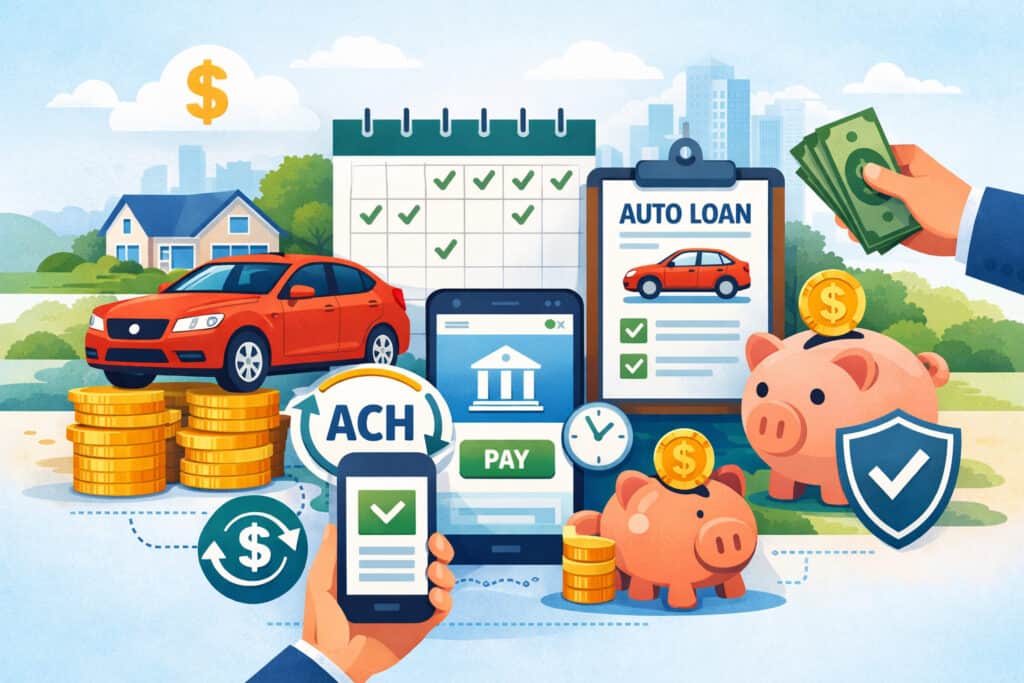
ACH recurring payments for auto loans are often the operational backbone of predictable collections. They allow a dealership or lender to debit a borrower’s bank account on a recurring schedule based on the authorization the borrower has already provided.
For installment financing, that is often a practical fit because the loan terms are known in advance and the payment pattern is usually stable.
The biggest reason ACH is so common in auto loan payment processing is that it aligns well with the structure of installment debt. Borrowers typically know the amount and due date ahead of time, which makes it easier to authorize scheduled debits.
For the business, ACH can support lower transaction costs compared with some card-based options, especially across a long repayment cycle with many individual payments.
ACH also helps reduce collection friction. A borrower who has already enrolled in recurring bank debits does not need to remember to log in and make each payment manually.
As long as funds are available and the account remains active, the system can process payments consistently. That does not eliminate returns or payment issues, but it does reduce one major cause of delinquency: forgetfulness.
Because of these advantages, many businesses use ACH as the preferred payment method while still keeping other options available for backups, updates, or special circumstances. If you want to understand the broader mechanics and considerations behind bank-based payments, resources on accepting ACH payments for automotive businesses can add useful context.
Why ACH works well for predictable installment collections
ACH is especially effective when payment schedules are fixed and the business wants repeatable collections at scale. A monthly auto loan installment, for example, is a good candidate for an ACH debit because the amount is known, the timing is predictable, and the borrower can align the debit date with payroll or other regular deposits.
For weekly or bi-weekly plans, ACH can also work well, though the business needs a system that can handle more frequent scheduling and follow-up. Smaller recurring debits may be easier for some borrowers to manage, but they also create more transaction events to track. That makes monitoring and exception handling even more important.
Another reason ACH is attractive is cost control. Over a long loan term, even modest differences in transaction cost can add up. Businesses that collect recurring installments from a large portfolio often find that ACH supports more sustainable economics than relying heavily on credit cards.
That said, ACH is not maintenance-free. Bank accounts can be closed. Customers can revoke authorization. Payments can be returned for insufficient funds. Because of that, ACH should be paired with a clear retry policy, customer notifications, and documented account notes.
Practical ACH considerations for dealerships and lenders
To use ACH well, the business needs more than a bank-routing form and a due date. It needs a repeatable process for enrollment, validation, notifications, and exception handling. That starts with collecting correct account information and a properly documented recurring payment authorization.
A strong ACH workflow usually includes:
- Clear borrower consent for recurring debits
- Exact debit schedule and amount disclosure
- Rules for what happens if the payment date falls on a weekend or holiday
- Notification procedures for plan changes
- Return code tracking and staff follow-up
- Easy ways for borrowers to update account details
- Account history that shows every debit attempt and result
If ACH is not monitored actively, it can create hidden delinquencies. For example, if the system retries a failed debit but staff do not know the first attempt failed, the borrower may continue to appear current until the issue becomes more serious. Good reporting closes that gap.
How to set up recurring payments for car loans step by step
To accept recurring payments for car loans successfully, businesses need a setup process that is easy for borrowers and dependable for staff. A poor setup creates collection issues later, even when the payment platform itself is capable. A good setup, by contrast, makes the rest of the loan term easier to manage.
The process should begin as early as possible in the borrower relationship, ideally at the time the loan or finance contract is finalized. That is when payment terms are fresh, the borrower is already reviewing documents, and staff can explain how the recurring payment plan will work.
Waiting until after the borrower leaves the dealership or closes the account often reduces enrollment rates and increases follow-up work.
At a minimum, the setup process should define the payment amount, payment frequency, first draft date, approved payment method, authorization language, communication preferences, and what happens if a payment fails. The borrower should leave the process knowing exactly how the plan works, how to see payment activity, and how to update details later.
A recurring plan that is set up correctly from day one is much less likely to produce confusion, disputes, or missed collections later.
Step 1: Define the payment schedule clearly
The first operational task is deciding how the recurring installment plan will work. For some loans, the payment schedule is simple and fixed. For others, especially buy-here-pay-here or flexible collections models, payment dates may be tailored to the borrower’s pay cycle.
Clarity matters more than complexity. The borrower should know:
- The amount of each recurring payment
- The due date or draft date
- The frequency of payment
- Whether the plan includes any fees
- What happens if a due date falls on a non-banking day
- Whether the amount may ever change under the agreement
If the business offers multiple schedules, staff should be trained to explain the tradeoffs. Weekly plans can lower the per-payment amount but create more transaction events. Monthly plans are familiar and easier for some borrowers, but the larger amount may be harder for certain households to manage in one debit.
Step 2: Collect and document authorization correctly
Authorization is one of the most important parts of recurring billing for dealerships. The business needs documented borrower approval for the recurring debit arrangement, not just a general payment acknowledgment. The authorization should match the payment method being used and clearly describe the recurring nature of the transaction.
At a practical level, that means the authorization should identify:
- The account or card to be charged
- The payment frequency
- The expected amount or method for calculating it
- The start date
- The borrower’s right to revoke or update payment details
- Contact information for questions or disputes
The exact format may vary depending on the payment rail and business process, but the principle is the same: the borrower must understand what they are authorizing, and the business should be able to retrieve that authorization later if needed.
If the borrower enrolls after origination through an online payment portal, the business should still ensure the authorization is captured and stored in a retrievable format.
Step 3: Store payment details securely and connect them to the loan account
Once the payment plan and authorization are in place, the business needs to store the payment credentials securely and link them to the correct account. Staff should not be keeping full payment details in local spreadsheets, shared inboxes, or handwritten notes. Secure storage and tokenization are important for both operational control and risk reduction.
The recurring billing system should tie the payment method to the borrower’s loan account so staff can see:
- The active payment method
- The next scheduled payment
- The recent payment history
- Any failed attempts or returned items
- Notes related to changes or revocations
This account-level visibility is critical. Without it, teams often end up searching through multiple systems to answer basic borrower questions or resolve exceptions.
If your broader payment stack also includes remote payments, account updates, and customer-facing billing tools, educational content on how payment processing works for auto dealers can help frame the larger operational picture.
Features dealership recurring payment solutions should include
Not every recurring billing tool is designed for the realities of auto finance payment processing. Some platforms are built mainly for subscription businesses with fixed monthly charges and low exception rates.
Car loan collections need more flexibility and stronger account management features because the payment relationship is longer, the stakes are higher, and missed payments require structured follow-up.
Dealership recurring payment solutions should support both the payment event and the servicing workflow around it. That includes automation, but it also includes visibility, reporting, customer communication, and exception handling.
A system that charges accounts automatically but gives no clear way to manage failed payments or changed borrower details is not enough.
The best setup for recurring billing for dealerships is one that helps the business answer practical questions quickly. What is due tomorrow? Which accounts failed today? Which borrowers revoked authorization? Which accounts changed cards this week? Which customers are on weekly plans versus monthly plans? Good tools make that information easy to find.
Features matter because recurring collections are not judged by whether payments run once. They are judged by how consistently the process works over the full life of the contract.
Core automation and borrower management features
At a minimum, recurring payment solutions for car loans should include:
- Flexible scheduling for weekly, bi-weekly, semimonthly, and monthly plans
- Recurring authorization capture and storage
- Secure payment credential storage or tokenization
- Automatic payment retries when appropriate
- Payment reminders by email or text
- Borrower self-service options for updating payment methods
- Account notes and transaction history
- Reporting for due, paid, failed, and delinquent accounts
- Controls for pausing, changing, or ending a recurring plan
These features reduce manual workload and support collections consistency. They also create a better borrower experience because customers can see what is happening and fix issues faster.
Payment reminders are especially useful. A recurring debit may reduce forgetfulness, but reminders still help customers prepare for the draft and prevent avoidable insufficient funds situations.
Borrowers are more likely to stay engaged when they receive timely, understandable communication before a payment problem becomes serious.
Reporting and exception handling are just as important as payment collection
One of the most overlooked parts of loan payment automation is reporting. Businesses often focus on how the payment gets initiated but not on how the team will monitor the results afterward. In practice, collections success depends heavily on how quickly staff can see exceptions and act on them.
Good reporting should allow managers and collectors to view:
- Payments scheduled for a selected date range
- Successful and failed transactions
- Return and decline reasons
- Accounts with repeated failures
- Borrowers with outdated payment credentials
- Payment method distribution across the portfolio
- Accounts that need manual intervention
Exception handling tools matter because no recurring billing setup eliminates all issues. Cards expire. Bank accounts change. Some borrowers need temporary rescheduling. Others make early payoff decisions or partial cure payments after a missed installment. The system should allow those changes without breaking the account history or creating duplicate billing plans.
Managing failed payments, payment updates, and real-world exceptions
No recurring billing program works perfectly every cycle. Even strong recurring payment systems will face declined cards, insufficient funds, account closures, authorization disputes, and borrowers who need to change the payment date. The goal is not to eliminate every failure. It is to build a workflow that catches issues quickly and resolves them consistently.
This is where operational discipline becomes visible. A business that accepts recurring payments for car loans needs defined procedures for failed payments, plan updates, account changes, and unusual loan events. Without those procedures, accounts can drift into delinquency simply because nobody knows what step to take next.
For example, a failed debit on a Tuesday should not sit unnoticed until the following week. The account should be flagged automatically, the reason code or decline status should be visible, the borrower should receive a prompt notice when appropriate, and staff should know whether the next step is a retry, a manual outreach, or a payment method update.
Recurring billing works best when failures are treated as expected exceptions with clear playbooks, not as surprises that require improvised responses every time.
How to handle failed recurring payments without creating confusion
A failed recurring payment should trigger a consistent sequence. First, confirm the reason for failure. Was it insufficient funds, expired credentials, account closure, or another issue? Then decide whether the account qualifies for an automated retry or requires human review first.
A strong failed-payment workflow often includes:
- Immediate failure flag on the borrower account
- Clear reason code or status message
- Customer notification with next steps
- Scheduled retry logic when appropriate
- Collector task assignment for unresolved issues
- Notes documenting borrower contact or payment changes
The borrower experience matters here. A vague message such as “your payment did not go through” is less helpful than a notice explaining that the payment could not be processed and directing the borrower to update the payment method or contact support. Clarity increases the odds of fast resolution.
At the same time, the business should avoid creating duplicate confusion by retrying too aggressively without notice. If multiple attempts occur without clear communication, borrowers may become frustrated, especially if their balance is tight.
Updating payment methods, dates, and account terms
Borrowers often need to update payment details during the life of a loan. They may switch banks, replace a debit card, close an account after a fraud event, or ask to move a draft date to better match their income cycle. If the update process is difficult, borrowers are more likely to miss payments during the transition.
Recurring billing for dealerships should make updates easy but controlled. That means the borrower can submit changes through a secure portal or with trained staff assistance, while the business keeps a clear record of when the change was made and by whom.
Common updates include:
- Replacing an expired debit card
- Changing a checking account
- Adjusting the draft date
- Moving from monthly to bi-weekly billing
- Pausing the recurring plan pending review
- Stopping recurring payments after early payoff
Early payoff is an especially important exception. When a borrower pays off the loan ahead of schedule, the recurring billing plan should be ended promptly so no further debits are attempted. The account history should still preserve the original schedule and all prior payments, but the active recurring instruction must be closed cleanly.
Risk management for recurring billing and auto finance collections
Risk management is a central part of auto loan payment processing. Recurring transactions can improve consistency, but they also create specific exposures related to authorization, payment reversals, disputed debits, stored credentials, and failed or misapplied transactions.
Businesses that ignore these risks often find that collections problems are not caused by the payment tool itself, but by weak controls around how it is used.
The main goal is to reduce preventable friction. That means collecting and storing authorization properly, monitoring payment exceptions, keeping borrower records current, limiting unauthorized access to payment data, and documenting account changes carefully.
It also means understanding that recurring billing should be auditable. If a borrower challenges a payment, the business should be able to show the payment terms, the recurring authorization, and the account history leading up to the transaction.
Risk management is not only about external fraud. Many issues arise internally from incomplete notes, poorly explained billing arrangements, or staff overrides that are never documented. When accounts are handled by multiple employees over a long term, documentation quality becomes a risk control in its own right.
Key risk areas in recurring car loan payment processing
Several risk categories show up repeatedly in recurring collections:
- Missing or unclear borrower authorization
- Incorrect payment scheduling
- Payment reversals or disputed debits
- Insufficient funds and returned items
- Outdated stored payment credentials
- Fraud involving account takeover or unauthorized changes
- Duplicate debits or posting errors
- Weak internal documentation
Authorization problems are often the most damaging because they can undermine the business’s position if a payment is disputed. If the recurring plan was not explained clearly or the documentation is incomplete, staff may struggle to prove the borrower consented to the debit arrangement.
Payment reversals and disputes can also create avoidable losses. Clear customer communication, accurate amounts, and visible account history help reduce misunderstandings. If your operation handles remote payments, card-not-present activity, or stored credentials more broadly, guidance on chargebacks in the auto industry and automotive chargebacks can help strengthen your prevention practices.
Documentation, controls, and staff training reduce preventable problems
Risk control is strongest when policies are simple enough for teams to follow consistently. Staff should know when recurring authorization is required, how to record account changes, how to handle borrower revocations, and when to escalate payment disputes or unusual account activity.
Important internal controls include:
- Limiting who can change payment methods or schedules
- Requiring notes for every significant account update
- Storing authorization records in a retrievable location
- Reviewing failed payments and return codes daily
- Separating setup, collections, and supervisory review where possible
- Auditing a sample of recurring accounts periodically
Training also matters. Employees should be able to explain recurring billing accurately and avoid overpromising. For example, a borrower should never be told that recurring payments guarantee no late issues if the underlying account can still fail because of insufficient funds or expired credentials. Clear explanations reduce future complaints.
Customer experience matters more than many businesses realize
Recurring payments are often discussed as an internal collections tool, but borrower experience plays a major role in whether the system actually works. A recurring billing program that feels rigid, hard to understand, or difficult to update can create frustration and missed payments even if the technology itself is functioning correctly.
From the borrower’s perspective, recurring billing should reduce stress, not add to it. Customers want to know when the payment will draft, how much will be withdrawn, what to do if a payment fails, and how to update their information if their card expires or bank account changes. They also want proof of what happened after each payment attempt. That visibility builds trust.
A borrower who can easily review their account, receive reminders, and make updates online is less likely to become unreachable or confused. A borrower who has no visibility into the recurring plan may not notice a failed payment until fees or delinquency issues have already grown.
Good customer experience does not mean weakening collections standards. It means making the payment process clear enough that borrowers can succeed within those standards.
What borrowers need from a recurring car loan payment system
Borrowers usually value the same core things, regardless of payment method:
- Clear payment dates and amounts
- Reminder messages before debits
- Confirmation after successful or failed attempts
- Easy access to payment history
- A secure way to update bank or card information
- A clear path to ask questions or request approved changes
Transparency matters especially when accounts have exceptions. If a borrower misses a scheduled payment and then agrees to a catch-up arrangement, the revised plan should be visible and understandable. Confusion about what will happen next often leads to another missed payment.
Flexibility matters too, within policy. Some borrowers need a draft date that matches payroll timing. Others may need to switch from monthly to bi-weekly installments because a single larger debit is harder to manage. When the business can offer structured flexibility, collections often improve.
Communication can reduce missed payments before they happen
Payment reminders and proactive communication are among the simplest ways to improve recurring billing performance. A reminder a few days before the debit gives the borrower time to move funds, update an expired card, or contact the business if there is a problem.
Post-payment communication is also important. Confirming successful payments gives reassurance and reduces unnecessary inbound calls. Confirming failed payments with actionable next steps helps the borrower address the issue faster.
The tone of communication should be firm, clear, and practical. Borrowers do not need vague notices or alarming language when a simple explanation would do. They need to know what happened and what action is required.
For example, a strong failed-payment message might tell the borrower that the scheduled payment could not be processed, explain that the payment method may need to be updated, and direct them to the secure portal or support team. That is more effective than a generic warning with no solution path.
Real-world scenarios: weekly, bi-weekly, monthly, missed payments, and early payoff
Understanding recurring payments for car loans becomes easier when viewed through realistic account scenarios. Dealerships and lenders often manage accounts that look similar at origination but behave very differently over time.
Payment cadence, borrower income timing, failed transactions, and loan changes all influence how the recurring billing process should operate.
A monthly borrower with a stable checking account may rarely need support beyond reminders and receipts. A weekly borrower paid hourly may need tighter monitoring because even one returned debit can affect multiple upcoming installments.
A borrower who changes banks after a fraud event may need fast assistance updating payment details to avoid avoidable delinquency. A borrower who decides to pay off the vehicle early needs the recurring plan closed promptly and accurately.
These scenarios highlight why dealership recurring payment solutions should be flexible enough to handle everyday exceptions without making staff reinvent the process each time.
Scenario 1: A bi-weekly ACH plan that stays current
A borrower finances a vehicle and chooses a bi-weekly ACH plan because it lines up with paycheck deposits. At origination, the borrower signs the recurring debit authorization, confirms the bank account details, and selects email and text reminders. The system schedules the first debit for the next payroll cycle.
Each payment runs on the same pattern, reminders go out in advance, and the borrower receives confirmation after each successful debit. Staff can see the next due date, the last payment date, and the current account status in one view. Because the process is predictable, the account remains current with very little manual intervention.
This is the ideal use case for loan payment automation. The borrower benefits from smaller, regular debits. The business benefits from lower manual collections workload and a dependable payment record.
Scenario 2: A monthly debit card plan with repeated failures
Another borrower enrolls using a debit card for monthly recurring payments. The first few installments process normally. Then the card is replaced after a fraud alert, but the borrower forgets to update the card on file. The next scheduled payment fails.
If the business has strong processes, the account is flagged immediately, the borrower gets a notification, and a secure update link is sent. Staff can see the failure reason and follow up if the borrower does not respond. Once the card is updated, the business can collect the missed installment and resume the plan.
If the business lacks those controls, the failed payment may sit unnoticed. The borrower may assume the account is still being debited automatically, and the delinquency grows. This type of breakdown is common when businesses rely too heavily on automation without monitoring exceptions.
Scenario 3: A missed payment followed by rescheduling
A borrower on a weekly plan experiences a temporary income disruption and contacts the finance office before the next payment date. Instead of letting the debit fail, the business reviews policy, documents the conversation, and approves a short rescheduling arrangement that shifts the next draft by several days.
The key here is documentation and system control. The old recurring instruction should not remain active in a way that causes a duplicate debit. The updated schedule should be visible to staff and confirmed to the borrower. When the account resumes regular billing, the history should show both the original plan and the approved adjustment.
This is an example of flexibility supporting collections. Structured changes can keep an account on track when handled clearly.
Scenario 4: Early payoff and recurring plan closure
A borrower decides to pay off the remaining balance early after receiving a tax refund. The business provides the payoff amount, confirms the payment, posts the account as satisfied, and immediately stops future recurring debits.
This sounds simple, but early payoff errors can create serious borrower frustration if the recurring plan is not terminated correctly. The system should confirm that no additional drafts are scheduled, and staff should verify that the payoff event is fully reflected in the account record.
Common mistakes businesses make with recurring billing for dealerships
Many recurring billing problems are not caused by the borrower or the payment processor. They come from avoidable business mistakes.
These mistakes usually begin with good intentions: getting accounts set up quickly, relying on familiar manual methods, or assuming the system will handle everything automatically. Over time, however, they create missed payments, internal confusion, and preventable collection losses.
One of the most common mistakes is treating recurring billing like a simple convenience feature instead of an operational process. If enrollment, authorization, monitoring, and follow-up are not handled with discipline, the business will still end up doing a large amount of manual collections work. The difference is that the errors can be harder to see until they become serious.
Another common issue is offering too few payment options. Some businesses push all borrowers into one method because it is easier administratively.
That can reduce enrollment or create higher failure rates if the chosen method does not fit the borrower’s financial habits. A better approach is to prioritize the most operationally sound option while still offering reasonable alternatives.
The mistakes that create the most avoidable friction
The following issues show up often in recurring car loan collections:
- Failing to collect proper recurring authorization
- Storing payment details insecurely or outside approved systems
- Not monitoring failed or returned payments daily
- Relying on spreadsheets or manual notes as the primary account record
- Offering only one payment option with no practical backup
- Making account changes without documentation
- Forgetting to stop recurring billing after payoff or repossession events
- Sending unclear or inconsistent customer communications
These mistakes lead to operational drift. Staff spend more time fixing problems than preventing them. Borrowers receive mixed signals. Management has less confidence in reporting. As the portfolio grows, the strain becomes more visible.
Why limited visibility is often the root problem
In many cases, the deeper issue is visibility. Managers cannot improve collections consistency if they do not know which accounts failed today, which payment methods are causing the most problems, or whether staff followed up on returns promptly. A recurring billing process is only as strong as the visibility around it.
This is why manual workarounds are so risky. They may help solve one immediate account problem, but they often leave no reliable trail for the next staff member who touches the file.
A customer might call about a rescheduled payment, and nobody can tell whether the note in the system is current, who approved the change, or whether the old recurring instruction was canceled.
Businesses that reduce these visibility gaps tend to improve collections even before they change payment methods. The combination of structure, monitoring, and documentation makes the whole program more reliable.
Practical checklist for setting up and managing recurring payments for car loans
A good recurring billing strategy does not have to be complicated, but it does need structure. The checklist below gives dealerships, lenders, and finance teams a practical framework for implementing and maintaining recurring payments for car loans in a way that supports collections consistency and customer clarity.
Use this as a working operations checklist, not just a planning document. The strongest processes are the ones teams can actually follow day after day.
Setup checklist
- Define which payment methods you will support for recurring plans
- Decide whether ACH, debit card, or another method will be the preferred default
- Create approved payment schedules such as weekly, bi-weekly, or monthly
- Build clear recurring payment authorization forms or digital consent workflows
- Make sure payment details are stored securely through approved systems only
- Connect recurring billing data directly to the borrower’s account record
- Enable reminders before each scheduled debit
- Create post-payment confirmations for successful and failed attempts
- Train staff on setup, changes, revocations, and exception handling
- Establish reporting for scheduled, successful, failed, and returned payments
Ongoing management checklist
- Review failed and returned payments every business day
- Follow up quickly on expired cards, closed accounts, or insufficient funds
- Make it easy for borrowers to update payment methods securely
- Document every schedule change, payment-method update, or special arrangement
- Reconcile payment activity with loan account records consistently
- Stop recurring plans immediately after payoff, account closure, or approved termination
- Audit a sample of recurring accounts regularly for documentation quality
- Review borrower communications to make sure they are clear and accurate
- Track which payment methods perform best across your portfolio
- Adjust your workflow when repeated failure patterns appear
This checklist is especially useful for operations that are moving away from manual collection methods. It helps create a repeatable process without requiring every account to be handled differently.
Frequently Asked Questions
Can a dealership or lender set up recurring payments for weekly or bi-weekly car loan plans?
Yes. Recurring payments for car loans do not have to be monthly. Many businesses support weekly and bi-weekly payment plans, especially when borrowers prefer smaller, more frequent installments that align with payroll timing. The key is making sure the recurring billing system can handle the chosen cadence accurately and that the borrower clearly understands the payment schedule.
Is ACH usually better than card payments for recurring auto loan collections?
ACH is often preferred for recurring auto loan collections because it fits predictable installment schedules and can be more cost-efficient over long repayment terms. It also works well when borrowers are comfortable using a checking account for automatic debits. Debit cards still play an important role, especially for borrowers who prefer card-based payments or want a simpler online enrollment experience.
What happens if a borrower changes bank accounts or gets a new debit card?
The borrower should be able to update payment details through a secure and documented process. Once the change is made, the recurring plan should point to the new payment method, and the account record should show when the update occurred. A strong recurring billing workflow helps prevent missed payments during the transition and gives staff a clear record of the update.
Do recurring payments eliminate missed car loan payments completely?
No. Recurring billing reduces missed payments caused by forgetfulness, but it does not remove all payment risk. Payments can still fail because of insufficient funds, expired cards, closed accounts, revoked authorization, or posting issues. That is why recurring billing should be paired with reminders, exception reporting, and active follow-up procedures.
Should businesses allow borrowers to manage their own recurring payment settings online?
In many cases, yes. Secure borrower self-service can improve customer experience and reduce staff workload. Borrowers who can log in to view payment history, update payment methods, and confirm upcoming drafts are more likely to resolve issues quickly. However, self-service should still operate within controlled policies, with account changes tracked properly for internal review.
What is the biggest mistake to avoid when implementing car loan recurring billing?
One of the biggest mistakes is failing to collect and store proper authorization for the recurring payment arrangement. If a borrower later disputes a payment and the business cannot show clear consent, the issue becomes much harder to resolve. Other common mistakes include not monitoring failed payments promptly and relying too heavily on manual tracking methods.
Conclusion
To accept recurring payments for car loans effectively, businesses need more than a payment tool. They need a practical collections system built around clear authorization, reliable scheduling, secure payment storage, borrower visibility, and consistent exception handling.
When those elements work together, recurring billing becomes a powerful way to reduce missed payments, improve collections consistency, and lower manual workload across the portfolio.
ACH recurring payments auto loans often provide the strongest foundation for predictable installment collections, but the most effective programs usually support a thoughtful mix of payment options.
Debit cards, online account access, reminders, and secure payment updates all play important roles in keeping borrowers engaged and accounts current. The best recurring billing for dealerships is not the most complicated system.
It is the one that helps staff see what is due, identify what failed, and resolve issues before they become bigger collection problems.
For dealerships, finance managers, lenders, and operators, the real value of recurring billing is operational consistency. It creates structure around the life of the loan. It helps teams move from reactive collections to proactive account management. And it gives borrowers a clearer, easier way to stay on track.
If you want to accept recurring payments for car loans in a way that truly supports long-term performance, start with the fundamentals: collect proper authorization, offer practical payment choices, monitor exceptions daily, document every significant change, and make the borrower experience clear from day one.
That is what turns recurring billing from a convenience feature into a dependable collections strategy.