
Payment processing for Buy Here Pay Here dealerships is more complex than taking a down payment at the sales desk and moving on.
In a BHPH model, the dealership is not only selling vehicles but also collecting installment payments over time, managing customer accounts, and protecting cash flow across dozens or even hundreds of active payment relationships. That changes the role of payment processing from a back-office task into a core part of operations.
For many operators, the real challenge is not whether customers can make a payment today. It is whether the dealership has a reliable system for collecting next week’s payment, handling a missed installment, documenting authorizations, tracking account history, and reducing avoidable losses.
A weak setup can create administrative bottlenecks, inconsistent collections, and unnecessary risk. A strong setup can improve predictability, reduce manual work, and make it easier for customers to stay current.
That is why payment processing for BHPH dealerships deserves a closer look. The right approach helps owners and finance managers balance convenience with control, improve collection rates without creating friction, and build a payment environment that supports both the business and the customer relationship.
This article explains how BHPH dealership payment processing works, which payment methods make the most sense for installment-based collections, where the biggest risks tend to appear, and how to create a practical system that is easier to manage day after day.
What payment processing for Buy Here Pay Here dealerships actually involves
Payment processing for Buy Here Pay Here dealerships is the system used to accept, schedule, track, and reconcile customer payments tied to in-house financing. Unlike a traditional dealership that often hands financing off to an outside lender, a BHPH store keeps the payment relationship in-house.
That means the dealership is responsible for collecting down payments, ongoing weekly or bi-weekly installments, late payments, partial payments, and, in some cases, fees associated with missed due dates or payment plan changes.
This is where payment processing for car dealers financing starts to look very different from standard retail card acceptance. A traditional dealership may process a one-time deposit, a service invoice, or a parts purchase.
A BHPH dealer may need to manage hundreds of recurring obligations at once, each with its own due date, amount, customer communication history, and risk profile. The payment system is not just moving money. It is supporting collections, reporting, customer service, and account management.
A well-run BHPH dealership payment processing setup usually includes:
- A way to accept multiple payment methods
- Tools for recurring payment scheduling
- Customer account tracking
- Authorization storage and documentation
- Reminder and notification workflows
- Return and decline monitoring
- Reporting for collections performance
- Clear internal procedures for follow-up
For a helpful foundation on broader dealership payment workflows, educational resources on how payment processing works for auto dealers can provide useful context.
How BHPH payment workflows differ from standard dealership transactions
A standard retail vehicle sale often revolves around one major transaction or a small number of transactions. The customer pays a down payment, outside financing closes the rest, and the dealership receives funds based on the lender arrangement. After the sale, the dealership may only process future payments for service, maintenance, or add-on products.
BHPH operations work differently because the dealership remains closely tied to the life of the contract. Instead of processing a one-time sale and moving on, the store must manage an ongoing stream of payments over the term of the agreement.
That includes setting up due dates, posting payments accurately, monitoring delinquencies, and updating records when payment plans change.
This makes buy here pay here payment solutions much more dependent on process discipline. A dealership cannot rely on memory, scattered notes, or disconnected spreadsheets when there are frequent installment payments coming in from different customers on different schedules.
The more active accounts a store has, the more important it becomes to have structured workflows and payment systems for BHPH dealers that support consistency.
Why payment processing becomes a collections issue, not just a transaction issue
In BHPH, payment acceptance and collections are tightly connected. If a customer forgets to pay, uses an old card, changes banks, or disputes an authorization, the dealership has to respond quickly.
Every missed payment affects expected cash flow, and repeated misses increase portfolio risk. That is why BHPH dealership payment processing should be viewed as part of receivables management rather than as a simple payment acceptance tool.
A good system helps staff see what happened, what is due next, and what action should follow. Was the payment returned for insufficient funds? Did the customer miss only one installment or are they already trending into a longer delinquency cycle? Was there an approved reschedule? Did the customer receive a reminder? These are operational questions, and payment processing tools should help answer them.
Common payment methods used in buy here pay here payment solutions

Most BHPH dealerships need to support several payment methods because customers do not all pay the same way, and one method rarely fits every account. At the same time, not all payment types perform equally well for installment-based collections.
Some are more predictable and lower-cost, while others are more convenient but come with higher processing costs, greater reversal risk, or more administrative work.
The goal is not to offer every possible payment option. The goal is to offer a practical mix that improves customer access to payment while helping the dealership maintain control, documentation, and consistency.
In many cases, the best results come from steering customers toward the methods that support routine, trackable payments without creating unnecessary friction.
Below is a comparison of the payment methods commonly seen in payment processing for BHPH dealerships.
| Payment Method | Best Use Case | Main Advantages | Main Limitations | Relative Risk Level |
| ACH / bank draft | Recurring weekly, bi-weekly, or monthly installments | Lower cost, good for scheduled collections, predictable | Returns can occur, requires accurate bank data and authorization | Moderate |
| Debit card | One-time or recurring customer payments | Convenient, familiar, quick authorization | Cards expire, card replacement interrupts billing | Moderate |
| Credit card | Occasional manual payments or catch-up payments | Convenient for customer, immediate approval response | Higher cost, dispute risk, not ideal for long-term routine collections | Higher |
| Cash | In-person payments | Immediate, no bank decline issue | Manual handling, reconciliation burden, security concerns | Moderate |
| Online payment portal | Self-service payments outside business hours | Convenient, reduces staff workload, supports reminders | Depends on good customer adoption and system usability | Moderate |
| Mobile payment option | Remote payments from phone | Easy for customers, supports quick catch-up payments | May not fit every contract workflow, can create fragmented records if poorly integrated | Moderate |
| Text or payment link invoicing | Missed payment follow-up or one-time rescheduled payments | Fast response, easy to send, useful for collections | Should be tied to clear records and secure processing | Moderate to higher |
ACH payments, card payments, cash, and self-service portals
ACH payments for auto dealers are often the backbone of installment-based collections because they fit recurring billing better than many other methods. When a customer is paid on a predictable schedule, a bank draft arrangement can align closely with their income cycle.
This can make auto dealer in-house financing payments more routine and easier to manage, especially when the dealership has documented authorization and clear payment dates on file.
Debit cards also play an important role, especially when customers prefer cards over bank drafts or need flexibility.
They can work for scheduled payments, but they create more maintenance because cards expire, get reissued after fraud alerts, or are replaced after account changes. That can disrupt recurring payments if the dealership does not have a good process for updating stored credentials.
Cash remains common in some BHPH environments, but it is labor-intensive. Staff must count, record, secure, and reconcile every payment. Cash-heavy collections also require customers to come in physically, which may not always support on-time payments.
Online payment portals and mobile-friendly options can help fill that gap by giving customers a secure self-service path when they cannot visit the store in person.
Choosing payment methods based on consistency, not just convenience
Convenience matters, but consistency often matters more. A payment method that customers find easy to use but regularly causes missed drafts, lost documentation, or weak reporting may not actually help the dealership.
This is why BHPH payment systems should be designed around repeatable performance rather than just the broadest possible menu of payment types.
For example, a dealership may accept credit cards, but that does not mean credit cards should be the default option for every installment account. Card-based recurring billing can work, but higher processing costs and dispute exposure make it less attractive for some portfolios.
In many cases, ACH or debit may be a better fit for routine payments, while credit cards are reserved for one-time catch-up payments or special situations.
Why ACH payments for auto dealers are commonly used in BHPH collections
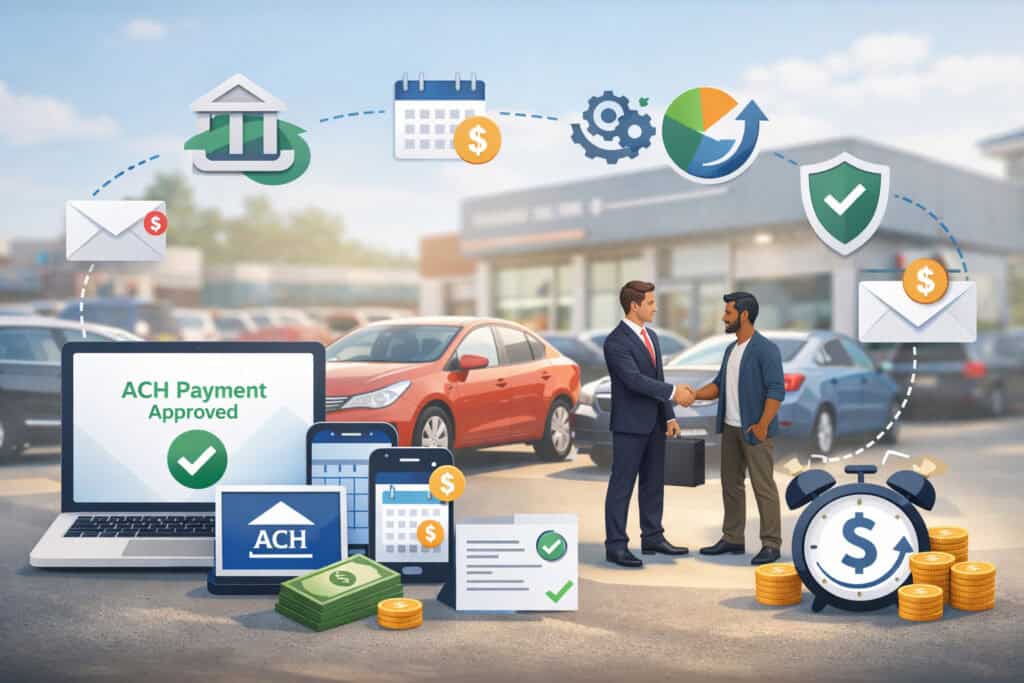
ACH is one of the most practical tools in payment processing for Buy Here Pay Here dealerships because it aligns well with ongoing installment obligations. In a BHPH environment, the dealership is trying to create regularity.
Payments need to arrive on schedule, staff need visibility into what has posted and what has failed, and the collections team needs a manageable process for following up on returns or missed drafts. ACH supports that kind of rhythm better than many alternatives.
For dealerships managing weekly or bi-weekly notes, ACH payments for auto dealers can reduce some of the unpredictability that comes with relying on walk-in cash or last-minute manual card payments.
If the customer has agreed to a recurring draft schedule tied to payday or another predictable date, the dealership can automate much of the process while keeping better records. That does not eliminate risk, but it often improves consistency.
Educational content around ACH payment processing for the automotive industry and accepting ACH payments for automotive businesses can be helpful for operators looking to understand the wider ACH landscape.
Benefits of ACH for recurring payment systems BHPH operations rely on
ACH works especially well when the dealership wants to reduce manual effort and create a more predictable collections cycle. Instead of waiting for customers to remember each due date, a recurring ACH arrangement allows the payment system to initiate collection on the agreed schedule.
That can improve on-time payment behavior for some customers and reduce the number of staff calls required just to chase routine installments.
Another major benefit is cost control. In many cases, ACH can be more economical than card acceptance for repeated installment payments. Over a large portfolio, even modest differences in per-transaction cost can matter.
Lower transaction costs do not automatically make ACH the best option for every account, but they do make it attractive for recurring collections where processing efficiency matters.
ACH also tends to fit the customer behavior common in BHPH. Many customers are budgeting week to week or paycheck to paycheck. A recurring bank draft tied to income timing can feel simpler than logging into a portal or visiting the dealership every time a payment is due.
When the setup is properly explained and authorized, ACH can improve both convenience and operational consistency.
Limits of ACH and what dealerships need to watch closely
ACH is useful, but it is not a magic fix. Bank account information can be entered incorrectly. Accounts can be closed. Customers can move funds out before the draft date. Payments can be returned for insufficient funds or administrative reasons. If staff assume ACH means “set it and forget it,” problems can pile up quickly.
That is why recurring payment systems BHPH operators use should include monitoring tools, not just payment initiation tools. Staff should review return codes, track repeated failures, and know when an account needs a follow-up call, an updated authorization, or a revised payment arrangement.
A dealership that notices returns only after several failed attempts is giving up valuable time and increasing its own exposure.
The role of recurring payments and scheduled collections in BHPH cash flow
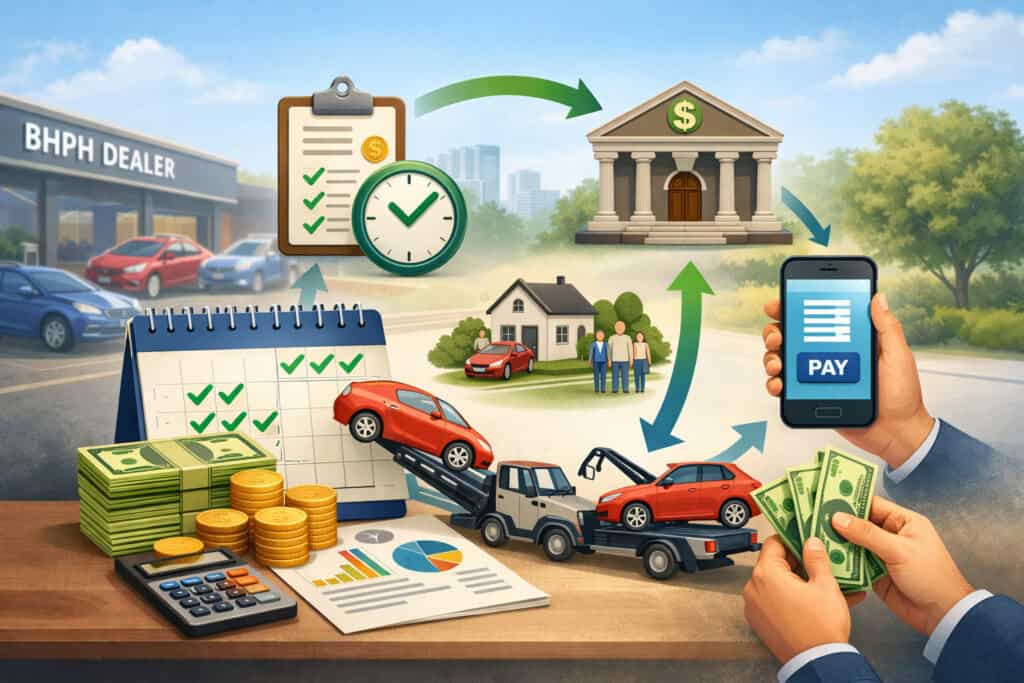
Recurring payments are not just a convenience feature in BHPH dealership payment processing. They are one of the most important tools for stabilizing cash flow.
Because the dealership is carrying the note, incoming customer payments help support payroll, overhead, inventory movement, and overall operating continuity. When too many payments are late, returned, or manually rescheduled without structure, the business feels the impact quickly.
The reason recurring payments matter so much is that they create a system instead of a series of isolated collection efforts.
Instead of starting from scratch each time a payment is due, the dealership builds an expected rhythm: draft date, posting, confirmation, follow-up if needed, and account reporting. That rhythm makes it easier to forecast collections and spot problems before they become portfolio-wide issues.
Payment processing for BHPH dealerships should therefore support more than mere acceptance. It should help finance managers and collections staff understand what is scheduled, what succeeded, what failed, and what needs action.
This kind of visibility is essential when a dealership has many accounts with staggered due dates and different payment methods.
How scheduled payments support discipline for both the dealership and the customer
Scheduled collections reduce dependence on memory and improvisation. Customers do not have to remember every due date on their own, and staff do not have to call every borrower each week just to see whether a payment is coming.
The payment system handles the routine cases, allowing staff to focus more of their time on the exceptions that actually need attention.
This helps create better internal discipline too. When payments are scheduled, staff can measure how many are posted on time, how many are returned, how many needed follow-up, and which accounts are showing early warning signs.
Without a recurring structure, collections can become reactive. The dealership spends all day responding to problems instead of managing a process.
A weekly or bi-weekly BHPH portfolio often performs better when there is a clear cadence that customers understand from the beginning. They know when the payment will occur, how they will be notified, and what happens if there is a problem. That clarity can reduce confusion and lower the chance of disputes later.
Example: weekly payment workflow for an in-house financing account
Imagine a customer whose installment is due every Friday. The dealership sets up recurring ACH with written authorization, sends a reminder text on Thursday, processes the payment Friday morning, and reviews exceptions by midday. If the payment succeeds, the account updates automatically. If it fails, the system flags the account for same-day outreach.
Now compare that to a dealership with no recurring setup. The customer is expected to remember the due date, call in or visit the lot, and pay manually each week. Staff may not notice a missed payment until several days later.
By then, the customer may already be behind on the next obligation, and what could have been a quick recovery turns into a bigger collection problem.
What payment systems for BHPH dealers should be able to do
Not every payment platform is built for BHPH operations. A system that works fine for one-time retail payments may be too limited for installment collections, customer account tracking, and delinquency management.
That is why payment systems for BHPH dealers should be evaluated through an operational lens. The question is not only whether the system can accept money. The question is whether it can support how the dealership actually works.
A practical BHPH dealership payment processing platform should help the team manage the full payment lifecycle. That includes initial setup, authorization storage, recurring payment scheduling, posting and reconciliation, late-payment follow-up, and reporting.
It should also make it easy to see customer history in one place rather than forcing staff to piece together information from different tools.
Operators reviewing automotive merchant services setup checklists often find that the most important systems are the ones that reduce manual handling and improve visibility, especially when payment activity is tied closely to collections.
Core features that matter most in payment processing for BHPH dealerships
A useful system should support the daily realities of auto dealer in-house financing payments. That means being able to set up recurring or scheduled payments, save customer payment methods securely, track posted and failed transactions, and document authorizations. It should also help staff record notes, see account history, and create reports that show payment trends over time.
Other features that matter include payment reminders, payment rescheduling tools, and easy reconciliation. If a customer calls to move a Friday payment to Monday, staff should be able to update the account clearly and create a record of the change.
If management wants to know the weekly return rate or delinquency trend, that information should be accessible without major manual effort.
Good reporting is especially important. A dealership should be able to identify which payment types perform best, which accounts are repeatedly failing, and which staff processes may need improvement. A system that accepts payments but hides patterns is only solving part of the problem.
Integration, account visibility, and staff usability
A payment system is only as strong as the team’s ability to use it consistently. If staff have to jump between multiple screens, manual logs, and separate customer files just to understand one account, efficiency suffers.
The more steps required, the more likely it becomes that something is missed. A missed note, a wrong due date, or an undocumented authorization can create larger issues later.
That is why usability matters. Finance managers, collectors, and front-office staff should be able to see essential account details quickly.
The system should make it obvious when the next payment is due, whether there was a recent return, whether reminders were sent, and what follow-up is pending. It should also help reduce duplicate work by keeping payment and communication records connected.
Payment processing challenges specific to BHPH dealerships
BHPH stores face payment challenges that many other businesses do not experience at the same intensity. The dealership is not simply collecting the sale price of a product and moving on.
It is managing a portfolio of customers with ongoing obligations, changing payment circumstances, and a higher likelihood of missed installments. Because of that, payment processing for BHPH dealerships often includes more exceptions, more follow-up, and more operational pressure.
One challenge is missed payments caused by inconsistent customer cash flow. Another is payment reversals, ACH returns, and card declines that interrupt what looked like a stable arrangement.
Fraud risk can also appear in the form of unauthorized payment claims, mismatched account information, or account takeover behavior. On top of all of that, compliance and documentation standards still matter. A dealership that cannot show authorization records, payment history, and clear terms may be in a weak position when disputes or audit questions arise.
Customer communication is another common friction point. If reminders are inconsistent, staff messages vary, or payment terms are not explained clearly from the start, confusion grows. That confusion can quickly turn into delinquency or conflict, even when the original payment amount was manageable.
Missed payments, return rates, and reversals
Missed payments are a normal risk in BHPH, but they should not be treated casually. A single missed installment can often be recovered with prompt contact and a clear plan. Several missed installments in a row are harder to unwind.
This is why BHPH dealership payment processing should include same-day awareness when scheduled drafts fail or manual payments do not arrive as expected.
High ACH return rates or repeated card declines may point to a bigger issue than customer forgetfulness. They may indicate that the payment date does not align with income timing, that account data is outdated, or that the customer’s chosen payment method is simply not sustainable.
Dealerships that monitor return patterns can adjust early. Dealerships that ignore them may discover too late that a large segment of the portfolio is becoming unstable.
Reversals and disputes add another layer of complexity. Even when a dealership believes a payment was valid, poor documentation can make it harder to defend. Accurate records, signed authorizations, and clear payment history matter.
Compliance, customer communication, and process breakdowns
Compliance in this context is not only about checking a box. It is about protecting the dealership from avoidable disputes and operational confusion. Staff should know how authorizations are collected, how payment terms are communicated, how customer data is handled, and how changes to payment plans are documented. A dealership that handles these tasks inconsistently is more exposed when something goes wrong.
Customer communication matters just as much. If a customer misses a payment and receives no reminder, no timely call, and no clear explanation of next steps, the account can deteriorate faster than necessary.
On the other hand, a dealership with a calm, consistent communication process is more likely to recover the account while maintaining professionalism.
For general education around risk controls and operational safeguards, content on compliance requirements for auto merchant accounts can add useful context.
Risk management strategies for high-risk payment processing auto dealers often need
Because BHPH collections involve installment payments, changing customer circumstances, and a higher rate of payment exceptions, many operators eventually realize they are dealing with a form of high-risk payment processing auto dealers must manage carefully.
Risk does not mean the business model is flawed. It means payment systems and collections processes need tighter controls than a standard low-touch retail payment environment.
Risk management starts before the first recurring payment is ever submitted. The dealership needs accurate customer information, documented authorization, payment terms that are easy to understand, and internal procedures for handling failures.
Then it needs ongoing monitoring. The longer a dealership waits to respond to warning signs, the more likely those small issues become serious losses.
Strong risk controls do not have to be aggressive to be effective. In fact, the best ones are often simple and consistent. They create clarity, reduce confusion, and help staff respond the same way every time.
Verifying account details, documenting authorizations, and setting expectations
One of the most basic but overlooked controls is verifying customer payment information carefully at setup. If ACH data is entered incorrectly, recurring drafts will fail. If a card number is mistyped, the customer may not know until the due date has already passed. Accuracy at onboarding saves time later.
Documentation is equally important. The dealership should have clear authorization records for recurring drafts, stored payment methods, and any agreed payment changes.
If a customer approves a new draft date over the phone, there should be a consistent way to record that change. Weak documentation creates risk in disputes and makes collections harder to manage internally.
Setting expectations also matters. Customers should know the payment amount, due date, acceptable methods, late-payment process, and what to do if they need to request a temporary adjustment. Clarity reduces surprises, and fewer surprises generally mean fewer disputes.
Monitoring return codes, building response rules, and using consistent collections workflows
A dealership should not treat all failed payments the same way. An ACH return for insufficient funds may call for a quick follow-up and another attempt based on the customer’s next pay date. An invalid account return may require immediate account verification.
A repeated card decline may mean the stored card is no longer active. Response rules help staff act quickly and appropriately.
It is also helpful to create an internal collections workflow with clear timing. For example:
| Payment Event | Recommended Internal Response |
| Payment fails on due date | Review reason code and attempt same-day contact |
| Customer confirms temporary issue | Document conversation and set approved retry date |
| Second failed payment within short period | Escalate for account review and payment method verification |
| No response after reminder attempts | Move account into formal collections follow-up queue |
| Payment method repeatedly fails | Require updated authorization or approved alternative method |
Consistent collections workflows reduce staff guesswork and improve fairness across accounts. They also help management measure whether the process is working or needs adjustment.
Customer experience matters more than many BHPH operators expect
Payment processing for Buy Here Pay Here dealerships is often viewed through an operational or risk lens, but customer experience plays a major role too.
A dealership can have solid controls and still struggle if the payment process feels confusing, inconvenient, or inconsistent. Customers are more likely to stay current when they know what to expect, understand their options, and can make payments without unnecessary friction.
This does not mean removing all structure. It means building a payment experience that is firm, transparent, and manageable. BHPH customers often benefit from practical systems that make staying on track easier.
Flexible reminders, multiple payment channels, and clear communication during late-payment situations can all improve outcomes without weakening standards.
The dealership also benefits when customer experience improves. Fewer misunderstandings lead to fewer disputes. Easier payment options can support better collection rates. More transparency can reduce conflict when problems occur. In short, a more thoughtful payment experience often supports both customer retention and portfolio performance.
Flexible options, transparency, and communication during missed payments
Customers should know early in the relationship how they can pay, when payments are due, and what happens if they run into trouble. If the dealership accepts ACH, debit, online portal payments, and in-person payments, those options should be explained clearly.
If recurring drafts are available, the benefits and responsibilities should also be made clear. Transparency helps customers choose the method most likely to work for them.
Missed payments are where communication quality really matters. A customer who misses one installment does not always need a harsh approach. Often, they need a prompt reminder, a clear explanation of the issue, and a defined path to get current.
The tone should stay professional and consistent. Mixed messages from different staff members create confusion and weaken trust.
A good communication strategy may include reminder texts before due dates, confirmations when payments post, notices when a payment fails, and documented follow-up on approved reschedules. These steps help customers stay informed and reduce the “I didn’t know” problem.
Example: bi-weekly customer with a temporary shortfall
Consider a customer who pays every other Friday by ACH. One Friday, the payment is returned for insufficient funds. The customer explains they had an unexpected deduction from their paycheck and asks to move the payment to the following Tuesday.
A dealership with a strong process can document the conversation, approve the revised date under its policy, and update the account accordingly.
Now compare that to a dealership with no structured payment adjustment process. One staff member tells the customer to come in when they can. Another makes a note on paper. No system update happens.
The customer assumes Tuesday is acceptable, but the account is treated as delinquent because the agreed change was not recorded properly. This is how customer frustration and internal confusion happen.
Real-world BHPH scenarios that show how payment processing decisions affect collections
The easiest way to understand BHPH dealership payment processing is to see how it plays out in day-to-day operations. The difference between a well-run account and a troubled account is often not dramatic at first. It can come down to one setup choice, one missed reminder, or one undocumented payment change. Over time, those details add up.
The following scenarios show how payment systems for BHPH dealers can either support better collections or create avoidable friction. These examples are simple, but they reflect common situations that many dealerships encounter regularly.
Scenario 1: weekly ACH account that performs well because the setup is strong
A customer purchases a vehicle and agrees to a weekly payment schedule. During onboarding, the dealership verifies bank information carefully, obtains ACH authorization, explains the draft day, and sets the payment to align with the customer’s direct deposit timing.
The customer receives an automatic reminder the day before each payment and a confirmation after each successful draft.
Because the system is structured, staff do not need to chase the account manually each week. When management reviews performance, the account shows a clear pattern of on-time payments.
The customer also benefits because the payment process feels predictable. This is a good example of how recurring payment systems BHPH operations rely on can improve both efficiency and customer follow-through.
Scenario 2: missed installment turns into a larger delinquency because of weak follow-up
A different customer is making bi-weekly debit card payments. The stored card expires, and the next scheduled payment fails. The system records the decline, but no one on staff checks exceptions until several days later.
By then, the customer has already missed the payment window and is harder to reach. No reminder went out, and no updated card request was sent promptly.
This situation might have been recoverable with same-day contact and an easy way for the customer to update the payment method. Instead, the delay increases delinquency, adds staff workload, and creates tension in the account relationship. The lesson is simple: payment method flexibility only helps if the dealership has a disciplined exception process.
Scenario 3: payment plan adjustment works because the dealership documents it correctly
A customer who usually pays on time experiences a short-term disruption and requests a one-week shift in payment timing. The dealership reviews the request under its policy, approves a revised draft date, records the authorization, sends a written confirmation, and updates the account schedule in the system.
Because the adjustment is documented properly, there is no confusion later. The collections team sees the approved change, the customer understands the new due date, and management can still report accurately on account status.
This kind of organized flexibility often performs better than rigid systems that leave no room for temporary issues or informal systems that create inconsistencies.
Common mistakes dealerships make with BHPH dealership payment processing
Many problems in payment processing for BHPH dealerships do not come from the payment methods themselves. They come from avoidable operational mistakes.
A dealership may accept ACH, cards, cash, and online payments, but still struggle because the process around those methods is weak. In-house financing payments need structure. Without it, even good tools will underperform.
Some of the most common mistakes are surprisingly simple. Manual tracking remains one of the biggest. When staff rely on spreadsheets, handwritten notes, or memory to manage active accounts, errors become more likely.
Another mistake is offering too few payment options, which can make it harder for customers to stay current. On the other hand, offering many options without integrating them into one clear system can also create fragmented records and reporting gaps.
Documentation failures are another major issue. If authorizations are incomplete or payment changes are not recorded properly, disputes become harder to resolve and internal accountability gets weaker.
Finally, many dealerships fail to monitor payment performance data closely enough. Without reviewing return rates, decline trends, and account-level behavior, management loses the chance to improve proactively.
Manual processes, weak documentation, and limited visibility
A dealership may feel it is saving money by handling collections manually, but manual systems often create hidden costs. Staff spend more time tracking down information, payments are posted less consistently, and management has a harder time understanding what is happening across the portfolio.
A manual process also depends too much on individual employees. If one key staff member is absent, records can become harder to interpret.
Weak documentation is another expensive mistake. A missed signature, unclear authorization, or undocumented reschedule may seem minor in the moment. Later, it can make it difficult to defend a payment, explain account status, or prove that a customer agreed to a recurring draft. Documentation should not be treated as optional admin work. It is part of risk control.
Limited visibility hurts decision-making as well. If leadership cannot see which accounts are repeatedly failing, which payment methods are generating the most trouble, or how quickly staff are following up on missed payments, performance improvement becomes guesswork.
Failing to adapt payment options and ignoring performance data
Some dealerships still rely too heavily on a single payment method, often because “that’s how we’ve always done it.” But customers have different circumstances, and a one-size-fits-all approach can create unnecessary delinquencies.
A customer who would do well on ACH may not stay current if expected to bring cash in person every week. A customer whose card is frequently reissued may need a more stable bank-draft arrangement.
At the same time, flexibility should be guided by data. If a dealership notices that a certain payment type has a much higher failure rate, that should shape policy and staff recommendations.
If one reminder process consistently improves recoveries, that should become part of standard workflow. Data does not replace judgment, but it should inform it.
A practical checklist for improving payment processing for BHPH dealerships
Dealerships do not need to rebuild everything at once to strengthen BHPH dealership payment processing. In many cases, improvement starts with identifying the weak points in the current setup.
Are payment methods too limited? Are recurring drafts being monitored carefully? Is there a reliable process for missed payments and reschedules? Is documentation strong enough to support disputes and audits? These are practical questions, and they can be reviewed systematically.
The checklist below is designed for dealership owners, finance managers, and operators who want to evaluate their current payment environment and identify realistic next steps. Some items may already be in place. Others may reveal gaps that are costing the business time, money, or consistency.
Operational and payment setup checklist
Use this checklist to review your payment processing for Buy Here Pay Here dealerships:
- Do we offer payment methods that fit installment-based collections, not just one-time transactions?
- Are ACH, debit, card, in-person, and self-service options clearly defined by policy?
- Can we set up recurring or scheduled payments easily?
- Do payment dates align with customer pay cycles whenever possible?
- Are customer payment authorizations documented and stored consistently?
- Do we verify bank or card information carefully at setup?
- Can staff see full payment history and account notes in one place?
- Do we have automated reminders before due dates?
- Are failed payments flagged promptly for same-day or next-day follow-up?
- Do we track return codes and decline reasons by type?
- Is there a defined process for payment rescheduling or temporary hardship requests?
- Are partial payments and catch-up plans documented clearly?
- Can management review payment performance and delinquency trends easily?
- Do we know which payment methods perform best across the portfolio?
- Are staff trained to explain payment options and expectations consistently?
Management and collections workflow checklist
A dealership should also ask:
- Do we have written procedures for collections follow-up after a missed payment?
- Does every staff member handle delinquency communication in a consistent way?
- Are repeated failed payments escalated according to policy?
- Do we review accounts showing early signs of stress before they become severe?
- Are communication logs accurate and easy to review?
- Do we reconcile received payments and exceptions daily?
- Are we relying too much on manual spreadsheets or disconnected systems?
- Do our reports help us make better decisions, or only show totals?
- Are we balancing customer convenience with risk controls effectively?
- Have we recently reviewed whether our current payment system still fits our business model?
A checklist like this does not solve the problem by itself, but it helps management move from vague frustration to specific action.
FAQs
What is the best payment method for Buy Here Pay Here dealerships?
Why is payment processing for BHPH dealerships more complex than traditional dealership processing?
Are credit cards a good option for recurring BHPH payments?
How can a dealership reduce missed payments in a BHPH portfolio?
What should be documented for recurring payments?
What are the biggest risks in payment processing for car dealers financing customers directly?
Conclusion
Payment processing for Buy Here Pay Here dealerships is not just about accepting money. It is about building a structured system for collecting in-house financing payments consistently, documenting them accurately, and responding effectively when things do not go as planned.
Because BHPH dealerships carry the payment relationship long after the vehicle is delivered, the payment process has to support operations, cash flow, customer communication, and risk management all at once.
The most effective payment processing for BHPH dealerships usually includes a practical mix of payment methods, with special attention to recurring ACH and other scheduled collection tools that improve consistency.
It also includes strong documentation, timely reminders, clear account visibility, and a defined response process for missed payments, reversals, and reschedules. These are not extra features. They are core parts of running a stable BHPH portfolio.
For dealership owners, finance managers, and operators, the goal should be simple: make it easier for customers to pay on time while making it easier for staff to manage accounts with clarity and control.
When payment systems for BHPH dealers are designed around real collections needs instead of one-time transaction thinking, the dealership is better positioned to improve follow-through, reduce unnecessary risk, and create a more dependable financial operation over time.