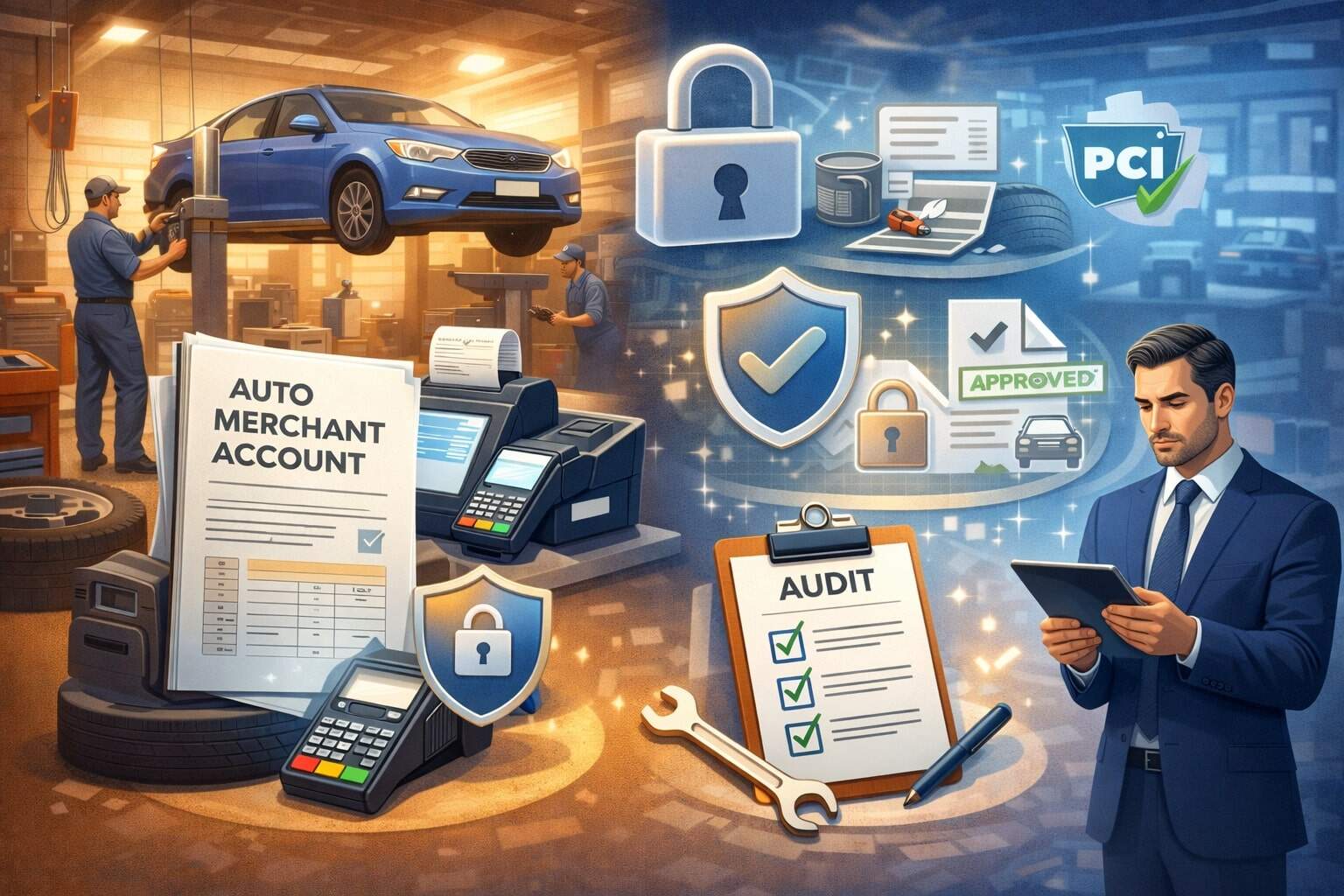
Auto merchant accounts sit at the intersection of large-ticket card payments, sensitive consumer data, and highly regulated sales and financing practices. That combination makes underwriting stricter, ongoing monitoring more intense, and compliance non-negotiable.
If you want reliable approvals, stable processing, and fewer account holds, you need a compliance program built specifically for automotive payments.
This guide explains the compliance requirements for auto merchant accounts in plain language—what processors, acquiring banks, and card brands expect; what federal and state rules commonly apply; how to reduce chargebacks; and how to prepare for where enforcement and network monitoring are heading next.
What “compliance” means for auto merchant accounts
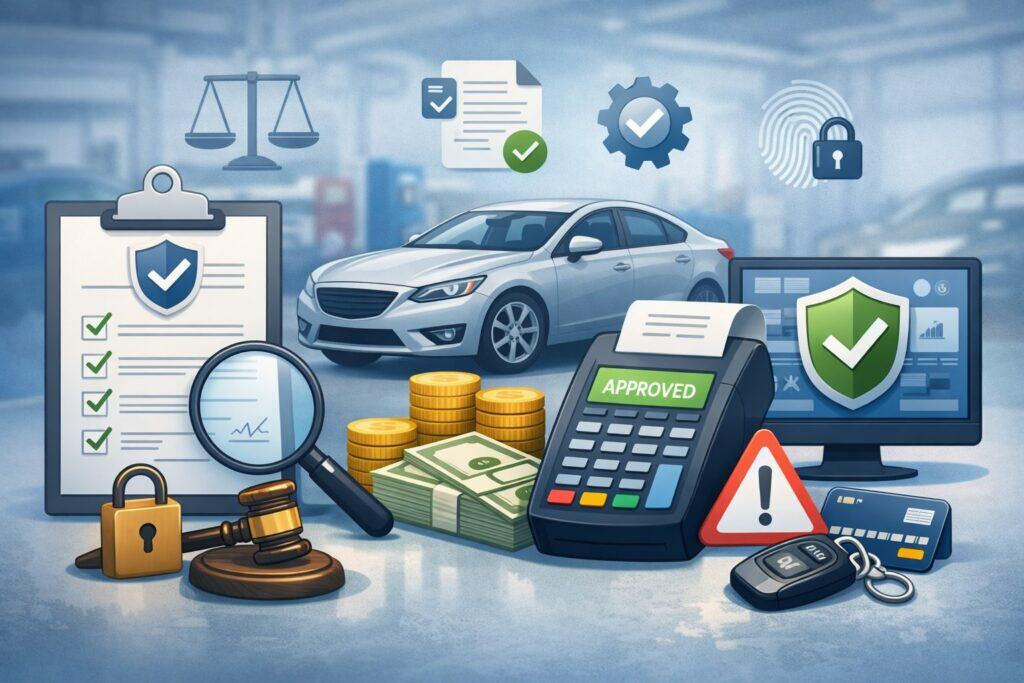
For auto merchant accounts, compliance is not a single checklist. It is a system of controls that proves your business can process payments safely, honestly, and consistently. Payment providers evaluate “compliance” using three lenses: legal/regulatory compliance, card-network compliance, and risk-operational compliance.
Legal and regulatory compliance is about how you advertise, sell, finance, and protect customer information. Auto businesses often handle driver’s license data, insurance details, credit applications, and bank information.
That raises expectations for privacy and safeguards, especially when the dealership arranges financing or shares data with lenders and service vendors.
Card-network compliance is about the rules set by the networks (and enforced through acquirers). This includes rules for authorization, refunds, surcharging, receipts, chargebacks, and data security. These rules apply even if you never “see” them—because your processor must answer for your behavior.
Risk-operational compliance is how you run day-to-day: clear invoices, consistent descriptors, deposit timing, cancellation policy, delivery/vehicle handover proofs, and dispute documentation. This is where most auto merchant accounts break down.
Not because the business is doing something illegal, but because the business cannot demonstrate what happened in a transaction quickly and clearly.
When those three lenses align, auto merchant accounts are easier to approve, less likely to be flagged, and more resilient during disputes, audits, and reviews.
Why auto merchant accounts are treated as higher risk

Many automotive transactions are high-dollar, financed, delayed-delivery, or involve complex add-ons. Each of those variables increases dispute risk. Card brands and acquiring banks know that chargebacks on large tickets are expensive and difficult to reverse without documentation.
Several common automotive patterns raise risk scores during underwriting:
- High average ticket and sporadic volume: A store might run a few small repair tickets and then one large down payment. That variability is normal in automotive, but it looks like a risk to a bank unless it’s explained upfront.
- Split payments and deposits: Down payments, reservation deposits, or partial payments are common. But if your deposit policy, refund policy, and delivery proof are not airtight, you can lose chargebacks even when the customer received value.
- Third-party financing and add-on products: Warranties, GAP, service contracts, and accessories can be legitimate, but they generate disputes when disclosure is unclear or cancellation handling is slow.
- Keyed transactions and remote pay links: Phone and online payment links are convenient, but they can increase fraud and “no authorization” claims if identity checks are weak.
Because of these factors, compliance requirements for auto merchant accounts often include enhanced underwriting, stronger documentation standards, and ongoing monitoring programs that tighten as your volume grows.
Core underwriting requirements for auto merchant accounts

Underwriting is where your processor decides whether to approve your auto merchant account and what limits, reserves, or monitoring thresholds to apply. Approval is not just about credit. It is about proving legitimacy, transparency, and operational control.
Most providers expect a complete business identity package: formation documents, EIN, ownership verification, business bank account, and physical address verification. For dealerships, licensing and dealer credentials matter. For repair shops, shop registration, insurance, and evidence of real operations matter.
Underwriters also focus heavily on “transaction clarity.” You should be ready to present:
- A website or digital presence that clearly describes what you sell and how you bill
- Written policies for refunds, cancellations, deposits, and special orders
- Sample invoices and receipts that show line items (vehicle price, fees, taxes, add-ons)
- Delivery or completion workflows (handover forms, repair completion sign-off)
Auto merchant accounts often require an explanation of how you take payments: in person, online, over the phone, by invoice link, or recurring for service plans. Each channel changes your exposure and the controls you must implement.
Finally, underwriting evaluates financial stability: bank statements, processing history, chargeback ratios, and projected volume.
If you misrepresent volume or ticket size, you can trigger early account reviews, funding delays, or termination. For auto merchant accounts, being conservative and transparent is almost always the fastest path to long-term stability.
Data security compliance: PCI DSS and secure card acceptance
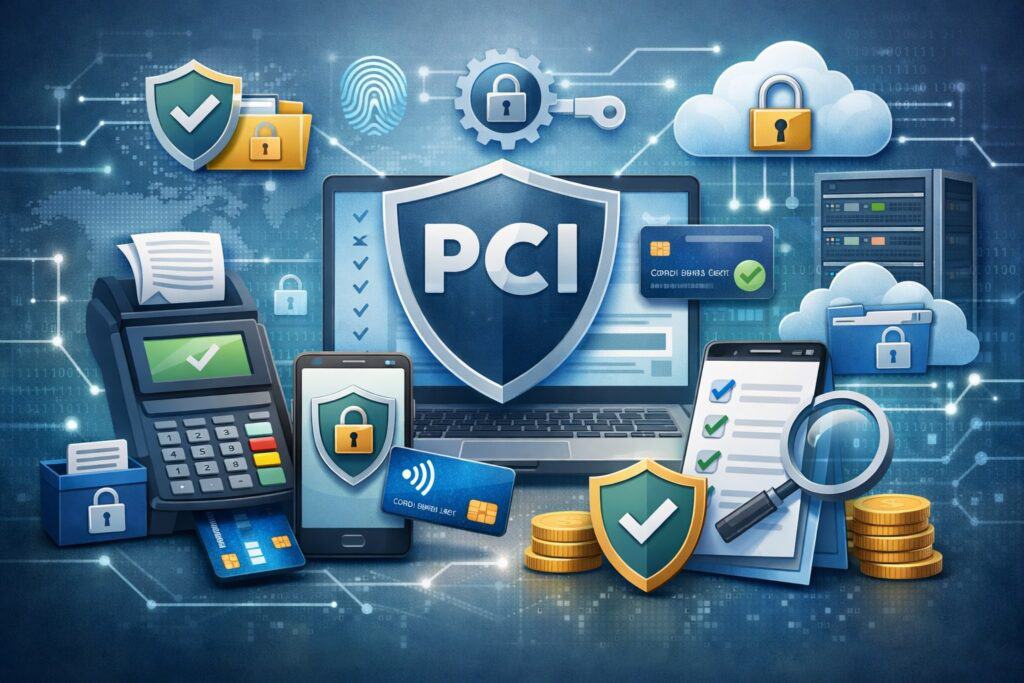
If you store, process, or transmit card data, you inherit PCI responsibilities. For auto merchant accounts, PCI compliance is not optional—noncompliance increases breach risk and can increase fees and scrutiny.
PCI DSS v4.0 is now the active standard, and the transition deadline that mattered most for many businesses was March 31, 2025. After that, v3.2.1 is retired and future-dated v4.0 requirements become mandatory by that date.
For automotive businesses, the most practical way to manage PCI scope is to reduce it. That means:
Tokenization and hosted payment pages. Use approved terminals and hosted checkout links so card data never touches your computers.
No card data storage. Do not save card numbers in DMS notes, email, spreadsheets, or text messages. Even partial storage can create massive compliance exposure.
Segment networks. If your service department has Wi-Fi for customers, keep it separate from the network that touches POS systems.
Strong access controls. Use unique logins, MFA, and quick revocation when employees leave. Automotive turnover is real, and “shared credentials” are a common audit failure.
Vendor accountability. If your DMS, CRM, or payment gateway touches customer data, you need a vendor oversight process. This aligns closely with the expectations in the Safeguards Rule environment for dealerships and similar businesses.
PCI compliance is both a technical and operational discipline. The best approach for auto merchant accounts is to combine secure payment technology with a simple internal rule: “If it looks like card data, we don’t write it down.”
Privacy and customer information safeguards for dealerships and service operations
Automotive businesses often collect nonpublic personal information: credit applications, income details, driver’s license data, and financing terms. If your operation is treated as a non-banking financial institution for privacy/security purposes, you may be expected to maintain a written information security program with ongoing oversight.
The FTC has repeatedly emphasized that the Safeguards Rule applies to non-banking financial institutions, including motor vehicle dealers, and expects a comprehensive security program to protect customer information.
The FTC also issued sector-specific guidance and FAQs affecting dealers and their vendor relationships, reinforcing expectations around third-party oversight and security controls.
For auto merchant accounts, this matters because processors increasingly evaluate how you protect sensitive information—not just card data. A strong safeguards posture reduces fraud, reduces disputes, and lowers the chance of catastrophic events that lead to account shutdowns.
Key safeguards expectations you should operationalize:
- Designate an owner for information security: One accountable leader who coordinates IT, compliance, and operations.
- Risk assessment and controls: Identify where sensitive data enters, where it is stored, and where it leaves. Then apply encryption, access controls, and retention limits.
- Vendor management: Dealerships often rely on OEM systems, DMS providers, CRM platforms, lenders, and marketing vendors. Maintain due diligence files, contracts, and a process for reviewing vendor security posture.
- Incident response planning: If a device is stolen or a system is compromised, you need a documented response plan. Processors and insurers increasingly ask for this during reviews.
Even for businesses that are not clearly in-scope for every privacy rule, these practices are still “good processing hygiene.” Auto merchant accounts that demonstrate strong safeguards are less likely to be interrupted by risk reviews.
Card brand dispute monitoring: chargebacks, fraud ratios, and VAMP
Chargebacks are the #1 operational compliance risk for auto merchant accounts. They drive higher fees, reserves, monitoring programs, and account closures. Networks track disputes and fraud, and the thresholds are not forgiving when tickets are large.
Visa introduced the Visa Acquirer Monitoring Program (VAMP) to simplify and strengthen dispute and fraud monitoring. Visa has communicated timelines and transition updates, including VAMP becoming effective April 1, 2025, as part of its program evolution.
The practical takeaway: auto merchant accounts must manage disputes as a core business function, not an afterthought. That means designing transactions to be “defensible” from day one.
High-impact controls that reduce disputes:
- Clear descriptors: Use a billing descriptor customers recognize. If your legal name differs from your storefront, add “DBA” support where possible.
- Signed documentation: For vehicle deposits, repairs, or add-ons, capture signatures and disclosures. Digital signatures are fine if the audit trail is strong.
- Proof of delivery or completion: For vehicle handover, store delivery confirmations. For repairs, store completion approvals, photos (when relevant), and pickup acknowledgments.
- Fast refund workflows: Many disputes start because a refund took too long or was not communicated. Make refunds trackable, time-bound, and documented.
- Fraud screening for remote payments: If you take pay-by-link or keyed payments, verify identity: matching ID, callbacks, and device/email checks.
Because VAMP and similar programs evolve, the future trend is tighter monitoring with more holistic metrics. That means auto merchant accounts that invest in dispute prevention now will be far more stable later.
Advertising, pricing transparency, and sales practice compliance
Payment processors increasingly connect “sales practice risk” to payment risk. If customers feel surprised—about fees, add-ons, financing terms, or cancellation rules—disputes rise. That’s why compliance requirements for auto merchant accounts often include policy reviews and website content checks.
Auto businesses should build a “truthful pricing” discipline:
- Advertised price alignment: Ensure the price a customer sees matches what they pay, excluding clearly disclosed taxes and government fees.
- Fee transparency: Document dealer fees, documentation fees, service fees, and processing fees (if applicable). Hidden or inconsistent fees are dispute magnets.
- Add-on consent: Warranties, protection plans, accessories, and service contracts need explicit customer authorization and clear cancellation instructions.
- Written policies at the point of payment: If deposits are non-refundable or only refundable under conditions, that must be disclosed before the card is charged.
It’s also important to track changes in regulatory enforcement. For example, the FTC’s CARS Rule was finalized in late 2023 but faced legal challenges; the Fifth Circuit vacated the rule in early 2025 before it took effect.
Even when a specific rule is vacated, the underlying enforcement themes—clear disclosures, truthful advertising, and consumer protection—remain active.
Auto merchant accounts perform best when sales practices are engineered for clarity. Your payment environment becomes calmer when your customers understand exactly what they’re paying for.
Payment flow compliance: deposits, partial payments, and delayed delivery
Automotive payment flows are rarely “simple swipe and done.” That’s why auto merchant accounts must pay extra attention to authorization strategy, deposit labeling, and delivery timing.
Common compliant structures include:
- Refundable reservation deposits with written terms: If a deposit is a reservation fee, state what it does, when it becomes non-refundable (if ever), and how cancellations work.
- Down payments tied to a purchase agreement: The charge should map to a signed buyer’s order or purchase agreement, with a copy stored for dispute response.
- Service department estimates and final invoices: If you charge above the estimate, capture approval before charging. Many disputes start with “I never approved that extra work.”
- Delayed delivery controls: If the vehicle is delivered days later, store proof of delivery and maintain a clean timeline of payment, contract signing, and handover.
A major compliance issue for auto merchant accounts is “misaligned timing.” For example, charging a large amount before a vehicle is ready, without clear written terms, can trigger “services not rendered” disputes. Processors also dislike long gaps between authorization and capture unless your process is designed for it.
A future-proof approach is to standardize your payment playbook: which transactions are deposits, which are down payments, which are final balances, and which are service invoices. When everyone follows the same structure, compliance becomes repeatable instead of reactive.
ACH, check-by-phone, and alternative payment compliance
Many auto businesses use ACH for large balances or recurring service plans, and some accept eChecks or remote check capture. These methods can reduce card fees, but they add their own compliance responsibilities.
For ACH, you must follow network rules and consumer authorization standards. The most important compliance concept is “provable authorization.” If a customer disputes an ACH debit, you need to demonstrate they authorized it in the correct format.
For check-by-phone or eCheck, treat bank details as sensitive information. Do not collect bank info through insecure email or text. Use secure forms, limit access, and store only what you truly need.
From a processor perspective, ACH and alternative payments are attractive when they reduce card disputes. But they become a compliance problem if your authorizations are sloppy. Auto merchant accounts should implement:
- Signed ACH authorization forms for recurring debits
- Recorded verbal authorization protocols (where permitted and properly disclosed)
- Secure storage and retention policies
- Clear refund and cancellation timelines
The future direction here is more automation and audit trails. Providers are moving toward systems that create timestamped authorization evidence by default, because it lowers disputes and improves compliance defensibility.
Refunds, cancellations, returns, and chargeback representment readiness
Refund handling is one of the most overlooked compliance requirements for auto merchant accounts. Yet it is one of the easiest ways to prevent chargebacks.
A compliant refund program for auto merchant accounts includes:
- Documented policy: The customer can find it easily (website and in-store). The policy uses plain language and avoids surprises.
- Consistent execution: Staff follow the same steps every time, regardless of customer mood or ticket size.
- Written confirmation: When a refund is initiated, provide a dated confirmation showing amount and expected posting time.
- Cancellation workflow for add-ons: Warranties and service contracts often have cancellation rights. If you delay cancellations, customers dispute the entire ticket.
- Chargeback representation “kit:” Build a standard packet for disputes: signed contract, invoice, proof of delivery, communications, and refund/cancellation policy.
Most automotive disputes fall into a few categories: “I didn’t authorize,” “I didn’t get what I paid for,” “I canceled,” or “the charge is wrong.” Your job is to make each category easy to rebut with organized documentation.
As monitoring programs tighten, the future of auto merchant accounts will favor merchants who treat disputes like a measurable operational KPI. Track dispute reasons, fix the upstream process, and reduce dispute volume month over month.
Surcharging, convenience fees, and dual pricing compliance
Automotive businesses sometimes ask whether they can pass card costs to customers. The answer depends on network rules, state rules, and how you structure the program. This is a high-risk area for compliance because improper fee practices trigger complaints, disputes, and even account termination.
If you choose to implement surcharging, convenience fees, or dual pricing, auto merchant accounts should follow a strict compliance process:
Use processor-supported configurations. DIY fee add-ons through manual line items often violate rules or create inconsistent receipts.
Disclose before payment. The customer must know the fee amount and reason before they present the card.
Itemize correctly. Receipts should show the base amount and fee clearly, using language consistent with network expectations.
Maintain signage and online disclosures. In-store signage and online checkout disclosures reduce complaints and “unexpected charge” disputes.
Because rules and enforcement can change, you should treat fee programs as “reviewed quarterly.” Your processor should be able to provide the permitted structure in your state and for your card acceptance method. The compliance risk is not worth improvisation.
For auto merchant accounts focused on ranking and reputation, it is often better to pursue cost reduction through optimized interchange, ACH options, and better authorization practices than to add poorly disclosed fees.
Ongoing monitoring, audits, reserves, and what triggers account holds
Getting approved is only step one. Auto merchant accounts are monitored continuously. Providers use automated systems to flag unusual activity, rising disputes, or policy mismatches.
Common triggers for funding delays or reserves include:
- Sudden spikes in volume or ticket size: If you normally process $20,000/week and suddenly run $200,000, expect a review.
- High refund volume: Excessive refunds can indicate customer dissatisfaction or laundering behavior.
- High chargebacks or fraud claims: Even a few disputes on large tickets can move ratios quickly.
- Mismatch between business model and transaction type: For example, a repair shop processing repeated large “down payments” without documentation looks suspicious.
- Insufficient proof in prior disputes: If you lose several disputes because you cannot document the transaction, processors may treat you as unstable.
The best defense is proactive reporting. If you expect a big sales week, tell your provider ahead of time. If you change your website or policies, keep them consistent across marketing and receipts. Auto merchant accounts are most stable when providers are not surprised.
Building a compliance program that keeps auto merchant accounts stable
Compliance becomes manageable when it’s built into workflows. The goal is not to create paperwork. The goal is to make every transaction self-explaining.
A practical compliance program for auto merchant accounts includes:
- Policy stack: Refund policy, deposit policy, cancellation policy, and privacy/security policy. Keep them readable and consistent.
- Training: Teach staff what creates disputes and what documents must be captured. Reinforce monthly.
- Documentation standards: Define what must be stored for each transaction type (deposit, down payment, service invoice, add-on product).
- Security controls: PCI scope reduction, device control, access management, vendor oversight, and incident response planning.
- Dispute management: A single owner, a defined timeline, templates for response, and root-cause analysis after every dispute.
- Compliance is also a marketing advantage: Customers trust businesses that communicate clearly. And processors trust merchants who can document transactions quickly.
If you want auto merchant accounts that last, treat compliance like preventive maintenance: regular, structured, and cheaper than a breakdown.
Future outlook: what will change next for auto merchant accounts
The direction of travel is clear: tighter data security expectations, more holistic dispute metrics, and stronger consumer-protection scrutiny.
Expect these trends to shape auto merchant accounts over the next 12–36 months:
- More PCI automation and scope reduction: As PCI DSS v4.0 expectations mature, more providers will push tokenization, hosted pages, and “no data touches your network” designs as the default.
- Dispute monitoring consolidation and integrity scoring: Visa’s evolution toward VAMP-style monitoring points to fewer programs, clearer metrics, and faster enforcement—meaning fewer “second chances” once ratios rise.
- Stronger third-party oversight: Dealer ecosystems rely on many vendors. Guidance emphasizing safeguards and vendor relationships signals that oversight expectations will keep rising.
- More scrutiny of add-ons and fees: Even when specific rules change through litigation, enforcement priorities around transparency remain. The best long-term strategy is to make fees, add-ons, and financing terms unmistakably clear.
The winning approach for auto merchant accounts will be “compliance by design”: build sales, payments, and documentation so disputes are rare and easy to defend.
FAQs
Q.1: What documents do I need to open auto merchant accounts?
Answer: Most providers request business registration documents, EIN verification, an active business bank account, ownership identification, and proof of operations (website, invoices, photos, or lease/utility). Dealerships are commonly asked for dealer licensing evidence and insurance.
You’ll also need written refund and deposit policies, plus an explanation of how you accept payments (in-person, online, pay-by-link, phone). Auto merchant accounts are approved faster when you submit these items in a single organized package and your policies match how you actually transact.
Q.2: Do auto merchant accounts require PCI compliance even if I don’t store card numbers?
Answer: Yes. If you accept card payments, you still have PCI responsibilities, even if you do not store card numbers. The good news is that many auto merchant accounts can keep PCI scope small by using approved terminals, tokenization, and hosted payment links.
PCI DSS v4.0 is the active standard, and organizations transitioned away from v3.2.1 on the published timeline, with key v4.0 requirements tied to the March 31, 2025 deadline. The simplest rule: never store card data in notes, email, or spreadsheets.
Q.3: Why are chargebacks so damaging for auto merchant accounts?
Answer: Auto tickets are large, and dispute ratios can rise quickly even with a small number of chargebacks. Disputes also create operational friction: funding delays, reserves, and monitoring programs.
Network monitoring is evolving toward consolidated integrity programs such as Visa’s VAMP approach, so merchants need stronger prevention and documentation practices to stay stable. For auto merchant accounts, the best defense is clear agreements, proof of delivery/completion, and fast refund/cancellation workflows.
Q.4: Can I take deposits on a card for a vehicle?
Answer: Yes, but deposits are one of the highest-dispute transaction types in automotive. Auto merchant accounts should treat deposits as a distinct product with written terms. Your receipt and customer agreement should state whether the deposit is refundable, when it becomes non-refundable (if applicable), what it reserves, and how cancellation works.
You should also store customer communications and a timestamped record of policy acceptance. When deposit terms are vague, “canceled transaction” disputes become hard to win.
Q.5: Are dealerships expected to follow customer data safeguards standards?
Answer: Many dealerships and auto finance-adjacent businesses are expected to maintain robust information security controls for customer data, especially when they handle financing-related information.
The FTC has emphasized that the Safeguards Rule applies to non-banking financial institutions, including motor vehicle dealers, and expects a comprehensive security program.
FTC guidance and FAQs have also highlighted vendor and OEM relationship considerations for dealers. Even beyond strict legal scope, strong safeguards reduce fraud and protect your auto merchant accounts from disruption.
Q.6: What’s the biggest compliance mistake businesses make with auto merchant accounts?
Answer: The biggest mistake is failing to document transactions in a dispute-ready way. Many businesses run legitimate sales, but can’t produce a clean paper trail: signed terms, delivery proof, approvals, refund confirmations, and itemized invoices.
The second biggest mistake is inconsistent policies—your website says one thing, your staff says another, and the receipt shows something else. Inconsistent information increases complaints, disputes, and monitoring risk.
Conclusion
Auto merchant accounts thrive when compliance is treated as a system, not a one-time hurdle. Approval depends on transparency and readiness. Long-term stability depends on secure payment design, consistent policies, strong documentation, and disciplined dispute prevention.
The most practical roadmap is simple: reduce PCI scope, protect customer information, standardize deposit and invoice workflows, and make every charge easy to understand and easy to prove.
Then track disputes like a business metric, not a back-office annoyance. As network monitoring evolves and consumer-protection scrutiny stays active, the auto businesses that “design for clarity” will keep their auto merchant accounts approved, funded, and scalable.