
Auto dealer payment processing is the system that lets a dealership accept money securely and efficiently across every revenue stream—vehicle down payments, full purchases (when allowed), F&I products, service and parts invoices, recurring maintenance plans, and online deposits.
While “payment processing” sounds simple, auto dealer payment processing has extra moving parts compared to many retail businesses: higher ticket sizes, higher fraud risk, more split payments, more chargeback sensitivity, and more compliance expectations.
At a high level, auto dealer payment processing moves funds from a customer’s payment method (card, ACH, digital wallet, bank transfer, or instant payment rail) to the dealership’s merchant account, then into the dealership’s bank account.
Behind the scenes, the transaction is routed through a payment gateway or terminal, the acquiring bank (the dealer’s processor/acquirer), and the card networks or bank rails. The system checks identity signals, confirms funds, applies security controls, and records data for reconciliation.
What makes auto dealer payment processing distinct is the mix of use cases. A customer might place a small online deposit, bring a cashier’s check at delivery, and pay a service warranty by card in the finance office.
Another customer may pay service invoices monthly or authorize a card-on-file for recurring maintenance. Each flow has different risk, different fees, and different best practices.
In this guide, you’ll learn how auto dealer payment processing works step-by-step, how fees are built, what compliance and security really mean, how to reduce fraud and chargebacks, how to integrate with dealership systems, and where payments are headed next—including instant payments and more automated, data-driven risk controls.
Real-world decisions—like whether to surcharge, how to accept ACH, and how to structure deposits—can materially affect profit and customer satisfaction, so we’ll cover those in detail too.
Auto Dealer Payment Processing Basics: The Core Parties and Rails
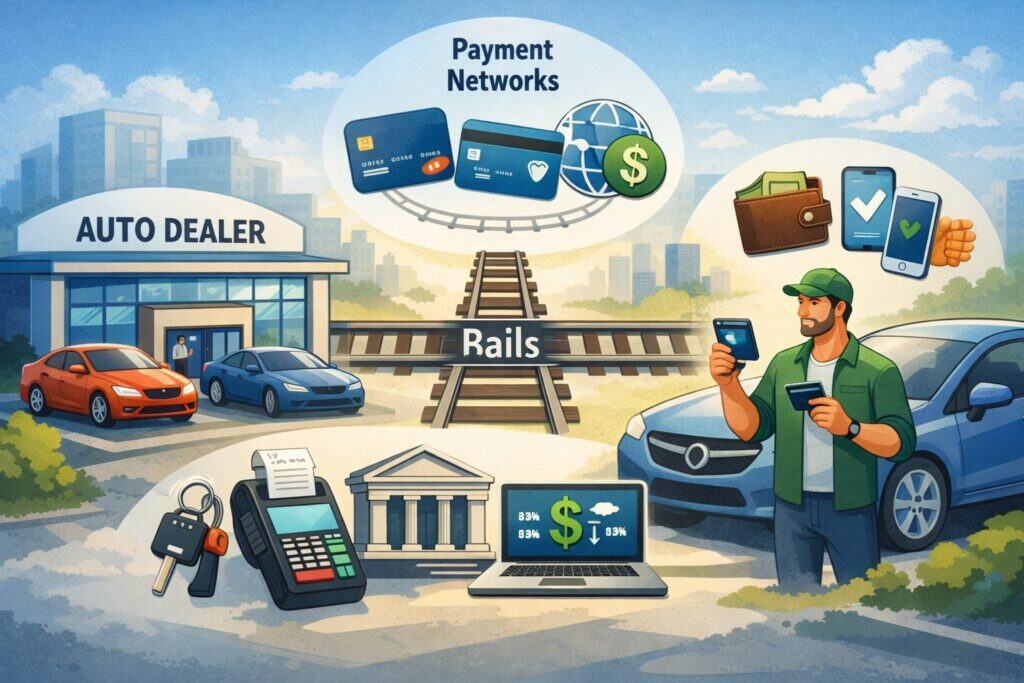
Auto dealer payment processing involves multiple parties that each do a specific job. Understanding who does what makes it easier to compare providers, troubleshoot funding delays, and design a smoother checkout experience.
The customer starts the payment using a card, bank account, digital wallet, or other method. The dealership is the merchant that accepts the payment.
In auto dealer payment processing, the dealership usually has multiple “points of acceptance,” like the sales desk, F&I office, service cashier, parts counter, mobile pay links, and the dealership website.
The payment gateway (for online and many integrated systems) securely transmits transaction data. The point-of-sale terminal (for in-person payments) reads the card or wallet token and sends payment data through encrypted channels.
The acquiring bank (also called the acquirer) provides the merchant account and routes transactions into the networks. The card network (for card payments) or bank rails (for ACH and instant payments) moves transaction messages and coordinates settlement. The issuing bank (the customer’s bank) approves or declines the transaction.
Auto dealer payment processing also depends on payment rails—the underlying networks that move money. Cards are one rail; ACH is another; instant payment rails are another.
Real-time payment options are expanding through modern networks (including the RTP Network and FedNow), which are designed for faster clearing and settlement with continuous availability.
The Auto Dealer Payment Processing Transaction Flow: Authorization to Settlement
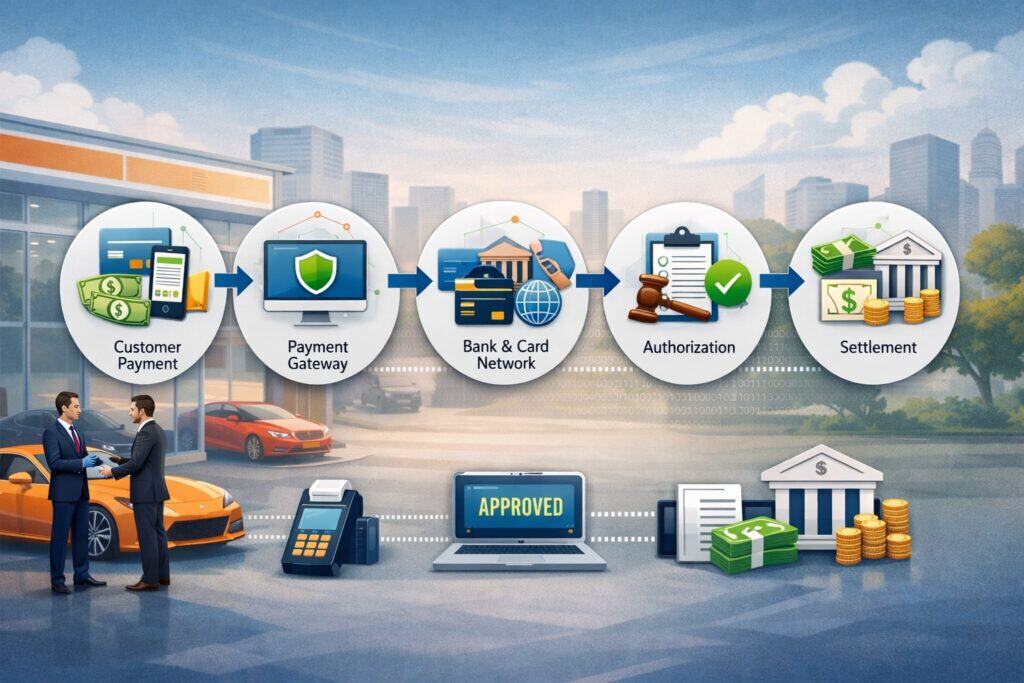
A card transaction in auto dealer payment processing follows a predictable sequence, even if the customer experience feels instant. It starts with authorization and ends with settlement, with several safeguards in between.
- Initiation: The customer taps, inserts, swipes, or pays online. The terminal or gateway formats the transaction request and encrypts sensitive data.
- Routing to the acquirer: The request goes to the dealership’s processor/acquirer. The acquirer identifies the card network and forwards the request.
- Network to issuer: The card network routes the authorization request to the customer’s issuing bank. The issuer checks available funds, fraud signals, account status, and authorization controls.
- Approval/decline: The issuer returns an approval code or decline code. If approved, the dealership receives an authorization response and can proceed with the sale, deposit, or invoice payment.
- Clearing and settlement: Authorizations are not the same as final payment. At the end of the day (or on a schedule), the dealership “batches” transactions. Clearing messages are sent, and settlement moves funds from issuers through the network to the acquirer, then to the dealership’s merchant account and bank deposit.
Auto dealer payment processing becomes more complex when you use partial approvals, split tenders, delayed capture, or incremental authorizations.
For example, a service department might authorize an estimated amount, then adjust once the final invoice is known. A sales department might take a deposit today and capture the balance later. Those decisions affect risk and chargeback exposure, so the processing configuration matters.
The most important operational concept is funding time: how quickly settled funds land in your bank. Funding speed depends on your processor, risk tier, underwriting, transaction types, and whether you accept faster rails like instant payments.
As instant payment networks expand, dealerships may increasingly treat settlement speed as a competitive advantage for cash flow and working capital.
Key Payment Types in Auto Dealer Payment Processing
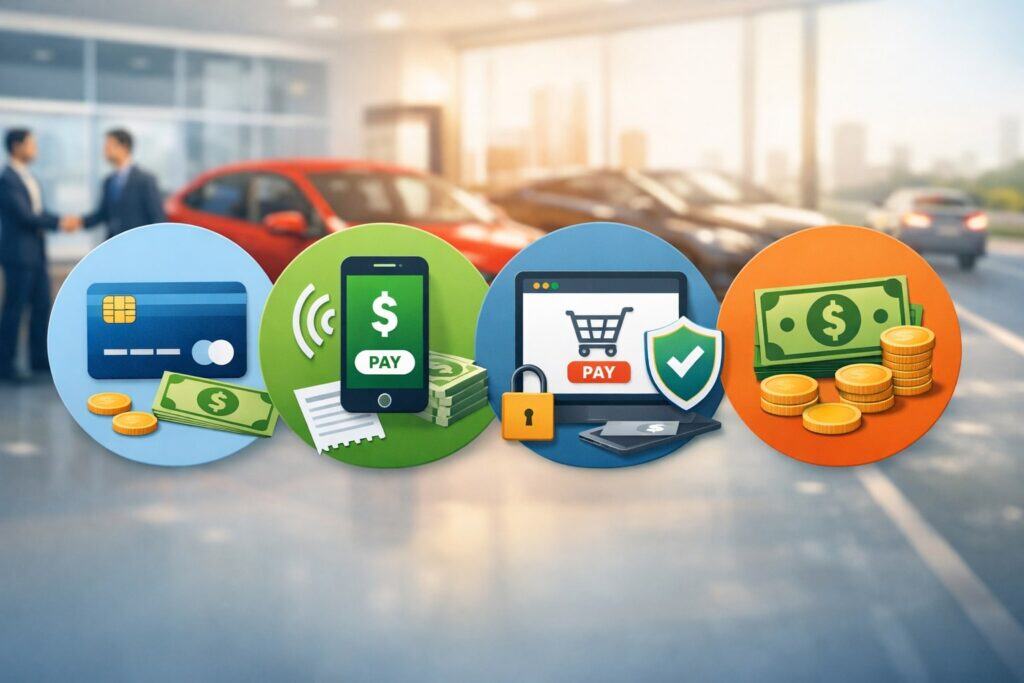
Auto dealer payment processing is rarely “cards only.” A strong payments program supports multiple payment types because dealership transactions vary in size, urgency, and customer preference.
Credit and Debit Cards for Dealership Sales and Service
Cards are popular for convenience, rewards, and speed. In auto dealer payment processing, cards are common for deposits, service tickets, parts purchases, accessories, and F&I add-ons. However, many dealerships limit cards for full vehicle balances due to fees, ticket size risk, and potential chargebacks.
A best practice is to create clear acceptance rules: maximum card amount for vehicle purchases, which items can be paid by card (service contract, accessories, repair orders), and when additional verification is required.
ACH and Bank Transfers for High-Ticket Payments
ACH is widely used for larger amounts where card fees would be expensive. In auto dealer payment processing, ACH is often used for down payments, remaining balances, or B2B payments (fleet, wholesalers, vendor invoices). It can also reduce chargeback risk compared to cards, though ACH has its own dispute and return processes.
Digital Wallets and Tokenized Payments
Digital wallets (tap-to-pay) can reduce certain types of fraud because they use tokenization and device-based authentication. For dealerships, enabling wallets at the service counter can speed lines and reduce key-entry errors.
Instant Payments for Faster Funding
Instant payment rails (like RTP and FedNow) are increasingly discussed for business payments. They can support near-immediate movement of funds, which could help dealerships with faster delivery workflows, service release, or refund handling.
The practical approach: auto dealer payment processing should match the payment type to the transaction risk and ticket size, not force every transaction into the same method.
Auto Dealer Payment Processing Fees Explained: What You Pay and Why
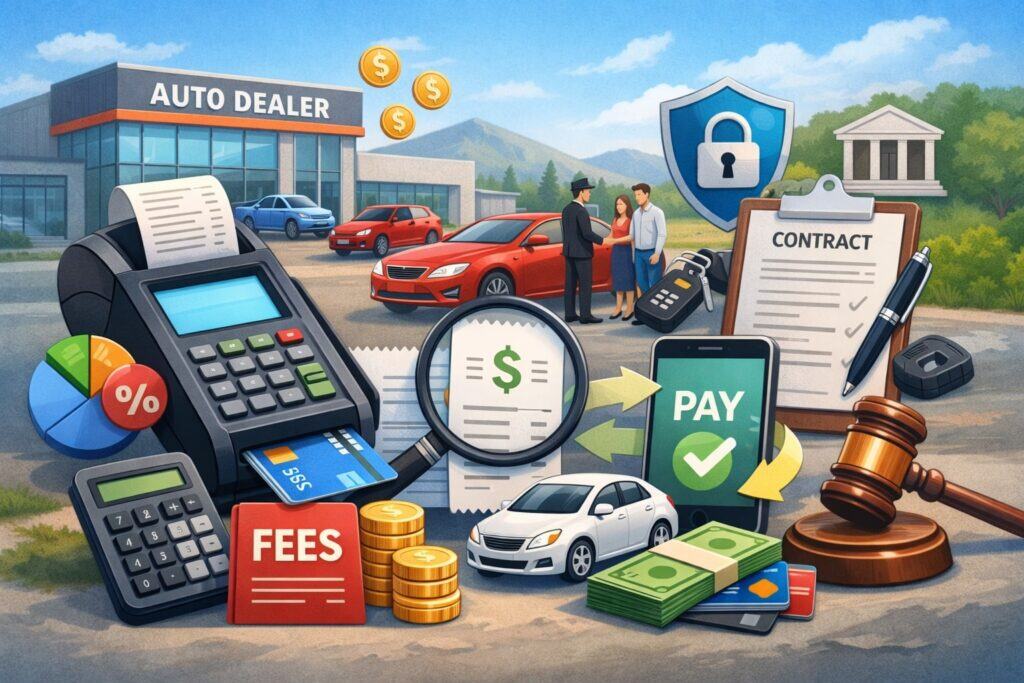
Understanding fees is essential because auto dealer payment processing margins can be affected by even small percentage changes—especially when you process large service volumes or allow higher card limits.
Most card pricing is built from:
- Interchange (paid to the issuer)
- Network assessments (paid to the card network)
- Processor/acquirer markup (your provider’s margin)
Auto dealer payment processing costs are influenced by transaction type (card-present vs. card-not-present), card category (rewards, corporate, premium), verification method, and risk signals. A chip (EMV) transaction with strong authentication tends to be safer than manually keyed transactions, and pricing can reflect that.
High-ticket transactions can also trigger extra scrutiny. Some processors add risk monitoring, rolling reserves, or delayed funding if underwriting believes the ticket size increases fraud or chargeback exposure.
Dealerships should also watch for:
- Gateway fees (online payments, integrations)
- PCI compliance fees (varies by provider)
- Chargeback fees
- Terminal rental or support fees
- Batch fees or statement fees
If you’re optimizing auto dealer payment processing, the biggest levers are usually (1) reducing keyed transactions, (2) shifting appropriate large payments to ACH or bank rails, (3) tightening fraud controls for deposits, and (4) negotiating transparent markup structures aligned to your volume and risk profile.
Underwriting and Merchant Account Setup for Auto Dealer Payment Processing
Before you can run transactions, your provider underwrites the dealership. Underwriting is the risk review process that determines whether you can accept certain payment types, what your limits are, and how funding will work.
In auto dealer payment processing, underwriters typically evaluate:
- Business model (sales, service, parts, online deposits)
- Average and maximum ticket size
- Refund and cancellation exposure
- Chargeback history (if any)
- Ownership structure and time in business
- Financial stability and banking relationships
- How you advertise and collect deposits
Because dealerships can process high amounts, underwriting may set per-transaction limits or require enhanced verification for card-not-present deposits. If your store has multiple rooftops or franchises, underwriting may separate locations by MID (merchant ID) or use aggregated reporting.
The best approach is to design auto dealer payment processing with underwriting in mind. If you know you need large payments, build a policy that routes certain amounts to ACH or bank transfer.
If you take online deposits, implement stronger validation, clear refund policies, and robust receipt documentation. These steps can reduce risk ratings and improve approval rates and funding speed.
Security and Compliance in Auto Dealer Payment Processing
Security is not optional in auto dealer payment processing. Dealerships handle sensitive information, and payment data is a prime target for attackers. Strong security protects customers and prevents catastrophic operational disruptions.
PCI DSS and What It Means for Dealerships
PCI DSS is the major security standard for organizations that store, process, or transmit card data. PCI DSS v4.x tightened expectations, and “future-dated” requirements became effective after March 31, 2025, meaning many controls that used to be treated as best practice now must be fully considered in assessments.
For auto dealer payment processing, the simplest way to reduce PCI scope is to:
- Avoid storing card numbers internally
- Use PCI-validated terminals and gateway tokenization
- Keep payments in encrypted, segmented environments
- Limit access based on roles (service cashier vs. controller)
- Maintain patching, logging, and incident response plans
EMV, Tokenization, and Encryption
EMV chip transactions shift certain fraud liability and reduce counterfeit card fraud when properly implemented. Tokenization replaces raw card data with non-sensitive tokens, which lowers breach impact. Secure acceptance—chip, tap, and tokenized e-commerce—reduces risk compared to key-entered transactions.
Disclosures and Transparency in Pricing
Dealerships are frequently under a spotlight for transparency. For example, the FTC’s CARS Rule was paused and later vacated by a federal appeals court in early 2025, reflecting how auto retail compliance can change quickly through litigation and rulemaking.
Even when rules shift, transparency remains a best practice that can reduce disputes and chargebacks—especially for add-ons, deposits, and refunds.
Security is also a customer experience feature. A smooth, secure checkout (chip/tap, digital receipts, clear invoice detail) builds trust and reduces payment friction in auto dealer payment processing.
Chargebacks and Disputes: Why Auto Dealer Payment Processing Needs Strong Documentation
Chargebacks are a critical pain point in auto dealer payment processing. A single dispute on a large-ticket payment can cause financial loss and trigger processor risk actions.
Common auto dealer chargeback reasons include:
- “Services not rendered” (especially deposits or delayed delivery)
- “Not as described” (misunderstandings about add-ons)
- “Unauthorized transaction” (card misuse or friendly fraud)
- Refund timing complaints
To reduce disputes, auto dealer payment processing should be supported by documentation discipline:
- Signed buyer’s orders or repair authorizations
- Deposit terms (refundable vs. non-refundable) clearly stated
- Proof of delivery or service completion
- Itemized receipts showing add-ons and taxes
- Clear cancellation and refund process
It’s also smart to keep payment descriptions consistent. If your statement descriptor doesn’t match your dealership name or brand, customers may not recognize the charge and dispute it.
For online deposits, strengthen controls: require AVS/CVV when available, add identity verification for higher deposit amounts, and use clear confirmation screens and email receipts. These steps reduce “I didn’t authorize this” disputes and improve overall auto dealer payment processing performance.
Surcharging, Cash Discounts, and Convenience Fees in Auto Dealer Payment Processing
Many dealerships explore surcharging because card acceptance costs can be significant. In auto dealer payment processing, the decision must balance compliance, customer experience, and competitive positioning.
Card network rules matter. For example, Visa’s guidance states that debit and prepaid cards cannot be surcharged, and surcharges must not exceed the merchant’s cost of acceptance, with required disclosures and itemization.
Mastercard provides merchant surcharge rules, including disclosure requirements and a maximum surcharge cap (often stated as 4% in its materials, subject to conditions).
Legal commentary and merchant guidance frequently note Visa’s cap as the lesser of 3% or the average merchant discount rate, and Mastercard’s as the lesser of 4% or the average effective rate.
In practice, auto dealer payment processing teams often choose one of these approaches:
- True cash discount program: Display a cash price and add a non-cash adjustment for credit cards (must be implemented carefully).
- Surcharge program: Add a fee for credit card use (with required signage, notices, and network compliance).
- Convenience fee for alternative channels: Sometimes used for certain remote payment channels, but must follow network and legal guidance.
Because rules vary by state and can change, dealerships should implement these programs with professional guidance and processor support. Done correctly, surcharging can protect margins.
Done poorly, it can trigger fines, disputes, and reputational damage. The safest strategy is to make auto dealer payment processing policies simple, transparent, and consistent across departments.
In-Person Payments: The Service Drive, Parts Counter, and F&I Office
In-person acceptance is the heart of auto dealer payment processing, especially in service and parts. Customers expect speed, minimal friction, and a modern experience.
Service drive payments often happen under time pressure. The customer wants to pick up the vehicle quickly, sometimes after receiving unexpected repair news. Here, the best payments setup includes:
- Chip + tap terminals (reduces counterfeit fraud)
- Digital receipts (text/email)
- Clear invoice presentation
- Optional split payments (card + financing, card + cash)
Parts counter payments have retail-like characteristics: high volume, smaller tickets, repeat customers. Enabling stored tokens for authorized commercial accounts can speed recurring purchases without storing raw card data.
F&I office payments must be especially careful. Customers are signing contracts, reviewing add-ons, and making large decisions. Auto dealer payment processing in F&I should emphasize transparency and documentation—every product, fee, and payment authorization should be cleanly recorded.
Many dealerships improve results by standardizing payment workflows: same terminal model across departments, consistent receipt formatting, unified reporting, and a shared dispute documentation system. That operational consistency can reduce reconciliation time and lower chargeback rates.
Online and Remote Payments: Deposits, Pay-by-Link, and Service Pre-Pay
Digital acceptance is now a major part of auto dealer payment processing. Customers want to reserve vehicles, pay deposits, pre-pay service, and settle invoices remotely.
Online deposits are common for vehicle holds. The risk is that deposits can trigger disputes if terms are unclear or delivery timelines shift. Best practices include:
- A clear deposit agreement at checkout
- Confirmation emails and receipts
- Identity and fraud screening for higher deposits
- Easy cancellation process with documented communication
Pay-by-link (text or email link) is useful for service approvals and remote payments. It reduces the need to take card numbers by phone, which lowers PCI risk and decreases keyed-entry errors.
Online service payments can be integrated into scheduling or customer portals. When integrated properly, auto dealer payment processing becomes part of the customer journey: schedule → approve estimate → pay → pick up with minimal waiting.
Security is essential here. Use tokenization, strong authentication tools, and reputable gateways. This keeps auto dealer payment processing safer while meeting customer expectations for convenience.
Integrations: DMS, Dealer Platforms, Accounting, and Reconciliation
A major differentiator in auto dealer payment processing is integration quality. When payments are disconnected from dealership systems, you waste time on manual entry and reconciliation.
Common integration targets include:
- Dealer management systems (DMS)
- Service scheduling and RO platforms
- F&I software
- Parts inventory systems
- Accounting systems for reconciliation and GL posting
A strong integration setup enables:
- Automatic posting of payments to invoices
- Unified reporting across departments and rooftops
- Fewer errors from manual keying
- Better audit trails for disputes and compliance
- Cleaner reconciliation between processor batches and bank deposits
Because dealerships may run multiple payment channels (in-person terminals, online gateway, pay-by-link, ACH), reconciliation can get complicated. Auto dealer payment processing should include a clear settlement reporting structure—by department, by MID, and by channel—so the accounting team can quickly match deposits to activity.
Integration also supports better decision-making. When you can see payment type trends by department, you can shift more large payments to ACH, tighten deposit policies, and identify fraud patterns early.
Fraud Prevention in Auto Dealer Payment Processing
Fraud risk in auto dealer payment processing often clusters around card-not-present deposits, manually keyed transactions, and high-ticket amounts. You can’t eliminate risk, but you can reduce exposure with layered controls.
Effective controls include:
- Prefer chip/tap for in-person payments
- Reduce phone-based card entry by using pay-by-link
- Use AVS and CVV checks for online deposits (when supported)
- Set deposit caps and require stronger verification above thresholds
- Match customer identity to transaction signals (name/email/phone consistency)
- Maintain device and IP reputation tools on online checkout pages
- Train staff to recognize social engineering and urgency scams
Operational controls matter too. Keep refund policies consistent, require manager approval for high-value refunds, and document all customer communications. Fraud prevention is a process, not a single tool.
As real-time payments expand, fraud controls may shift. Instant settlement can reduce certain risks (like waiting for checks), but it can also reduce the time window to catch suspicious transactions. That’s why modern fraud prevention is increasingly data-driven and automated, especially as real-time rails grow.
Auto Dealer Payment Processing Best Practices by Department
Dealerships that treat payments as a single system—rather than separate departmental habits—tend to have lower costs, fewer disputes, and better customer experiences.
Sales Department Best Practices
Sales should define clear card acceptance limits and deposit rules. If you accept deposits online, make sure the same terms appear in-store. Align receipts and descriptors so customers recognize charges.
Service Department Best Practices
Service should focus on speed and clarity. Itemized invoices and signed repair authorizations reduce disputes. Offer tap-to-pay and pay-by-link to cut down on phone payments.
Parts Department Best Practices
Parts often benefits from faster checkout and repeat customer optimization. Consider secure tokenization for authorized commercial accounts (without storing raw card data). Keep refund processes consistent and well documented.
Controller/Accounting Best Practices
Accounting should require daily batch close discipline, unified reporting, and clear mapping between deposits and invoices. A standard reconciliation playbook reduces month-end chaos and prevents missed exceptions.
When auto dealer payment processing is standardized, staff training becomes easier, fraud controls are consistent, and the dealership can negotiate from a stronger position because performance is measurable and stable.
Choosing a Provider: What Matters in Auto Dealer Payment Processing
Selecting a provider is not just about headline rates. Auto dealer payment processing quality depends on risk support, integrations, funding reliability, and transparency.
Key evaluation criteria:
- Underwriting experience with dealerships and high-ticket patterns
- Integrated payments support for your DMS and service platforms
- Clear pricing model with minimal junk fees
- Chargeback management tools and response support
- Security posture and PCI guidance aligned with PCI DSS v4.x expectations
- Surcharging/cash discount support that follows network rules and disclosure requirements
- Multi-location support if you have multiple rooftops
A dealership-friendly provider should also help you design policies: deposit limits, acceptable payment types by department, and workflows for refunds and disputes. Auto dealer payment processing is operational infrastructure—your provider should act like a partner, not just a biller.
Future Predictions: Where Auto Dealer Payment Processing Is Headed
Auto dealer payment processing is evolving quickly, driven by consumer expectations, risk pressures, and faster payment rails. Several trends are likely to shape dealership payments over the next few years.
1) More instant-payment options for large transactions: Real-time payment networks are growing and are increasingly positioned as alternatives to legacy rails for certain business use cases. This could make instant settlement more practical for deposits, service release, and supplier payments.
2) Greater emphasis on transparency and dispute reduction. Even as specific regulatory outcomes can change through courts and agencies, the direction of travel favors clear pricing, clear consent for add-ons, and cleaner documentation.
The auto retail compliance environment has shown it can shift quickly, so building transparent, customer-friendly payment workflows is a durable advantage.
3) More tokenization and wallet-driven in-person payments. Tap-to-pay and tokenized methods reduce certain fraud types and improve speed, especially in service lanes and parts counters.
4) AI-assisted fraud and reconciliation. Expect more automation in detecting suspicious deposits, matching bank deposits to batches, and generating dispute packets. Dealerships that unify data across channels will benefit the most.
5) Smarter fee strategies. As processing costs remain a concern, more dealerships will adopt structured approaches like routing large payments to bank rails, or carefully implemented credit card surcharging programs with proper disclosures and caps.
Overall, auto dealer payment processing is moving toward faster money movement, tighter security expectations, and more integrated customer experiences.
FAQs
Q.1: What is auto dealer payment processing, in simple terms?
Answer: Auto dealer payment processing is the set of tools and networks that let a dealership accept card and bank payments and deposit funds into the dealership’s bank account. It includes terminals, gateways, the processor/acquirer, and the networks that move authorization messages and settle funds.
Because dealerships handle deposits, service invoices, and high-ticket payments, auto dealer payment processing usually needs stronger controls and clearer policies than standard retail processing.
Q.2: Can a dealership surcharge credit card payments?
Answer: In many places, yes—if it’s done correctly. Card network rules typically require specific disclosures, limits, and restrictions (such as not surcharging debit and prepaid). Visa’s guidance emphasizes that surcharges must not exceed the cost of acceptance and requires proper signage and receipt itemization.
Mastercard publishes surcharge rules and disclosure requirements, including a stated maximum surcharge cap in its materials. Because laws vary by state and can change, dealerships should implement surcharging with compliant tools and expert guidance.
Q.3: Why do dealerships limit credit cards for vehicle purchases?
Answer: Auto dealer payment processing for full vehicle balances can create high fee costs and higher chargeback exposure compared to smaller purchases.
Even when a transaction is legitimate, disputes on large amounts can be expensive and operationally disruptive. Many dealerships set card limits and encourage ACH or bank transfers for larger amounts to control costs and reduce risk.
Q.4: How does PCI compliance affect dealerships?
Answer: PCI DSS applies to businesses that store, process, or transmit card data. Dealerships can reduce PCI burden by using tokenization, avoiding storage of card numbers, and keeping payments in secure, validated systems.
PCI DSS v4.x introduced newer expectations, and requirements treated as best practice became effective after March 31, 2025 in PCI assessments.
Q.5: Are instant payments realistic for dealership use cases?
Answer: Instant payments are becoming more relevant as adoption grows. Networks like the RTP Network and FedNow support faster movement of funds, which could benefit deposits, service release, and certain large payments—especially when speed and certainty matter.
The best path is to evaluate where instant settlement improves cash flow or customer experience without increasing fraud exposure.
Conclusion
Auto dealer payment processing is a dealership-wide system, not a single checkout step. It touches sales, service, parts, accounting, compliance, and customer experience. When designed well, auto dealer payment processing speeds transactions, reduces disputes, improves funding reliability, and supports long-term growth.
The strongest programs share a few traits: multiple payment options aligned to ticket size and risk, secure acceptance methods (chip/tap and tokenized online payments), clear deposit and refund policies, strong documentation for disputes, and integrated reporting for clean reconciliation.
They also treat compliance as an ongoing practice. PCI expectations evolve, and the auto retail compliance landscape can shift quickly, so building transparent workflows and strong controls protects the dealership over time.
Finally, the future of auto dealer payment processing is about speed and intelligence. As real-time payment rails expand and automation improves fraud detection and reconciliation, dealerships that modernize now—without sacrificing clarity or compliance—will be positioned to deliver faster transactions, better customer satisfaction, and healthier margins across every department.