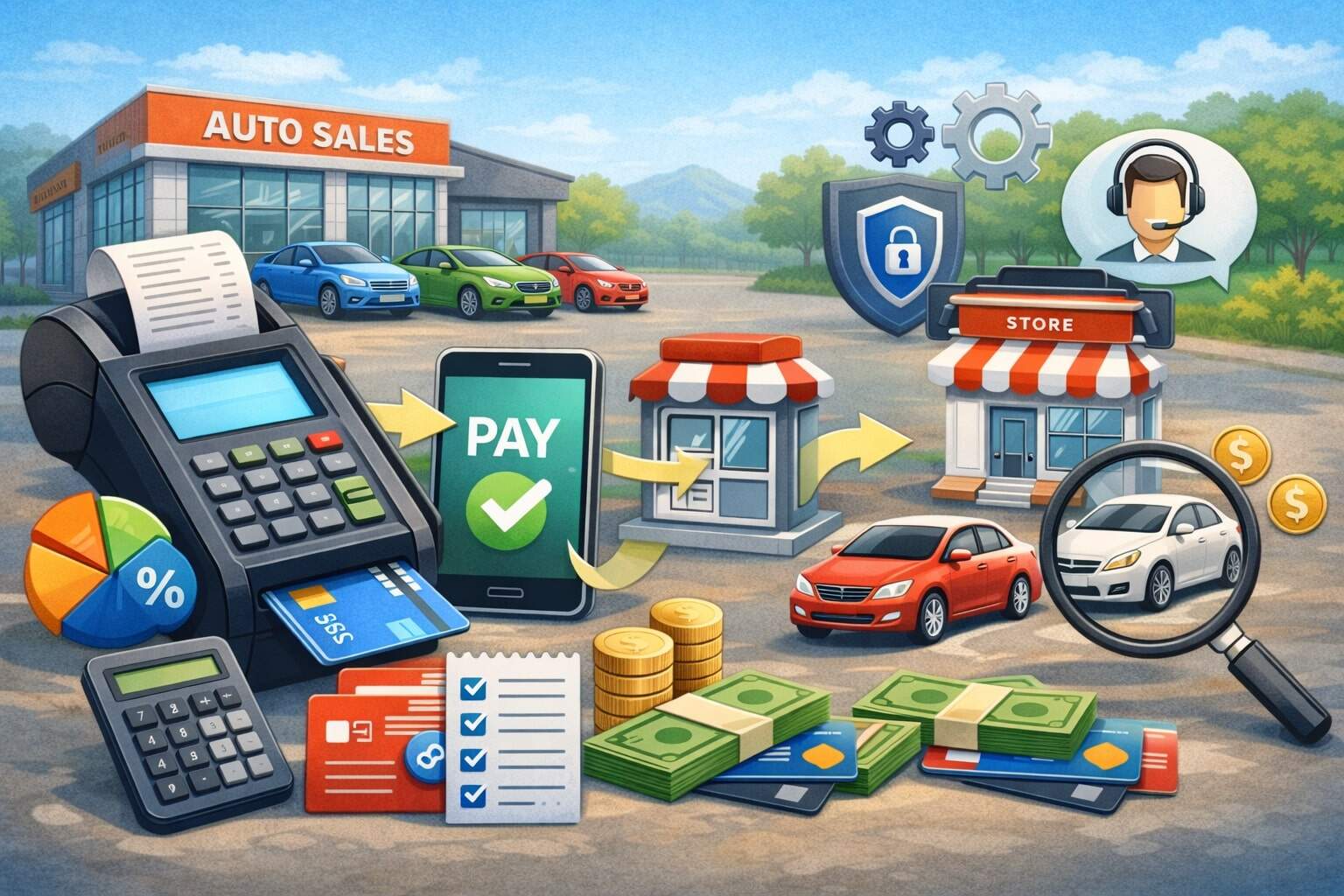
Independent dealers live and die by cash flow, approvals, and customer experience. The right auto merchant services stack turns messy, multi-step vehicle transactions into fast, trackable payments—without triggering avoidable chargebacks, funding delays, or compliance headaches.
This guide breaks down how Auto Merchant Services for Independent Dealers should work in 2026: the payment methods you must support, the risk controls that keep approvals high, the compliance items dealers often miss, and where payments are headed next (instant rails, “pay-by-bank,” and more).
Along the way, you’ll see the practical decisions that help independent lots compete with larger groups—while keeping costs predictable and operations simple.
What “Auto Merchant Services” Means for Independent Dealers (and Why It’s Different)

Auto merchant services for an independent dealer is not just “card processing.” It’s an end-to-end payment ecosystem designed for high-ticket, mixed-tender transactions that usually include: a deposit, a down payment, a balance due, taxes/fees, aftermarket add-ons, warranty/service contracts, and sometimes recurring service payments.
Unlike typical retail, vehicle sales combine large ticket sizes, higher fraud exposure, and longer dispute windows. A customer may place a deposit today, finalize financing next week, and pick up the vehicle after a title or lender step clears.
This creates real operational risk if your auto merchant services provider can’t support split tenders, partial captures, strong documentation, and reliable reporting.
Independent dealers also face a unique pressure point: funding time. If you’re buying inventory at auction, paying floor plan expenses, or reinvesting quickly, a “holds-first” processor can choke growth.
The best Auto Merchant Services for Independent Dealers focuses on stable approvals and consistent payouts, but also equips you with tools to reduce disputes, verify buyers, and keep clean records for lenders, auditors, and tax time.
Finally, independent dealers often do more with less staff. So your auto merchant services must be simple: clean checkout flows, clear receipts, easy reconciliation, and an integration strategy that fits your CRM/DMS/accounting—even if you’re not running an enterprise dealership platform.
How Vehicle Transactions Really Flow: Deposits, Down Payments, Split Tenders, and Final Balance
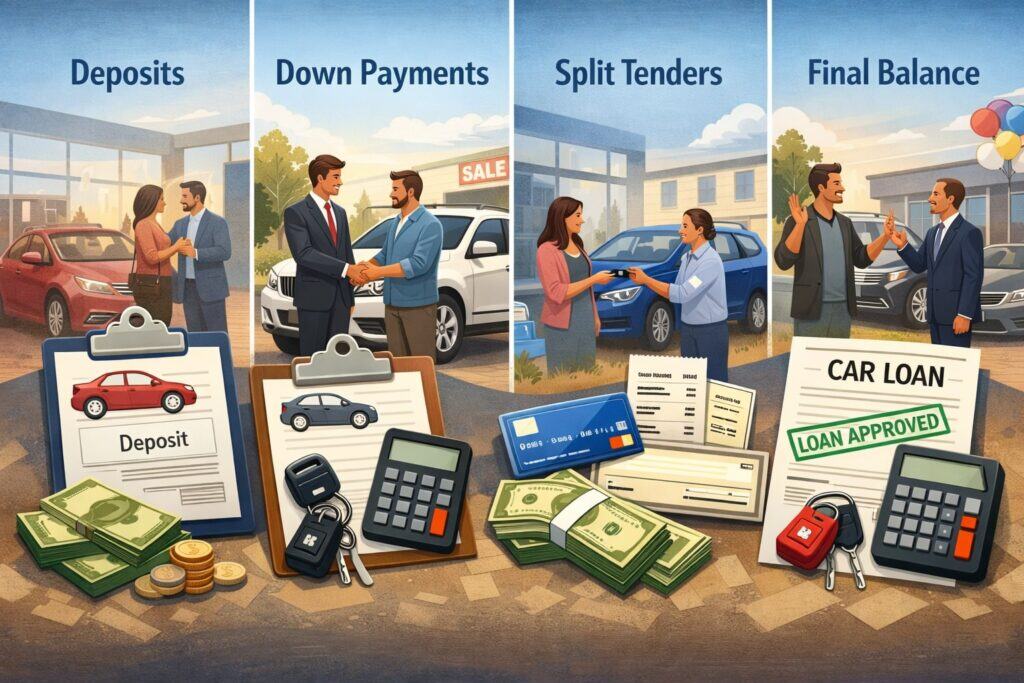
A strong auto merchant services setup mirrors how people actually buy vehicles. The most common structure is multi-stage:
- Reservation or deposit (often remote): holds the unit.
- Down payment: paid in-store or via secure link.
- Financed portion: handled via lender funding or ACH.
- Add-ons and fees: accessories, doc fee, warranty/service contract.
- Final balance due: paid at delivery or after conditions are met.
Independent dealers need split-tender flexibility because a customer may combine a debit card + cashier’s check + ACH, or pay part now and part later. If your processor treats each step as a brand-new transaction with poor linking, you’ll have a reconciliation mess and weaker dispute defense.
Your auto merchant services should support:
- Partial payments and multiple invoices tied to one deal
- Pre-authorization (where appropriate) vs. immediate capture
- Convenience-friendly pay links for remote steps
- Proper receipts that reference stock number/VIN (or at least an internal deal ID)
This is also where dealers lose money on preventable disputes. A clean flow includes buyer acknowledgments (refund terms, deposit conditions, “subject to financing”) and documentation stored with the payment record. That package becomes your chargeback armor if a customer later claims “service not provided” or “canceled transaction.”
Payment Methods Independent Dealers Should Offer in 2026 (Cards, ACH, Wires, Cash Alternatives, Instant Options)
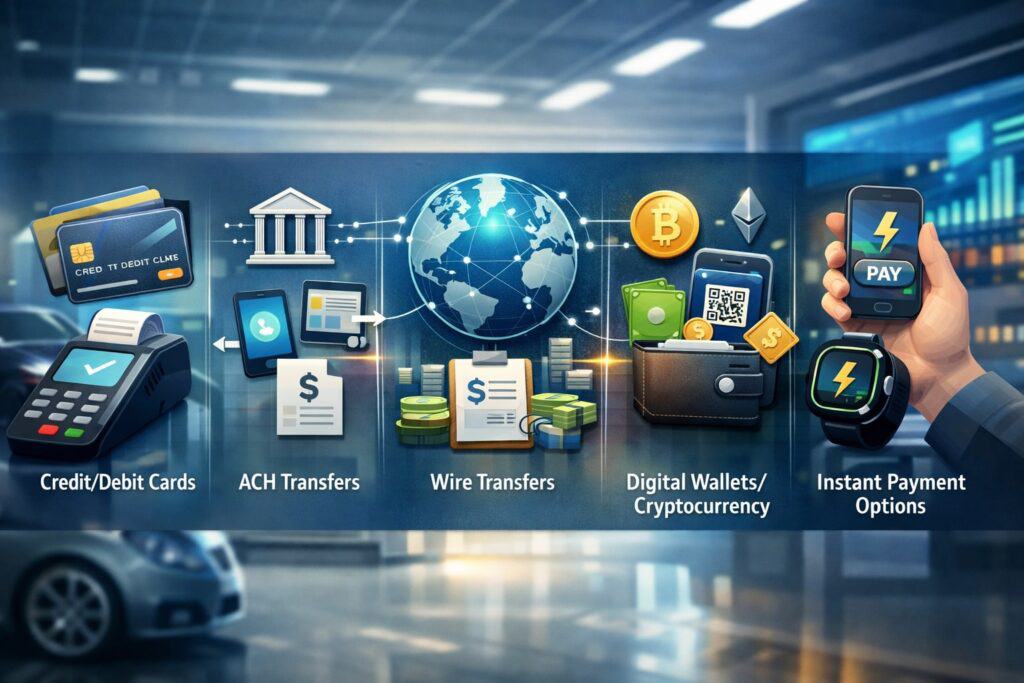
The best Auto Merchant Services for Independent Dealers is method-diverse, because your buyers have different comfort levels and limits.
Credit and debit cards
Cards are essential for speed and convenience, especially for deposits and smaller down payments. But they can carry higher processing costs and chargeback exposure for big-ticket items. Still, for many independent lots, cards close deals that might otherwise walk.
ACH and “pay-by-bank”
ACH is often the cost-effective option for larger amounts. It can be used for final balances, service contracts, and dealer-to-vendor payments.
ACH capabilities matter even more as networks evolve—Nacha is actively discussing raising the Same Day ACH per-entry limit from $1 million to $10 million, with a proposed effective date in 2027. This signals growing demand for larger, faster bank transfers.
Wires
Wires are still common for high-value purchases, especially out-of-area transactions. They’re harder to reverse than cards, but operationally heavier (bank visits, cutoffs, and confirmation steps).
Cash, cashier’s checks, and hybrid options
Cash and cashier’s checks remain common. Your auto merchant services strategy should still track them inside your deal system so your reporting reflects the total tender mix.
Instant rails and real-time payments
Real-time payments are becoming more relevant for dealers who want speed without card costs. FedNow continues to expand adoption and promotes 24x7x365 instant payments infrastructure.
Even if your bank isn’t fully enabled for every use case yet, planning your auto merchant services roadmap around instant settlement is increasingly smart.
Choosing the Right Merchant Account Setup: Aggregators vs. True Dealer Merchant Accounts

Independent dealers often start with “easy signup” payment apps. They’re convenient, but vehicle sales frequently trigger risk flags: high tickets, deposits, mismatched billing addresses, or card-not-present links. That can lead to sudden holds, rolling reserves, or account termination at the worst moment.
A more stable approach is a true merchant account underwritten for your dealership model—built specifically for auto merchant services use cases. The difference usually shows up in:
- Pricing transparency (interchange-plus vs. bundled)
- Stability (fewer surprise holds)
- Support for high tickets and split payments
- Chargeback tools and documentation workflows
- Integration options (virtual terminal, invoicing, API)
For Auto Merchant Services for Independent Dealers, underwriting alignment matters. A provider experienced with auto and inventory-based businesses can set realistic ticket and volume expectations, configure fraud tools properly, and help you adopt policies that reduce disputes without killing approvals.
If your business is scaling, or you sell higher-priced units, treating payments like “just another app” is a common mistake. What you want is predictable funding, a system that fits your sales flow, and risk controls that can be tuned—not a one-size-fits-all model.
Rates and Fees Dealers Actually Pay: Interchange, Markup, AVS, Chargebacks, and Hidden Costs
Most independent dealers care about “the rate,” but the real cost of auto merchant services is a bundle of line items:
Interchange + network assessments
Interchange varies by card type, rewards level, and whether the transaction is swiped, dipped, tapped, or keyed. Higher-risk conditions (keyed, card-not-present, no AVS match) often cost more and carry more dispute risk.
Processor markup
This is where providers differ most. Interchange-plus pricing makes it easier to compare. Flat-rate pricing can be okay for small deposits, but often becomes expensive as tickets rise.
AVS, gateway, and compliance fees
Address Verification Service (AVS) is useful for deposits and remote payments. Gateways, tokenization, and “PCI fees” may show up depending on the stack.
Chargeback costs
Chargebacks are not just “the refund.” You may pay chargeback fees, lose shipping/service costs, and spend staff time gathering evidence. Automotive disputes often hinge on documentation quality—so investing in a better workflow can cut costs more than shaving a few basis points off processing.
The best Auto Merchant Services for Independent Dealers approach is to align tender methods to deal stages: cards for deposits (and sometimes partial down payments), bank transfer rails for bigger amounts, and documentation everywhere. That mix typically lowers blended costs without harming conversion.
Chargeback and Dispute Prevention for Dealers: The Playbook That Works
Chargebacks are a fact of life, but dealers can dramatically reduce them with the right auto merchant services setup and process discipline. Many disputes stem from confusion, not pure fraud—unclear refund terms, disagreements about deposits, delays in delivery, or “I didn’t authorize this” claims from a spouse or family member.
A dealer-grade prevention playbook includes:
1) Clear, signed terms tied to the payment
For deposits, state whether the deposit is refundable, under what conditions, and how it applies to the deal. Store that acknowledgment with the payment record.
2) Strong descriptors and receipts
Your statement descriptor should match what customers recognize (your dealership name). Receipts should reference a deal ID and ideally stock number/VIN.
3) Evidence readiness
Maintain buyer ID verification, signed purchase documents, condition disclosures, and delivery confirmation. Automotive chargeback guidance frequently emphasizes documentation quality and process consistency as key defense tools.
4) Smart tender rules
Limit card down payments above certain thresholds, require chip/tap for larger in-person payments, and use ACH/wire for large balances.
5) Refund discipline
Refund the original tender when possible, document exceptions, and avoid “refund games” that trigger disputes.
The goal is not “zero chargebacks.” The goal is a system where disputes are rare, and when they happen, you can respond fast with clean evidence.
Fraud and High-Risk Controls: ID Verification, OFAC Basics, Velocity Rules, and Secure Pay Links
Independent dealers are a magnet for certain fraud patterns: stolen card deposits, synthetic identities, “remote buyer” scams, and chargebacks after vehicle pickup. A modern auto merchant services provider should support layered controls:
Identity verification
At minimum: government ID capture, address matching, phone/email verification, and consistent buyer information across the deal jacket and payment record. Some dealers add lightweight database checks or document verification tools.
Velocity and risk rules
Your system should flag:
- Multiple deposits from different cards for one buyer
- Multiple buyers using the same card
- Repeated declines followed by approval
- High-ticket card-not-present attempts
- Mismatched billing vs. delivery patterns
Secure payment links and tokenization
If you accept remote deposits, use pay links that:
- Expire
- Are tied to an invoice/deal ID
- Tokenize card data (so you don’t store it)
- Capture customer consent and receipt delivery
Compliance hygiene
Even basic checks matter more now because regulators and networks increasingly expect transparency and fair practices. While the FTC’s CARS Rule was ultimately vacated by a federal appeals court before it took effect, the push toward clearer pricing and disclosure in auto retail remains a practical expectation in the market.
Fraud prevention is not one tool. It’s a system: good underwriting, smart tender policy, strong receipts, and consistent deal documentation.
Compliance You Can’t Ignore: PCI DSS 4.0, Data Security, and Safer Payment Architecture
If your dealership touches card data the wrong way, your risk and liability jump. The safest path is to design auto merchant services so sensitive data never lives on your systems.
PCI DSS 4.0 realities
PCI DSS 4.0 introduced new requirements and had a transition window; many future-dated requirements became mandatory after March 31, 2025. For independent dealers, this matters because even “small” operations can be in scope if they key cards into unsecured devices, email card details, or store numbers in spreadsheets.
What “safe” looks like for dealers
- Use P2PE-capable terminals where possible
- Use hosted payment pages or tokenized pay links
- Restrict who can access the virtual terminal
- Turn on MFA and role-based access
- Keep devices patched and segmented from guest Wi-Fi
Why this helps your bottom line
Good PCI posture reduces breach risk, chargeback exposure, and processor scrutiny. It also makes underwriting smoother because your operation looks mature and controlled—exactly what stable Auto Merchant Services for Independent Dealers depends on.
Surcharging, Cash Discounting, and Dual Pricing: How Dealers Should Approach Fee Recovery
Many dealers want customers to cover processing costs. The challenge is doing it legally and in compliance with card network rules. A dealer should treat “fee recovery” as a policy project, not a quick switch.
Visa and Mastercard both maintain detailed requirements and caps for surcharging, including disclosure expectations and program rules. Some approaches are allowed in many states, but restrictions vary, and “junk fee” enforcement and state-level pricing transparency rules have increased scrutiny in recent years.
For independent dealers, the most sustainable options typically include:
Dual pricing (card price vs. cash price)
This is often clearer for consumers when done properly, because the displayed price aligns with the tender method. It can reduce surprise at checkout.
Cash discount programs
Instead of adding a surcharge, you offer a discount for cash-like tenders. This requires clean signage and consistent application.
Targeted policies by deal stage
Many dealers choose to absorb fees on deposits (for conversion) but steer larger amounts to ACH/wire.
Because rules vary and enforcement evolves, the best practice is to implement any surcharge/discount program with processor guidance and legal review, then train staff so the customer experience stays consistent.
POS, Virtual Terminals, Mobile, and Integrations: Building a Dealer-Ready Payments Stack
Independent dealers need tools that match how they work: on the lot, in the office, and often over the phone.
In-store terminals
Modern terminals support tap/chip and can reduce fraud compared to keyed entry. A good auto merchant services provider can also tune risk settings by ticket size and tender type.
Virtual terminals
Virtual terminals are essential for phone orders and remote buyers, but they increase risk. Your system should enforce permissions, log activity, and capture AVS/CVV where allowed.
Invoicing and pay links
Pay links that connect directly to a deal record simplify remote deposits and reduce sensitive data handling.
Integrations
The real win is clean reconciliation: matching payments to deals and deposits without manual spreadsheets. Whether you integrate with your CRM/DMS, accounting software, or a middleware tool, the goal is the same: fewer errors and faster month-end close.
In 2026, the edge goes to dealers who make buying easy without making risk worse. Strong Auto Merchant Services for Independent Dealers is as much about workflow design as it is about payments technology.
Funding Times and Cash Flow: Avoiding Holds, Reserves, and “Processor Shock”
Nothing frustrates a dealer faster than unexpected funding holds. They happen for predictable reasons: fast volume spikes, unusually large tickets, a high ratio of keyed transactions, elevated chargebacks, or unclear business documentation.
To keep funding stable, focus on:
Underwriting alignment
Be honest about your average ticket, max ticket, and monthly volume. A processor that underwrites you correctly is less likely to panic later.
Documentation and policies
Have written refund and deposit policies. Keep deal jackets clean. Document delivery and customer approvals. This reduces chargeback ratios and builds confidence.
Tender strategy
Use cards where they’re strongest (convenience, deposits). Use ACH/wire for larger balances. This reduces fee exposure and lowers dispute risk on the biggest dollars.
Monitoring and reporting
A strong auto merchant services portal should show chargeback trends, approval rates, and settlement reports in a dealer-friendly way.
Cash flow is the lifeblood of independent lots. Payments should accelerate it—not become the bottleneck.
Financing, Add-Ons, and Service Department Payments: Keeping Everything Consistent
Independent dealers often handle more than vehicle sales:
- Service and repair tickets
- Warranty/service contract down payments
- Accessories and aftermarket add-ons
- Buy-here-pay-here style recurring payments (where applicable)
Your auto merchant services should keep these flows consistent so your customer experience feels professional and your accounting stays clean.
For service, fast checkout matters, but so does dispute prevention: clear invoices, signed approvals, and accurate descriptors. For add-ons, avoid “surprise” charges by itemizing and confirming customer consent.
As regulatory attention has shifted over time, the practical message for dealers remains: transparency and good documentation reduce risk. Even though the FTC’s major auto retail rule effort was vacated, the broader direction of scrutiny around fees and disclosures continues through general consumer protection standards and state enforcement.
Future of Auto Merchant Services: Instant Settlement, “Payment Accounts,” and Smarter Risk Decisions
The next evolution of auto merchant services is about speed + certainty.
Instant payments become operationally meaningful
FedNow’s continued growth points to a world where more business payments settle instantly, including dealer disbursements and customer pay-ins. As instant rails mature, dealers can reduce reliance on cards for large amounts while still giving customers “it’s done” certainty.
Higher-value same-day ACH
Nacha’s proposal to increase Same Day ACH limits (with a proposed effective date in 2027) suggests bank-based payments will handle larger purchase scenarios more often. For dealers, this could mean more final balances paid via bank rails—faster than standard ACH, cheaper than cards.
New access models to payment infrastructure
The Federal Reserve has sought feedback on creating limited “payment accounts” that could give certain firms access to Fed payment services without full bank privileges. If initiatives like this progress, it could expand innovation in dealer-facing payment products and settlement options.
Smarter risk engines and better evidence automation
Expect more automated document capture, identity verification, and dispute evidence packaging inside dealer workflows. The winners will be independent dealers who treat payments as a system—where every transaction is easy, trackable, and defensible.
FAQs
Q1) What are auto merchant services for an independent dealer?
Answer: Auto merchant services are the tools and merchant account infrastructure that let dealers accept payments (cards, ACH, pay links, virtual terminal, and more), manage risk, and reconcile transactions across deposits, down payments, add-ons, and final balances.
For independent lots, the “right” setup is built for high tickets, split tenders, and strong documentation.
Q2) Should independent dealers accept credit cards for down payments?
Answer: Many do, but it depends on your risk tolerance and fee strategy. Cards are convenient for deposits and partial down payments, but larger card transactions increase costs and chargeback exposure.
A common best practice in Auto Merchant Services for Independent Dealers is to cap card amounts and use ACH/wire for big balances while keeping the customer experience smooth.
Q3) How can I reduce chargebacks at my dealership?
Answer: Use clear deposit/refund terms, match descriptors to your dealership name, store signed acknowledgments with the payment record, and keep a consistent deal jacket. Automotive chargeback defense improves dramatically when documentation is complete and easy to retrieve.
Q4) What does PCI compliance mean for car dealers in 2026?
Answer: It means designing your workflow so card data is protected and ideally never stored on your systems. PCI DSS 4.0 future-dated requirements became mandatory after March 31, 2025, so even smaller dealerships should ensure they’re using tokenized tools, secure terminals, and tight access controls.
Q5) Can I add a surcharge to cover card processing fees?
Answer: Sometimes, but it’s tightly regulated by state law and card network rules. Visa and Mastercard publish detailed surcharging requirements and caps. Many dealers consider dual pricing or cash discounting as alternatives, implemented carefully with proper disclosures.
Q6) What payment trends should dealers prepare for over the next few years?
Answer: Expect more bank-based instant payments and higher-value same-day transfers. FedNow adoption is expanding, supporting broader use of instant payments. Nacha is also considering higher Same Day ACH limits, potentially enabling larger fast bank payments.
Conclusion
The right Auto Merchant Services for Independent Dealers is a growth engine. It helps you close deals faster, get paid predictably, reduce disputes, and look more professional to buyers and partners.
Focus on fundamentals: payment flexibility (cards + bank rails), strong documentation, smart fraud controls, clean reconciliation, and security-first architecture aligned with modern PCI requirements.
Then build a tender strategy that fits vehicle sales reality—cards for convenience where appropriate, and cost-effective bank methods for larger amounts.
Looking ahead, dealer payments are moving toward instant settlement and smarter risk automation. With networks like FedNow expanding and new payment infrastructure ideas emerging, independent dealers who modernize their auto merchant services now will be positioned to compete harder, turn inventory faster, and protect margins—without sacrificing the customer experience.