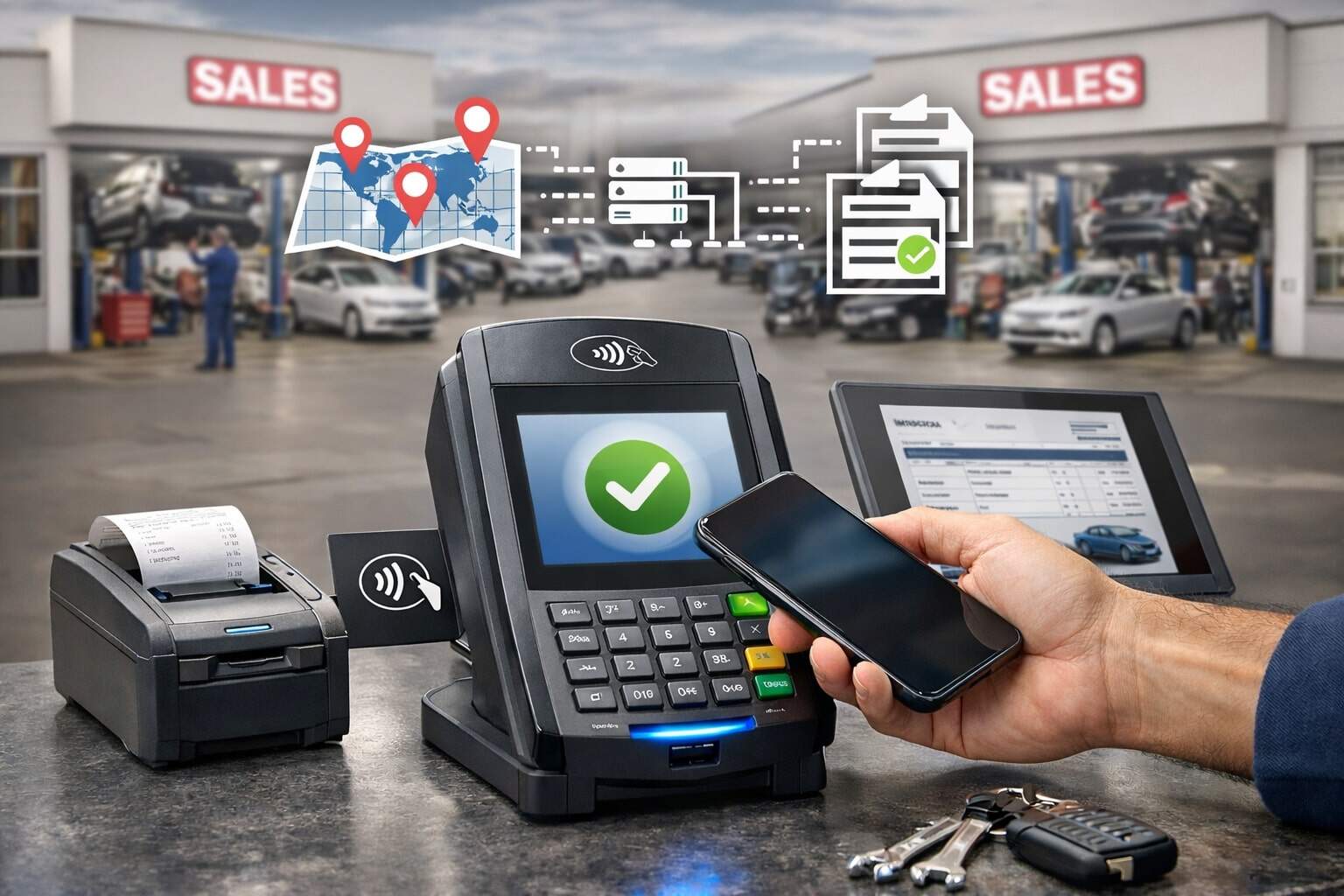
Running payments for a dealership group is not the same as running payments for a single retail store. Multi-location dealers handle larger average tickets, more payment types, more exceptions, and more risk—across sales, F&I, service, parts, body shop, and increasingly, online and remote transactions.
That’s why automotive merchant services has become a specialized category: it’s not just “credit card processing,” it’s an end-to-end payments strategy built around dealership workflows, compliance, reporting, and customer experience.
For multi-location dealers, automotive merchant services should do four things consistently: (1) accept payments anywhere customers want to pay, (2) reduce fraud and chargeback exposure without killing approvals, (3) simplify reconciliation across rooftops and departments, and (4) improve cash flow while staying compliant with card network rules and evolving security standards.
When the system works, customers get a seamless checkout, managers get clean reporting, and accounting gets predictable settlement and fee visibility.
This guide breaks down how automotive merchant services works for dealer groups, what to prioritize, how to evaluate providers, and where payments are heading next—so you can build a setup that scales with new rooftops, new sales channels, and new customer expectations.
Why Automotive Merchant Services Is Different for Multi-Location Dealers
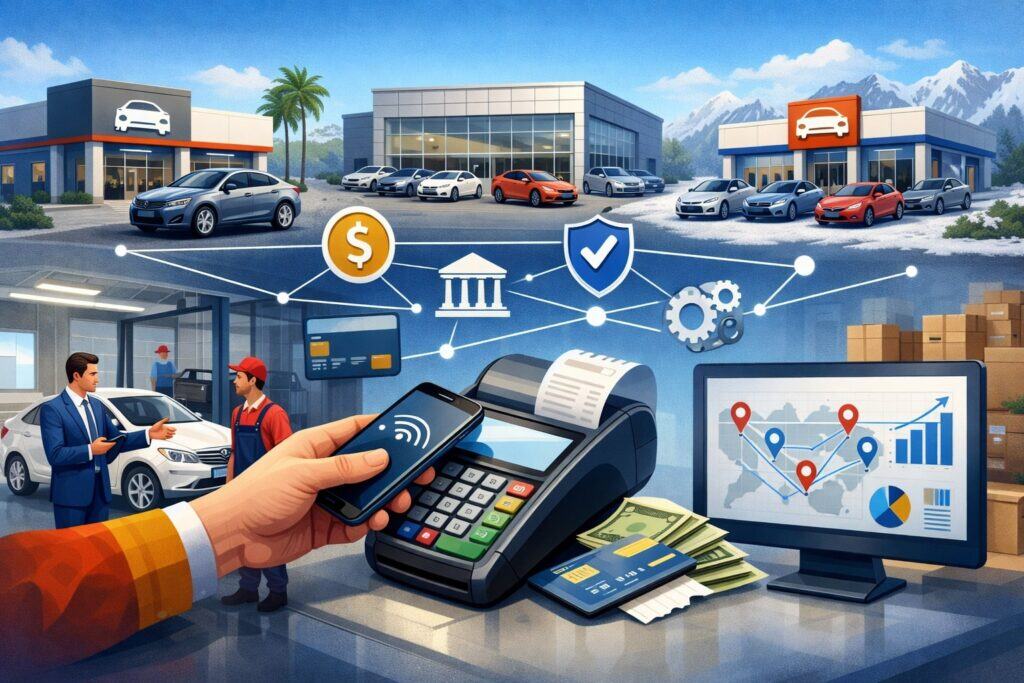
Multi-location dealers operate like a mini-economy. One rooftop may have different customer demographics, average tickets, and payment behaviors than another. One store might run heavy service lane volume; another might be primarily sales-driven.
Yet your payment stack needs to behave consistently across the group. The best automotive merchant services approach is built for standardization with flexible controls—so you can enforce policies centrally, while still letting each location operate efficiently.
Dealership payments also sit at the crossroads of multiple risk categories. High tickets can trigger issuer declines, fraud filters, or delayed funding.
Card-not-present payments (phone, online, pay-by-link) introduce higher dispute and fraud risk. Even legitimate scenarios—like a customer paying multiple deposits, switching cards, or splitting payments between spouses—can look suspicious to banks if you don’t structure transactions and data correctly.
Strong automotive merchant services isn’t about blocking payments; it’s about designing flows that keep approvals high while reducing preventable loss.
On top of that, multi-location dealers need to manage permissions and accountability. Service advisors, parts counters, and F&I managers should not all have the same access.
Role-based controls, audit logs, and consistent device management are not “nice-to-haves” in automotive merchant services—they’re operational necessities when you have multiple rooftops, staff turnover, and multiple departments touching money.
Finally, dealer groups can’t afford fragmented reporting. If every rooftop has a different processor statement format, different batch times, and different fee categories, reconciliation becomes a recurring monthly fire drill.
The real win in automotive merchant services is when finance and ops can see every payment—by rooftop, department, tender type, and channel—without manual cleanup.
Dealership Ticket Size, Approval Rates, and Customer Payment Behavior
Large tickets change everything. A $6,000 service repair or a $10,000 down payment behaves differently than a $25 retail purchase. Issuers apply different risk logic, and the way you present and sequence transactions can influence approval rates.
A high-performing automotive merchant services setup accounts for this with the right mix of payment methods (cards, ACH, instant bank payments, financing-related flows), smart transaction descriptors, and consistent identity signals.
Customer behavior in dealerships is also uniquely mixed. Some customers want to tap-to-pay quickly in the service lane. Others want to pay a deposit online after hours. Some will only pay by bank transfer for larger amounts.
Multi-location dealers need automotive merchant services that support all of these scenarios without forcing staff into workarounds that create errors and disputes. Approval optimization matters because “declined” doesn’t always mean “no money.” It often means “wrong timing,” “wrong data,” or “wrong method.”
For example, attempting a large card transaction without appropriate customer verification, or without using the best channel for that situation, can create unnecessary declines. The right automotive merchant services partner will help you tune the payment flow so approvals remain strong while risk controls remain defensible.
The best dealer groups treat payment acceptance as part of the customer experience. Quick, reliable checkout improves CSI scores and reduces friction at delivery. In service, it shortens the wait at pickup, helps advisors close recommended work, and reduces post-repair billing issues. That is why modern automotive merchant services are as much about experience and process as it is about fees.
Multi-Rooftop Operational Complexity and Standardization
As rooftops scale, payment inconsistency becomes expensive. One location might allow phone payments without documented authorization. Another might store card details incorrectly. A third might have staff using personal devices for payment links. These inconsistencies create compliance exposure, fraud vulnerability, and reconciliation mess.
A strong automotive merchant services strategy standardizes:
- Approved payment channels (in-person, pay-by-link, virtual terminal, invoice, recurring where applicable)
- Verification steps for card-not-present and high-ticket transactions
- Refund and void policies
- Batch timing and settlement expectations
- Role-based permissions and device controls
- Reporting formats across rooftops
Standardization doesn’t mean making every location identical. It means defining guardrails and shared best practices so every rooftop runs the same “playbook.”
For example, service lanes may need fast mobile acceptance and digital receipts, while F&I needs secure, auditable workflows with strong identity checks. The goal is a consistent payments foundation with configurable department-level workflows—exactly what dealer-grade automotive merchant services should deliver.
A multi-location mindset also requires vendor portability. Rooftops change. Acquisitions happen. Systems get replaced. Your payments stack should let you onboard a new location quickly, add devices fast, and map reporting into the same group-wide structure.
When automotive merchant services are built for scale, adding a rooftop feels like adding a user—not rebuilding an infrastructure.
Core Payment Acceptance Needs Across the Dealership

Dealer groups don’t run one business; they run multiple businesses under one brand. Sales, F&I, service, and parts each have different payment patterns, risk profiles, and operational constraints.
The best automotive merchant services setup supports each department’s realities while keeping management reporting unified across the group.
A practical approach is to define “where money moves” in each department and design acceptance accordingly. In-person payments should be fast, secure, and consistent. Remote payments should be controlled, documented, and optimized for approvals.
Large payments should have alternative rails available to reduce card costs and issuer friction. Refunds should be streamlined but auditable. And every payment should be attributable to a rooftop, department, user, and transaction context.
Most importantly, dealership payments now extend beyond the physical store. Customers expect online deposits, text-to-pay, email invoice links, and digital delivery experiences. That means automotive merchant services must support omnichannel acceptance without creating data silos.
Showroom and F&I Payments
Sales and F&I payments often include deposits, down payments, aftermarket products, document fees, and occasionally service contracts or protection packages.
These are high-scrutiny transactions because they can be high-dollar and occasionally disputed. A robust automotive merchant services solution supports secure in-person EMV transactions for delivery day, plus controlled remote options for customers who pay before arrival.
In F&I, documentation matters. Disputes are less likely when customers receive clear receipts, itemized descriptions, and consistent descriptors.
Your automotive merchant services provider should support customized descriptors and receipt fields that match your dealership brand and transaction context. It should also support secure payment capture methods that reduce staff handling of sensitive data.
Operationally, sales and F&I teams need speed without bypassing controls. That’s where role-based tools help: for example, allowing an F&I manager to initiate a pay-by-link with built-in expiration and audit logging, while restricting who can issue refunds or override risk settings. This kind of control is a key differentiator in dealer-focused automotive merchant services.
Finally, multi-location dealers should plan for edge cases: split tender across multiple cards, spouse payments, deposits followed by larger payments, and refunds after deal unwinds. A good automotive merchant services setup handles these smoothly while keeping reconciliation clean and approvals high.
Service Lane and Parts Counter Payments
Service and parts are volume-driven and time-sensitive. Advisors want customers in and out quickly, especially during pickup rushes. Parts counters need speed and accuracy, often with repeat customers and commercial accounts.
Here, automotive merchant services should emphasize low-friction acceptance (tap, chip, mobile) and quick receipts—while still supporting higher-risk scenarios like keyed entry or phone payments with strong controls.
Service also introduces complexity like pre-authorizations, estimates that change, supplements, and partial payments. Your payment workflow should align with how repair orders (ROs) actually behave.
That’s why many dealer groups prioritize integrated or semi-integrated payments that align the payment record to the RO, rather than relying on standalone terminals that create manual matching.
Service fraud patterns are also different. Stolen cards may be used for repairs; friendly fraud may appear when a customer disputes a repair charge; and chargebacks can spike when documentation is weak.
Strong automotive merchant services support better documentation (digital receipts, clear line items, optional signatures where appropriate) and better controls for high-risk transactions.
For parts, commercial accounts may prefer ACH or invoice-based workflows. The more your automotive merchant services support bank payments and structured invoicing, the more you can reduce card costs while improving cash flow and customer satisfaction.
Online, Phone, and Remote Payments
Remote payments are now standard in dealership operations: online deposits, text-to-pay links, phone payments, service invoice links, and remote delivery payments. These are convenient, but they raise risk because card-not-present transactions generally carry higher fraud and dispute exposure.
Dealer-grade automotive merchant services should offer remote payment tools that reduce risk and improve auditability:
- Pay-by-link with expiration, tracking, and customer identity signals
- Hosted payment pages that keep sensitive data out of dealership systems
- Virtual terminals with role-based access and strong logging
- Automated receipts and customer confirmations
- Clear authorization language for remote payments
The goal is to reduce “manual card handling,” because manual handling increases both PCI exposure and error rates. When customers can self-enter details through secure links, you reduce risk and improve customer experience at the same time.
Multi-location dealers also need consistent remote-payment policies. One rooftop allowing ad-hoc text links from personal phones creates a compliance nightmare. Proper automotive merchant services enable approved, branded communication methods and keep all payments visible inside one reporting and reconciliation environment.
Choosing the Right Processing Model for Dealer Groups

Not all payments architectures fit dealerships. The right choice depends on whether you prioritize deep integration, rapid deployment, risk controls, or omnichannel flexibility. Most multi-location dealers end up with a blended model: integrated for service and parts, plus secure gateway tools for online and remote payments, all under one reporting umbrella.
At a high level, you’ll see three approaches:
- Fully integrated payments tied directly to your dealership systems
- Semi-integrated solutions that reduce PCI scope while still linking transactions to orders
- Gateway-driven online and remote payment tools for customer self-pay
The best automotive merchant services strategy uses the right model in each department, while keeping consistency across rooftops. This prevents the common problem of “five different payment systems,” which leads to higher support cost and fragmented reporting.
Integrated Payments with Dealer Systems
Integrated payments aim to connect payments to operational data—such as repair orders, invoices, and customer records. This can reduce manual reconciliation and improve reporting accuracy. For multi-location dealers, integration can also standardize workflows across rooftops and departments.
The advantage of integrated automotive merchant services is operational discipline. When advisors process payments through a connected workflow, it’s easier to ensure each payment is attributed correctly. It also reduces the “sticky note” problem, where staff tries to manually match terminal receipts to ROs after the fact.
However, integration should be evaluated carefully. Not all integrations are equal. Some are “reporting-only.” Some support only certain transaction types. Some limit device choices. The best integrated automotive merchant services approach supports:
- Multiple departments and tender types
- Partial payments and refunds tied to the right record
- Unified customer and invoice history
- Reliable uptime and support escalation
Dealer groups should also consider integration portability. If you change systems or acquire new rooftops with different setups, you don’t want to rebuild your entire payments operation from scratch. Strong automotive merchant services integration is designed to scale and adapt.
Semi-Integrated and Tokenized Payments for PCI Reduction
Semi-integrated solutions typically keep card data out of dealership systems by using a secure device or hosted entry page, while still passing transaction details back to your systems. This is often a practical middle ground for multi-location dealers because it reduces PCI exposure while still improving reconciliation.
Tokenization is central here. Instead of storing card numbers, the system stores tokens that can be used for authorized follow-up payments or refunds. That supports safer workflows for deposits, delayed captures, and certain recurring scenarios.
It also supports cleaner dispute management because you can reference consistent transaction identifiers without exposing sensitive data.
With evolving PCI requirements, reducing your “card data footprint” matters. PCI DSS v4.x introduces future-dated requirements that became mandatory on March 31, 2025, pushing many organizations to upgrade authentication, logging, and security practices.
A dealer-grade automotive merchant services setup that minimizes sensitive data handling makes compliance simpler and reduces the likelihood of costly remediation.
For dealer groups, semi-integration also improves operational consistency. You can deploy the same payment experience across rooftops even if some back-end systems differ, as long as reporting can be unified.
Gateway-First for Omnichannel and Remote Transactions
A gateway-first approach focuses on secure online and remote acceptance: hosted checkout pages, pay-by-link, invoicing, and API-driven acceptance. Dealer groups increasingly need this because customer expectations are changing.
People want to place deposits from their phone, pay service invoices without waiting on hold, and complete transactions outside business hours.
The key with gateway-driven automotive merchant services is governance. You need consistent templates, approved workflows, and controlled user access. The gateway should provide:
- Branded payment pages
- Payment links tied to invoices or ROs
- Limits and expiration rules
- Detailed audit logs
- Centralized reporting across rooftops
It should also support stored credential compliance when you store tokens for future use, including clear transaction indicators and customer authorization. Visa and others publish guidance around credential-on-file frameworks to identify initial storage and subsequent use, which helps authorization performance when implemented correctly.
For multi-location dealers, a gateway-first layer often becomes the “standard remote payment platform” while in-store devices handle day-to-day counter payments. The best automotive merchant services providers unify both under one merchant relationship and one reporting environment.
Compliance, Security, and Risk Management for Dealer Payments

In dealerships, risk isn’t theoretical—it shows up as chargebacks, fraud loss, compliance findings, and delayed funding. Multi-location dealers need a risk program that’s designed for both in-person and remote payments.
The strongest automotive merchant services approach combines secure technology, repeatable processes, and staff training that matches real-world dealer workflows.
Your baseline is PCI compliance and secure device management. From there, you build processes for high-ticket verification, remote payment authorization, refund controls, and chargeback response.
Dealer groups should also consider how legal and regulatory changes affect disclosures and consumer transparency expectations, even when a specific rule is delayed or struck down.
PCI DSS v4.x and What Changed for Dealerships
PCI DSS v4.x introduces expanded expectations around authentication, monitoring, and secure practices, and future-dated requirements became mandatory on March 31, 2025. For dealerships, the practical takeaway is simple: the more you can reduce where card data flows, the easier compliance becomes.
A dealer-focused automotive merchant services provider can help by:
- Using P2PE-capable or securely managed devices where appropriate
- Offering hosted payment pages for remote payments
- Tokenizing stored payment data rather than storing card numbers
- Centralizing device control, updates, and replacement workflows
- Providing compliance support resources and clear responsibility boundaries
Multi-location dealers should also standardize internal controls: who can key-enter card data, who can issue refunds, and how receipts are stored. Many compliance problems in dealerships are process problems, not technology problems.
Finally, treat PCI as an ongoing program, not a once-a-year event. Dealer groups with multiple rooftops often benefit from a quarterly checklist: device inventory, user access review, security patch verification, and incident response readiness. Strong automotive merchant services should support these routines, not complicate them.
Chargebacks, Disputes, and Documentation that Actually Works
Chargebacks in dealership contexts often come from misunderstandings, weak documentation, or remote-payment ambiguity. In service, disputes can happen when customers don’t recognize the descriptor or feel the repair was not authorized. In sales, disputes may arise from deposits, cancellations, or confusion about what a payment covers.
The best automotive merchant services defense is proactive clarity:
- Use descriptors that customers recognize
- Provide itemized receipts or references (RO number, invoice number)
- Confirm remote payments with written authorization language
- Maintain clear refund and cancellation policies
- Train staff on what to capture when a customer disputes
Multi-location dealers should create standardized dispute packets: proof of authorization, receipts, repair order details, signed work approvals, communication logs, and delivery confirmations. When every rooftop handles disputes differently, your win rate drops and your labor cost rises.
Risk controls should be tuned for dealership reality. Overly aggressive fraud filters can reduce approvals and frustrate legitimate customers. Underpowered controls invite preventable fraud.
Dealer-grade automotive merchant services help you find the balance by using consistent verification flows for high-ticket and card-not-present scenarios, while keeping in-person EMV acceptance fast and frictionless.
Stored Credentials, Recurring Payments, and Safer Token Use
Many dealerships store payment credentials for convenience—service memberships, recurring maintenance plans, repeat commercial parts buyers, or delayed billing scenarios.
When you store payment credentials, you need to follow network expectations for identifying the initial storage and subsequent use, and for properly flagging transaction types (customer-initiated vs merchant-initiated).
Guidance around stored credential frameworks is designed to reduce confusion for issuers and improve approvals when done correctly.
From a dealership operations perspective, the safest approach is:
- Use tokenization, not raw card storage
- Capture clear customer consent for storage and future charges
- Provide easy cancellation paths for recurring arrangements
- Keep audit logs for who initiated charges and when
For multi-location dealers, centralized control matters. If each rooftop stores tokens in different systems, you create a security and operational nightmare. A unified automotive merchant services platform can standardize token handling and make compliance more defensible.
Stored credentials are also about customer trust. The more transparent you are about why you’re storing a payment method and how it will be used, the fewer disputes and angry calls you’ll get later.
Pricing, Interchange, and Cost-Control Strategies for Dealer Groups
Dealer groups feel processing costs more intensely because volume is high and tickets are large. Yet “cheapest rate” is rarely the best outcome in automotive merchant services. The right goal is predictable total cost, high approval rates, low disputes, clean reconciliation, and strong support.
A cost-control strategy starts with choosing the right pricing model and then improving how payments are routed—meaning: using the best tender for the situation. Card acceptance is essential, but it shouldn’t be the only tool. Bank payments, instant payments, and invoice-based flows can reduce cost for large amounts when used appropriately.
Multi-location dealers should also track costs at the right level: by rooftop, department, tender type, and channel. That’s the only way to stop cross-subsidization, where a high-risk workflow in one department quietly increases costs for the entire group.
Interchange-Plus, Flat Rate, and What Dealers Should Prefer
Most established dealer groups prefer interchange-plus pricing because it is more transparent and scalable. Flat-rate pricing can look simple, but it may be expensive for high-ticket environments and can hide fee structures that are hard to reconcile across multiple rooftops.
In evaluating automotive merchant services, focus on:
- Effective rate across all channels (in-person, online, keyed)
- Chargeback and retrieval fees
- Monthly, gateway, and device fees
- Batch timing and settlement practices
- Cross-rooftop statement consistency
Processing costs also depend on transaction quality. EMV and contactless generally reduce fraud exposure compared to keyed or card-not-present. That means your operational behavior can influence your effective cost over time.
The best automotive merchant services partner helps you reduce avoidable keyed entry and migrate remote payments to secure customer-entered flows.
Finally, be careful about “too good to be true” pricing that relies on aggressive downgrades, hidden non-qualified tiers, or high ancillary fees. Multi-location dealers need stability and clarity more than gimmicks.
Surcharging vs Cash Discounting: Rules, Risks, and Dealer Best Practices
Some dealerships consider passing processing costs to customers. This is sensitive territory and must be done carefully. Card networks allow surcharging in many cases, but there are strict rules and state-level limitations.
Visa’s guidance notes that surcharging applies only to credit transactions in the U.S. and territories and requires notice to the acquirer in advance; it also identifies states that prohibit or limit surcharging. Mastercard similarly requires advance notice and outlines caps tied to the merchant’s discount rate and disclosure expectations.
From a dealership standpoint, surcharging can create customer friction—especially in high-ticket contexts. Customers may perceive it as a surprise fee unless disclosures are extremely clear. Multi-location dealers should also consider brand consistency: if only some rooftops surcharge, customer complaints and reputation issues can follow.
Cash discounting is different from surcharging and is often implemented by posting a “cash price” and offering a discount for cash or other non-card methods.
The compliance and consumer perception implications differ, and dealer groups should use legal counsel and a knowledgeable automotive merchant services partner before rolling either approach across multiple rooftops.
If you do implement a cost-recovery strategy, the best practice is to:
- Use consistent signage and written disclosures
- Ensure receipts clearly show the fee/discount logic
- Train staff on how to explain it without sounding defensive
- Monitor customer complaints and dispute trends carefully
In dealer groups, the real savings often come not from surcharging, but from offering alternative rails for large payments and reducing manual exceptions.
Reconciliation and Fee Visibility Across Rooftops
Dealer groups lose money in reconciliation inefficiency—missed batches, mismatched terminals, unclear fee categories, and manual data entry. Your automotive merchant services provider should offer unified reporting that supports:
- Rooftop and department-level settlement views
- User and device tracking
- Chargeback and retrieval tracking
- Fee categorization that remains consistent across locations
- Export formats that match your accounting workflow
A high-quality setup also supports “exception management.” If a batch is out of balance, you should see it quickly. If refunds spike at one rooftop, you should spot it. If keyed transactions increase, you should know who is doing them and why.
Multi-location dealers should build a monthly payments scorecard. Not just total volume—but approvals, declines by reason, chargebacks, average ticket by channel, and fee trends. The best automotive merchant services approach turns payments data into operational insight, not just a monthly statement.
Funding, Cash Flow, and Bank Payment Rails Dealers Should Use
Cash flow is the heartbeat of dealership operations. Funding delays affect payroll, floorplan planning, vendor payments, and daily decision-making. Multi-location dealers should treat funding strategy as part of automotive merchant services, not a separate issue.
The modern dealer payment stack should include multiple rails:
- Cards for convenience and speed
- ACH for larger payments and lower cost where appropriate
- Instant payments were supported to improve speed and certainty
- Controlled remote-payment options to reduce manual friction
When you diversify rails, you also diversify risk. If card funding is delayed, bank payments can keep the machine moving. If a customer’s issuer declines a high-ticket card, ACH or instant payments can close the gap without losing the sale.
ACH for Deposits, Down Payments, and Service Invoices
ACH is often a strong fit for large-dollar, lower-margin transactions where card fees are painful. It can be useful for deposits, down payments, service invoices, and commercial parts accounts—especially when customers already prefer bank transfer for bigger amounts.
However, ACH brings its own rule framework and fraud considerations. The Nacha Operating Rules are the foundation of ACH operations and are updated over time, with changes published by effective date.
In recent updates, the industry has emphasized fraud monitoring and controls for certain online debit activity; some rule updates describe phased effective dates for origination fraud monitoring in 2026.
For multi-location dealers, the practical playbook is:
- Use bank payments for large invoices where the customer relationship is strong
- Use authenticated, customer-entered bank payment flows when possible
- Avoid informal “email me your routing number” practices
- Document authorization clearly for recurring or delayed bank debits
When implemented correctly, ACH can reduce cost and improve cash flow predictability—making it a valuable component of automotive merchant services.
Instant Payments and What FedNow Means for Dealers
Instant payments are becoming more relevant for businesses that want speed, certainty, and 24/7 settlement. The Federal Reserve launched the FedNow Service in July 2023, and the Fed has highlighted ongoing growth and new use cases as adoption expands.
For dealerships, instant payments could reshape a few areas over time:
- Faster customer payments for deposits and invoices
- Faster payouts in certain scenarios (rebates, refunds, insurance-related flows)
- Better weekend and after-hours cash flow compared to traditional bank cutoff times
That said, adoption varies by financial institution and customer readiness. The best automotive merchant services strategy treats instant payments as an emerging capability, not the only plan.
Dealer groups should ask their payments partner whether they support modern bank rails, whether settlement can be unified into reporting, and how they handle disputes, returns, and reconciliation.
Over the next few years, expect dealer groups to increasingly offer customers “pay by bank instantly” options alongside cards—especially for larger amounts where customers want to avoid card limits or where dealers want to reduce card fees. FedNow’s continued development and broader industry adoption supports that direction.
Hardware, Software, and Modern In-Lane Payment Experiences
Customer expectations are shaped by everyday retail experiences. People now expect tap-to-pay, digital receipts, and fast checkout. Dealers that still rely heavily on outdated terminals or manual key-entry create unnecessary friction—especially in service pickup and parts.
Multi-location dealers should treat device strategy as a key part of automotive merchant services. That includes countertop terminals, mobile devices for service lanes, and secure tools for remote acceptance. It also includes device management: inventory tracking, replacements, updates, and consistent configuration across rooftops.
EMV, Contactless, and Mobile Acceptance in Service and Parts
EMV chip acceptance is baseline. Contactless (NFC) is now a customer expectation, especially for quick service pickup. Mobile acceptance can reduce bottlenecks during rush hours and improve advisor productivity.
A dealer-grade automotive merchant services setup emphasizes:
- Contactless-ready devices everywhere customers pay
- Mobile devices for service lanes with secure management and role-based access
- Fast receipt delivery via email/text
- Consistent tipping/fee settings where applicable (for certain service contexts)
Mobile and contactless acceptance can also reduce fraud exposure compared to manual key-entry. The more you can keep transactions in secure, modern acceptance modes, the fewer exceptions you deal with later.
Multi-location dealers should also standardize how devices are named and assigned in the system so reporting remains clean. If you have ten rooftops and each has “Terminal 1,” reconciliation becomes harder than it needs to be. Strong automotive merchant services include disciplined device labeling and reporting structure.
Device Management, Staff Turnover, and Operational Controls
Dealerships have staff turnover. Devices get moved. Advisors swap shifts. Without strong controls, payment tools become a weak point.
Dealer groups should prioritize:
- Role-based permissions (who can refund, void, key-enter, create payment links)
- User-specific logins instead of shared credentials
- Audit logs for every action
- Remote device disablement for lost or stolen devices
- Standardized onboarding/offboarding workflows
These controls are not just about security; they’re about accountability and clean operations. If a refund is issued incorrectly, you want to know who did it and why. If one rooftop’s keyed entry spikes, you want to identify the behavior quickly.
The best automotive merchant services partner supports these operational realities with tools and training, not just hardware drop-shipping.
Multi-Location Reporting and Accounting That Doesn’t Break at Scale
Dealer groups win when accounting is boring. Clean settlements, consistent fee categories, and predictable exports reduce labor and reduce errors. Payments should not be a recurring monthly reconciliation crisis.
The reporting layer of automotive merchant services should unify:
- All rooftops
- All departments
- All payment channels
- Chargebacks and disputes
- Fees and funding events
This is where many providers fall short. They can process transactions, but they can’t provide dealership-grade visibility and control across a group.
Centralized Settlement Views with Rooftop and Department Breakdown
You should be able to answer these questions in minutes, not days:
- Which rooftops have the highest effective cost and why?
- Which department is generating the most chargebacks?
- Which users are key-entering transactions and at what rate?
- What’s the approval rate by channel (in-person vs remote)?
- Are refunds aligned with policy?
The right automotive merchant services reporting includes filters by rooftop, MID (merchant ID), department, device, user, and tender type. It also includes consistent naming conventions and export formats that can feed your ERP or accounting system reliably.
Multi-location dealers should also ensure settlement timing is consistent. If some rooftops batch automatically and others batch manually, you get unpredictable funding and reconciliation chaos. Standardization is a major benefit of unified automotive merchant services.
GL Mapping, Exception Handling, and Audit Readiness
Accounting needs predictable mapping: which payment types map to which GL accounts, how fees are categorized, and how refunds/chargebacks appear in reports. The more consistent this is, the fewer manual journal entries you need.
A strong dealer-group setup supports:
- Department-level mapping (service vs parts vs sales)
- Fee visibility by category (processing vs gateway vs device)
- Clear audit trails for adjustments, chargebacks, and reversals
- Exceptions reports for mismatched batches or unusual activity
Audit readiness matters because payment disputes, vendor disputes, and compliance reviews happen. If you can produce clean evidence quickly—receipts, logs, authorization records—your operational risk drops.
At scale, the difference between “good enough” and “dealer-grade” automotive merchant services is often the reporting and audit experience, not the swipe itself.
Implementation Roadmap for Multi-Location Dealer Groups
Rolling out payments across multiple rooftops is a project, not a purchase. The biggest failures happen when dealers treat automotive merchant services like plugging in a terminal. The best outcomes come from structured rollout: discovery, pilot, training, standardization, and then scaling.
A good provider will help you plan the deployment to minimize downtime, reduce staff confusion, and preserve reporting consistency from day one.
Discovery, Workflow Mapping, and Risk Policy Design
Start by mapping how each department accepts payments today:
- Sales deposits and down payments
- Service estimates and final invoices
- Parts invoices and commercial accounts
- Remote payments and phone payments
- Refund and adjustment policies
Then define your target state. Decide which transactions should move to customer-entered payment links, which should be in-person EMV, which should be bank payments, and where tokens or stored credentials are appropriate.
This is where multi-location dealers create their payment policy playbook. A strong automotive merchant services partner will help you define:
- High-ticket verification steps
- When keyed entry is allowed (and when it is not)
- Refund permissions and approval thresholds
- Chargeback response workflows
- Device and user management standards
A clear playbook prevents the “every rooftop does it differently” problem that creates risk and reconciliation headaches.
Pilot, Rollout, Training, and Ongoing Optimization
A smart rollout uses a pilot rooftop first—ideally one that represents typical volume and complexity. Use the pilot to test:
- Device performance and uptime
- Integration behavior and reporting accuracy
- Funding timing and reconciliation exports
- Staff training needs and common errors
- Remote payment workflows and customer experience
Then roll out in waves. Multi-location dealers should avoid “big bang” deployments unless the provider has proven capacity and your internal team is ready.
Training should be role-based. Advisors need fast, practical steps. Managers need controls and exception handling. Accounting needs exports and fee logic. Security needs device control and audit trails. Dealer-grade automotive merchant services providers deliver training materials that match each role, not one generic PDF.
Optimization is ongoing. Review approval rates, disputes, and keyed entry trends monthly. Tune policies, improve staff behavior, and expand bank payment options where it makes sense.
Regulatory and Industry Signals Dealers Should Watch
Even when specific rules change, the direction of travel is clear: transparency, security, and consumer-friendly practices are under scrutiny. Dealer groups should track industry signals because payments, disclosures, and customer communications are tightly linked.
One example is the FTC’s CARS Rule. The Fifth Circuit vacated the FTC’s CARS Rule before it could take effect in January 2025, but industry commentary suggests dealers should still monitor the underlying practices regulators care about—like pricing clarity and disclosures—because enforcement and state activity can continue in other forms.
For automotive merchant services, this matters because payment flows intersect with disclosures and customer experience. If customers feel surprised by fees, unclear pricing, or confusing payment descriptors, disputes and complaints rise. Dealer groups that proactively improve clarity tend to see fewer chargebacks and fewer headaches.
Security standards are also evolving. PCI DSS v4.x future-dated requirements became mandatory on March 31, 2025. Multi-location dealers should treat security upgrades as inevitable and plan systems that reduce card data handling and improve auditability.
Future Predictions for Automotive Merchant Services in Dealer Groups
The next phase of dealership payments will be defined by embedded experiences, faster bank rails, and smarter risk management. Dealer groups that modernize now will be positioned to scale faster, onboard rooftops more easily, and reduce both cost and operational friction.
- Prediction 1: More “pay-by-bank” options for high-ticket scenarios: As instant payments expand and more institutions participate, dealership workflows will increasingly include bank-based options alongside cards.
FedNow’s ongoing growth and expanding use cases support this direction. For dealers, that means fewer card-limit problems, lower fee pressure on large tickets, and improved after-hours settlement options. - Prediction 2: More omnichannel consistency: Customers will expect to start a transaction online and finish it in-store (or the reverse) without repeating steps. Dealer-grade automotive merchant services will unify customer identity, transaction history, receipts, and reporting across channels.
- Prediction 3: Tighter governance for remote payments: Pay-by-link and virtual terminals will remain important, but dealer groups will lock down permissions, templates, and audit trails to reduce fraud and compliance risk. This is especially true as dealer groups grow and add rooftops through acquisition.
- Prediction 4: Risk and approvals will be optimized with better data: Rather than simply blocking “risky” transactions, payment systems will use better signals—consistent customer records, device identity, token frameworks, and structured transaction metadata—to keep approvals high and disputes lower. Stored credential frameworks are part of this evolution.
- Prediction 5: Payments will become a performance lever, not a back-office function: Dealer groups will increasingly measure payments by customer experience metrics, service lane throughput, and accounting efficiency—making automotive merchant services a strategic operational system.
FAQs
Q.1: What is the best automotive merchant services setup for a dealer group with sales, service, and parts?
Answer: The “best” automotive merchant services setup is usually a unified platform with department-appropriate workflows. Sales and F&I need secure high-ticket acceptance and controlled remote payment options.
Service and parts need speed, contactless readiness, mobile devices, and reliable reconciliation tied to repair orders or invoices. Most dealer groups benefit from a blended approach: integrated or semi-integrated in-store acceptance (to reduce manual reconciliation) plus gateway-based tools for remote and online payments.
For multi-location dealers, the critical factor is consistency. You want standardized policies for remote payments, refunds, and user permissions across rooftops, while still allowing local flexibility where needed.
Reporting should be centralized so accounting can see volume, fees, and chargebacks by rooftop and department. If you can’t produce clean exports or track exceptions easily, the solution will create cost even if the processing rate looks good.
Finally, the best automotive merchant services setup supports multiple rails. Cards are essential, but bank payments (ACH and, over time, instant payments) can reduce cost and improve reliability for larger ticket scenarios when implemented correctly.
Q.2: Can dealerships surcharge customers for credit card payments?
Answer: In many cases, dealerships can surcharge credit card transactions, but it must be done carefully and within card network rules and applicable state restrictions.
Visa’s published guidance notes that surcharging applies only to credit transactions in the U.S. and territories, and that merchants must provide advance notice to their acquirer before surcharging. Mastercard also requires advance notice and outlines surcharge caps and restrictions, including that debit cards cannot be surcharged.
For multi-location dealers, surcharging introduces operational and reputational complexity. Disclosures must be consistent across rooftops, signage must be correct, and staff must explain it clearly. If disclosures are weak, customer complaints and disputes can rise—especially on large tickets where the surcharge feels more painful.
If a dealer group wants to reduce processing expense, many find better results by steering large payments to bank rails or structured invoice payments rather than relying heavily on surcharging.
A qualified automotive merchant services partner should help you evaluate options based on customer experience, compliance requirements, and financial outcomes.
Q.3: How do dealer groups reduce chargebacks in service and remote payments?
Answer: Reducing chargebacks is mostly about clarity, documentation, and controlled workflows. In service, disputes often happen because customers don’t recognize the business name on the statement, don’t recall approving work, or feel surprised by the final amount.
A strong automotive merchant services process uses consistent descriptors, itemized receipts, and clear references like RO or invoice numbers.
Remote payments require even more structure. Dealer groups should avoid informal phone payments when possible and push customers toward secure payment links where customers enter their own card details.
That reduces errors and improves audit trails. If phone payments are necessary, you need documented authorization and consistent staff training.
Multi-location dealers should also standardize dispute response. Create a repeatable packet: repair order, signed approvals, communication logs, receipts, delivery confirmation, and any relevant customer acknowledgments.
When every rooftop responds differently, win rates drop. The best automotive merchant services partners provide dispute tools and reporting that make these packets easier to assemble consistently.
Q.4: What does PCI DSS v4.x mean for dealerships and merchant services?
Answer: PCI DSS v4.x increases expectations around security practices and includes future-dated requirements that became mandatory on March 31, 2025. For dealerships, the biggest practical takeaway is to reduce exposure by minimizing where card data is handled, stored, or transmitted.
Dealer groups should prioritize automotive merchant services solutions that:
- Use secure devices and reduce manual key-entry
- Offer hosted payment pages for remote payments
- Tokenize payment data instead of storing raw card numbers
- Provide centralized user controls and audit logs
PCI compliance becomes simpler when your dealership systems never touch sensitive card data directly. This is especially important for multi-location dealers, where inconsistent practices across rooftops can create compliance gaps.
In short: PCI DSS v4.x is another reason to modernize your payments workflow. The best automotive merchant services approach makes compliance a byproduct of good architecture rather than a yearly scramble.
Q.5: Are instant payments like FedNow relevant for dealerships yet?
Answer: Instant payments are becoming more relevant, especially for large-ticket scenarios and after-hours settlement needs. The Federal Reserve launched the FedNow Service in July 2023 and continues to highlight growth, adoption, and expanding use cases.
For dealerships, the opportunity is faster “pay-by-bank” options that can reduce card-limit problems and lower fee pressure on high-dollar payments.
That said, readiness depends on customer banking access and your payment partner’s capabilities. Not every customer’s financial institution supports every instant payment method yet, and not every merchant platform makes instant payments easy to offer.
Dealer groups should view instant payments as an expanding tool: not a replacement for cards, but an additional rail that can improve speed and cost efficiency.
The best automotive merchant services providers can explain which bank rails they support, how settlement appears in reporting, and what the operational workflow looks like for service invoices, deposits, or commercial accounts.
Over the next few years, expect more dealers to offer instant bank payment options in parallel with cards as adoption expands.
Conclusion
Multi-location dealers need more than a processor—they need a scalable, secure, and reportable payments system that matches how dealerships actually operate.
The right automotive merchant services strategy standardizes acceptance across rooftops, supports each department’s workflow, reduces risk and chargebacks, and gives accounting clean settlement visibility without constant manual cleanup.
The strongest dealer groups build automotive merchant services around three principles: omnichannel convenience (in-store + remote), disciplined risk controls (without killing approvals), and unified reporting (by rooftop, department, device, and user).
They also diversify payment rails so high-ticket transactions don’t rely solely on cards, and they modernize their stack to reduce PCI exposure—especially as PCI DSS v4.x requirements became mandatory on March 31, 2025.
If you’re expanding locations, acquiring rooftops, or trying to modernize service lane checkout, treat automotive merchant services as a core operating platform.
Done right, it improves customer experience, reduces operational friction, strengthens compliance posture, and positions your dealer group for the next wave of embedded, faster, and more flexible payments.