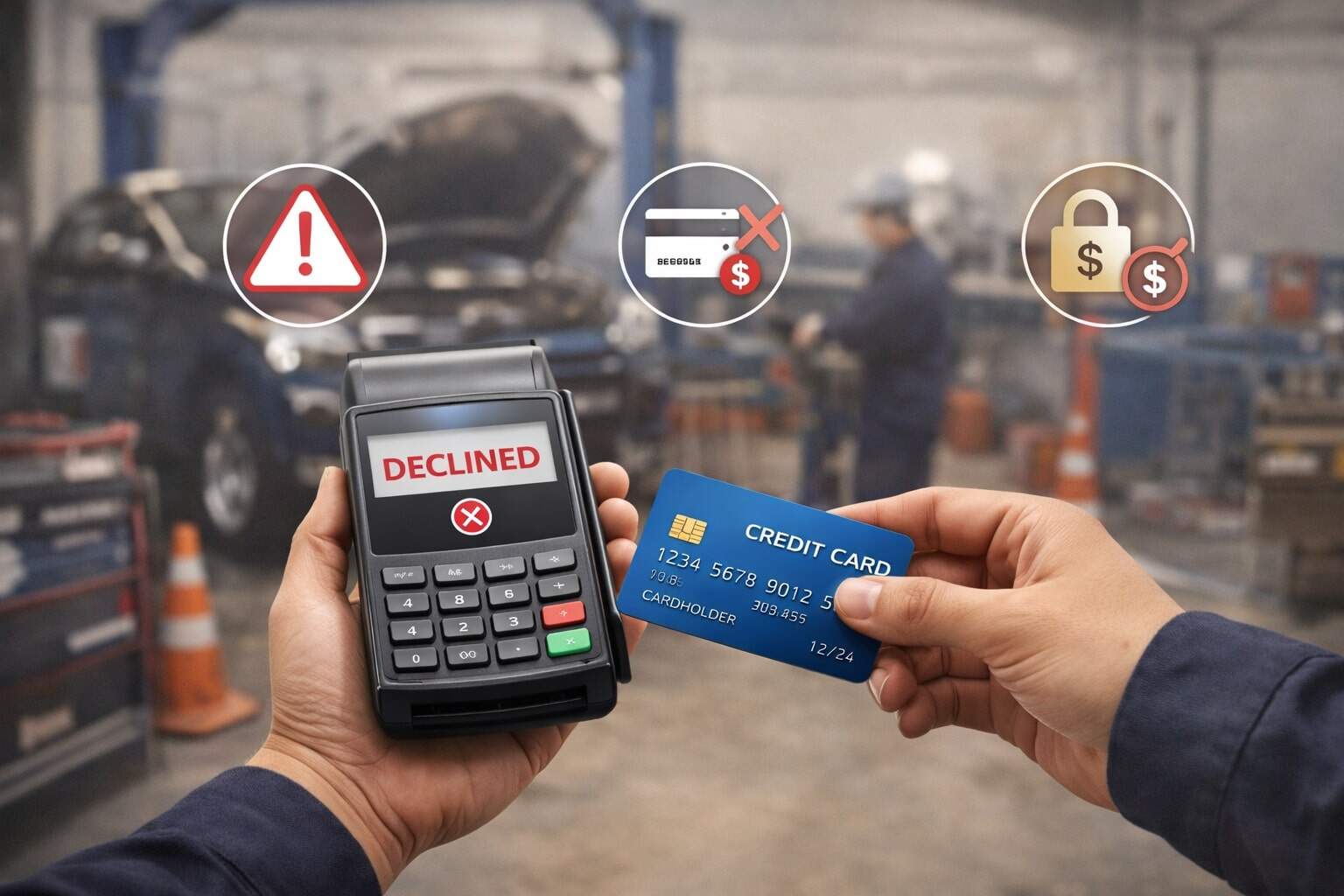
Credit card declines in automotive transactions are more than a momentary inconvenience. For dealerships, repair shops, towing operators, parts counters, detailers, and mobile mechanics, a declined payment can pause a delivery, delay a release from the lot, or turn a satisfied customer into a frustrated one.
Because many automotive tickets are higher than typical retail purchases, issuers apply stricter risk controls. That means credit card declines in automotive transactions often happen even when the cardholder has money available and is acting in good faith.
In automotive, declines show up in predictable “hot spots”: large down payments, service tickets that grow after a teardown, card-not-present phone payments for remote approvals, and after-hours releases where identity checks are weaker.
Add complex pricing (labor + parts + shop fees + taxes), partial fulfillments, and the occasional mismatch between who authorizes work and who pays, and you get an environment where credit card declines in automotive transactions are common—yet preventable.
This guide breaks down why credit card declines in automotive transactions happen, what the decline messages really mean, and how to reduce false declines without opening the door to fraud and chargebacks.
You’ll also learn how to align authorization practices with modern card network expectations, security standards, and customer experience—plus what to expect next as issuers use more machine learning and real-time risk signals to approve or decline automotive payments.
Why automotive payments get declined more often than typical retail
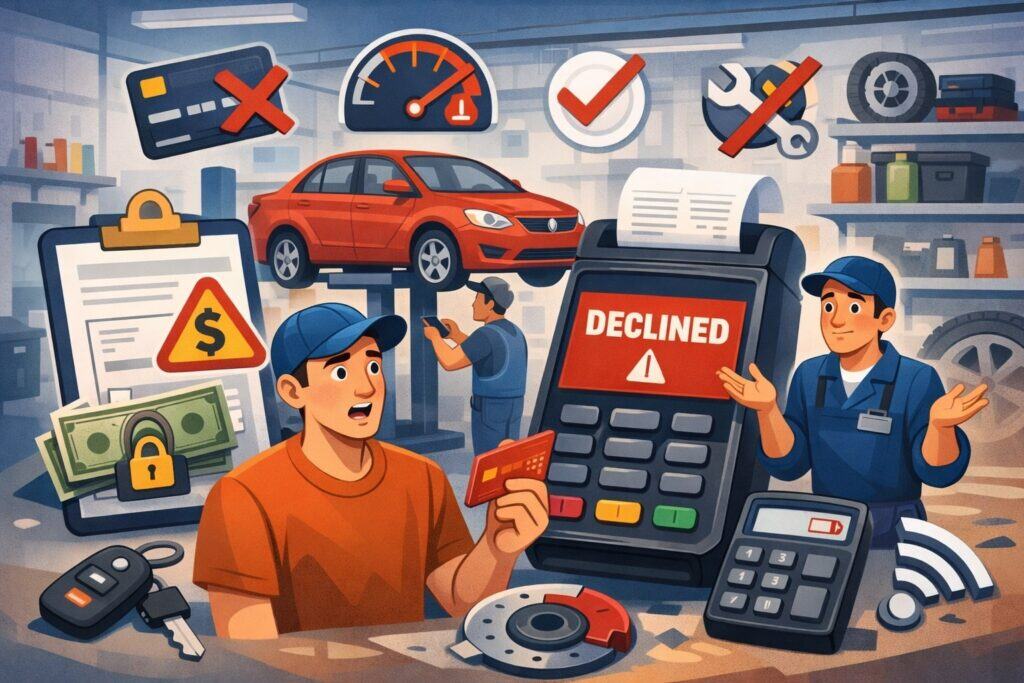
Credit card declines in automotive transactions occur at higher rates because the risk signals look different from a normal checkout. Issuers are trained to be cautious with high-ticket amounts, unusual merchant categories, and purchases that could be disputed later.
Many automotive purchases fit all three. A $2,500 repair bill, a $5,000 down payment, or a $1,200 towing charge doesn’t behave like a $60 grocery run, even when the cardholder is legitimate.
Another reason credit card declines in automotive transactions spike is “context switching.” Customers might authorize repairs from work, approve an extra service by phone, or send a spouse to pick up the vehicle.
Each of those scenarios changes device, location, name, and behavior patterns—exactly what issuer fraud models watch. If your checkout flow also skips strong data (chip, tap, AVS, CVV, invoice details), issuers may default to declining to avoid potential losses.
Automotive workflows also create timing issues. A shop might pre-authorize a smaller amount, then capture a larger final bill. A rental or loaner situation may use estimated or incremental authorizations (common in travel-like models).
Visa describes estimated and incremental authorization use cases for car rental-style scenarios, including requesting additional funds when needed.
If your systems don’t support the right authorization methods—or if staff “retries” a decline multiple times—credit card declines in automotive transactions can snowball into bank blocks, customer embarrassment, and lost revenue.
Finally, consumer expectations matter. Customers may not realize their bank flags large automotive transactions as “unusual,” especially when the payment is keyed in or split across multiple tenders.
Training your team to anticipate these patterns is one of the fastest ways to reduce credit card declines in automotive transactions while still staying safe.
The decline ecosystem: who actually says “no” and what that means
To fix credit card declines in automotive transactions, you need to know who declined the payment. Many merchants assume “the processor declined it,” but in most cases the issuing bank makes the final approval decision. That matters because the “right fix” depends on the decision-maker and the data they saw.
A typical card payment flows through your terminal or gateway, then to your processor/acquirer, then through the card network, and finally to the issuer. Declines can happen at multiple points, but issuer declines are the most common category in day-to-day commerce—often returning vague messages like “Do Not Honor.”
Shift4’s guidance explains that decline codes can originate from the processor, gateway, or (most commonly) the issuing bank, and that codes help identify the reason for failure. This distinction matters in automotive because “issuer said no” often means the customer must contact their bank or use a different tender—even if your settings are perfect.
There’s also a difference between “hard” declines and “soft” declines. A hard decline is a firm rejection (expired card, lost/stolen, invalid number). A soft decline may be retriable after changing something: correcting billing ZIP, using chip instead of swipe, providing CVV, or reducing the amount.
Automotive teams often turn a soft decline into a hard situation by repeatedly attempting the exact same transaction. Some issuers interpret rapid repeats as suspicious behavior, increasing the chance of additional credit card declines in automotive transactions.
The third category is “merchant-controlled declines.” If you set your gateway to reject certain AVS or CVV outcomes, you can decline a payment even if the bank would approve it. Authorize.net notes that merchants can configure AVS/CCV filters to decline transactions based on those results.
In automotive, overly strict filters are a common cause of false credit card declines in automotive transactions—especially for customers who recently moved, use corporate cards, or have non-standard billing setups.
The most common issuer decline codes in automotive—and how to respond
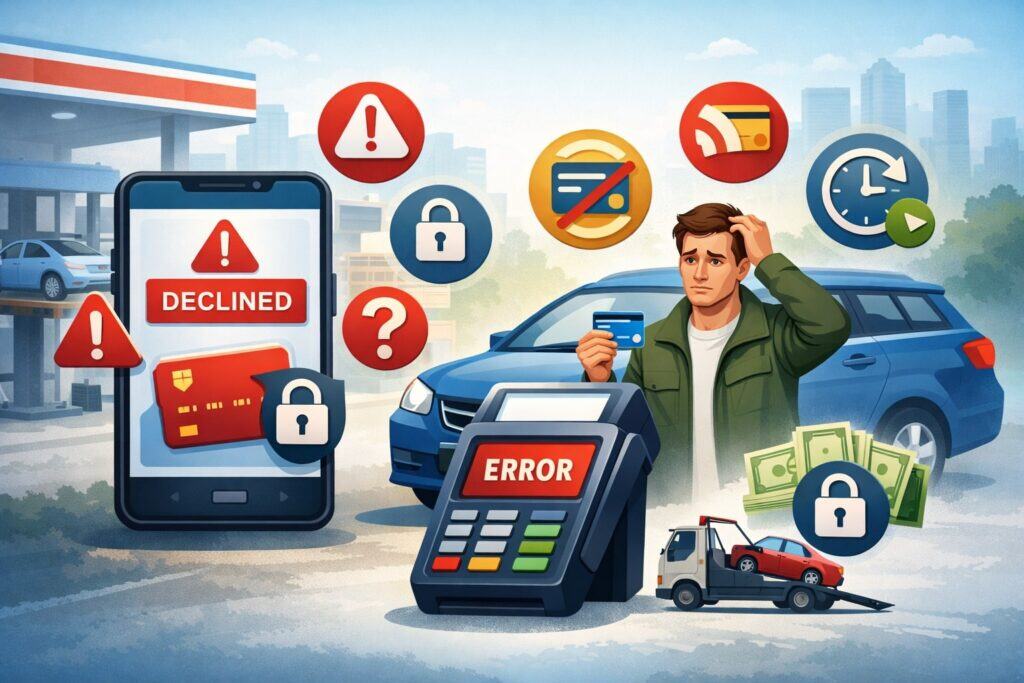
Credit card declines in automotive transactions often come back with short, cryptic messages. Staff members see “Declined” and either try again or ask for another card. A better approach is to categorize the decline, respond with the right next step, and avoid actions that escalate the issuer’s suspicion.
The most common issuer message in automotive is the equivalent of “Do Not Honor” (often code 05). Multiple merchant resources explain that “Do Not Honor” is intentionally vague and usually reflects issuer risk rules, automated security checks, or internal bank policies rather than a specific merchant error.
When you see this, the best move is not to keep retrying. Instead, change the conditions: chip/tap if available, confirm billing ZIP for keyed payments, or have the customer contact their bank while you offer an alternate method.
Another common reason behind credit card declines in automotive transactions is insufficient available credit (often code 51). Even high-income customers hit this when their available line is temporarily reduced by other holds—travel deposits, fuel station holds, or prior pre-authorizations.
In these cases, split tender and partial approvals can help. Visa’s Partial Authorization Service is designed to improve acceptance by allowing partial approvals when funds are insufficient, assuming your system supports split-tender.
Automotive teams that can smoothly split a $1,400 ticket into “approved amount + remaining balance” recover sales that otherwise become credit card declines in automotive transactions.
You’ll also see “CVV mismatch,” “AVS mismatch,” “restricted card,” “pick up card,” “suspected fraud,” and “invalid transaction.” Some of these are fixable with data: correct billing ZIP and street number, re-key carefully, or switch from manual entry to chip.
Others require customer action: the issuer may have frozen the card due to travel, recent fraud alerts, or unusual purchase behavior.
The key is scripting. Your staff should communicate in a calm, non-accusatory way: “Your bank is asking for verification. If you call the number on the back, they can approve it right away. We can also try chip/tap or split the payment.” That reduces embarrassment, shortens resolution time, and lowers repeat credit card declines in automotive transactions.
AVS, CVV, and fraud filters: stopping fraud without causing false declines

A major cause of credit card declines in automotive transactions is misconfigured fraud screening—especially for keyed and invoice-based payments. Automotive businesses often accept card-not-present payments for remote approvals, parts orders, deposits, or after-hours releases.
Those transactions carry higher fraud risk, but the solution is not “decline anything imperfect.” The goal is “collect enough signal to approve legitimate customers while blocking obvious abuse.”
AVS (Address Verification Service) compares the numeric portions of the billing address provided by the customer against the issuer’s records. Authorize.net explains that AVS verifies billing address numbers and CCV/CCV (CVV) compares the security code, and merchants can configure settings to decline based on outcomes.
If your settings automatically reject common “partial match” scenarios, you will create unnecessary credit card declines in automotive transactions—especially for customers who use PO boxes, have recently moved, or are paying with a card issued to a business address.
A better approach is risk-tiering. For example:
- Low-risk (repeat customer, card present, chip/tap): minimal friction.
- Medium-risk (keyed entry, matching AVS ZIP, CVV present): allow with monitoring.
- High-risk (keyed entry, AVS mismatch, no CVV, rush pickup): require alternate verification or different tender.
If you do decline based on AVS/CVV, communicate it clearly. “We need the billing ZIP and CVV to process this securely” feels different than “your card was declined.”
Also train staff to ask for the billing address exactly as it appears on statements, and to confirm the ZIP code carefully. Many credit card declines in automotive transactions are simple data-entry mistakes.
Finally, avoid turning fraud tools into a blunt instrument. If your gateway blocks all transactions from certain IP ranges or declines VPN usage automatically, you may block legitimate remote approvals.
Modern fraud controls should incorporate invoice context: vehicle VIN (when appropriate), RO number, customer history, pickup authorization, and signed work approval. Those operational signals reduce fraud and reduce credit card declines in automotive transactions at the same time.
High-ticket authorization strategy: down payments, repairs, towing, and parts

Automotive is a high-ticket category. High-ticket payments trigger issuer caution, and that’s why credit card declines in automotive transactions are especially common during down payments and large repair closings.
The fix is rarely “try again.” The fix is designing an authorization strategy that matches issuer expectations and customer behavior.
Start with amount management. If a repair can expand after diagnostics, set expectations and payment steps upfront. Many shops reduce credit card declines in automotive transactions by taking a smaller deposit, then collecting the balance when work is complete.
This is not only operationally smoother; it aligns with issuer risk systems that prefer predictable patterns over sudden large keyed charges.
Next, implement split-tender and partial approval handling. When issuers approve less than the requested amount, merchants who can accept partial approvals rescue the sale.
Visa’s partial authorization guidance emphasizes enabling split-tender functionality to support this experience. In automotive, split tender also helps when customers want to pay some on a rewards card and the rest by bank transfer, cashier’s check, or debit.
For towing and emergency roadside scenarios, the risk is higher because the customer is stressed, time is limited, and details change fast. That’s exactly when credit card declines in automotive transactions feel catastrophic.
In these cases, design a rapid fallback ladder: tap/chip → keyed with AVS/CVV → wallet pay → pay-by-link with verification → alternate tender. Keep it consistent so staff don’t improvise risky workarounds.
For parts and special orders, make your capture timing explicit. If you authorize today and capture later, you may hit authorization time frame rules or bank revalidation issues—leading to credit card declines in automotive transactions at the worst possible time (when the part arrives).
Your payment partner should help you pick the right approach: immediate capture, deposit + balance, or staged payments.
Card-present vs. card-not-present in automotive: how channel choice changes decline rates
Credit card declines in automotive transactions depend heavily on whether the card is present. Card-present (chip/tap) payments typically carry stronger authentication signals, while card-not-present (keyed entry, phone, online links) face more issuer scrutiny. That’s why the same customer may succeed at the counter but fail when paying remotely.
A best practice is to default to chip or tap whenever physically possible. Even if the customer calls in to approve additional repairs, consider capturing a deposit remotely and collecting the final amount in person—if that fits your workflow.
Issuers tend to trust EMV data more than manually keyed transactions, reducing the chance of credit card declines in automotive transactions.
When you must accept remote payment, improve the data quality. Use pay-by-link or hosted invoices that collect billing ZIP, address, and CVV. Provide invoice identifiers and consistent descriptors so the issuer can interpret the transaction correctly.
If you’re using a virtual terminal, staff training becomes critical: many declines are caused by small mistakes like swapping billing and shipping ZIP codes or entering the wrong street number.
For eCommerce-like automotive flows (online parts sales, accessory orders), consider adding modern authentication where appropriate. EMV 3-D Secure is designed to enable secure data exchange between merchants and issuers for eCommerce fraud reduction and can provide chargeback protections in certain fraud scenarios.
While not every automotive merchant needs 3DS, it can be valuable for higher-risk card-not-present transactions where credit card declines in automotive transactions are occurring due to issuer uncertainty.
The point is not to add friction everywhere. It’s to apply stronger methods where declines and fraud risk are highest. Done right, you reduce credit card declines in automotive transactions and improve approval rates without sacrificing customer experience.
Deposits, pre-authorizations, and incremental authorizations for automotive workflows
A lot of credit card declines in automotive transactions happen because the merchant uses the wrong authorization type for the situation.
Automotive businesses often need flexible payment structures: deposits for special orders, estimated totals for complex repairs, and additions when work expands. If your payment flow doesn’t match how authorizations work, you’ll see more declines, more reversed holds, and more customer confusion.
Deposits work best when clearly documented and tied to a signed estimate or parts order agreement. They reduce the final-ticket shock that triggers issuer declines.
They also reduce disputes because customers understand what they agreed to at each step. The most effective deposit programs treat payment as part of the service workflow, not an awkward add-on at the end.
Pre-authorizations (holding funds without capturing immediately) can be useful, but they come with time limits and issuer variability. If you pre-authorize and wait too long, you risk a capture failure later—which feels like a decline at closing time.
Some businesses interpret that as “credit card declines in automotive transactions,” but it’s really an authorization lifecycle problem. Your processor should guide you on best practices for timely capture and reversal.
Incremental authorizations can be relevant in automotive-adjacent flows that behave like rentals or unknown totals. Visa notes that certain merchant types like car rental can obtain estimated initial authorizations and request incremental funds if needed.
Industry explainers also describe incremental authorizations as a way to increase a previous approved amount when the final charge changes, including car rental examples.
If your business model includes extensions, add-ons, storage fees, or variable totals, incremental authorization support can reduce credit card declines in automotive transactions by aligning changes to issuer expectations.
The operational takeaway: map your real workflow (estimate → approval → changes → closeout) to the right payment primitives (deposit, capture, incremental). This is one of the most reliable ways to reduce credit card declines in automotive transactions without loosening fraud controls.
Surcharging, cash discounting, and customer messaging that prevents declines
Fees and pricing presentation can indirectly increase credit card declines in automotive transactions. If customers are surprised by a surcharge at the counter, they may switch cards, attempt a debit card that can’t be surcharged, or choose a card with insufficient available credit—triggering declines. The best “decline prevention” here is clarity.
Card network rules require specific disclosure and limits for surcharging credit cards. Visa’s U.S. merchant guidance states that surcharges must be disclosed at the point of entry and sale, must apply only to credit (not debit/prepaid), require notice at least 30 days prior, and must be capped at the merchant discount rate or 3% (whichever is lower).
Mastercard similarly requires advance notice to both Mastercard and the acquirer at least 30 days before implementing a surcharge, with disclosure requirements. These rules matter in automotive because many tickets are large, and a surcharge can push a customer over their available credit—creating more credit card declines in automotive transactions.
If you use cash discounting, train staff to explain it consistently and post signage clearly. Customers who understand pricing upfront are less likely to “test” multiple cards and trigger bank security blocks.
Also, be careful with how you present the receipt descriptor and invoice notes. Confusing descriptors are a leading cause of disputes and “friendly fraud,” which in turn can increase issuer skepticism and future credit card declines in automotive transactions for your merchant profile.
The goal is not “never charge fees.” The goal is “reduce surprises.” Surprise drives behavior that looks risky to issuers and results in more declines.
Security and compliance: PCI DSS 4.x and why it impacts approval rates
Security isn’t just about avoiding breaches. It also affects credit card declines in automotive transactions because compromised environments, suspicious traffic patterns, and poor data handling can lead to higher issuer and network risk scores. Over time, that can mean more scrutiny and lower approvals—even when individual customers are legitimate.
PCI DSS 4.x introduced strengthened requirements and a major transition timeline. The PCI Security Standards Council notes that organizations should be ready to meet new requirements that come into effect on March 31, 2025.
PCI SSC has also published guidance and clarifications around PCI DSS v4.0.1 and the move of future-dated requirements into mandatory status after March 31, 2025. For automotive merchants, the practical message is simple: reduce your exposure by limiting how and where card data touches your systems.
If your shop keys cards into a browser on an office computer, that workstation becomes part of your compliance scope and risk surface. If malware hits that machine, you may face not only a data incident but also increased declines as issuers detect fraud patterns tied to compromised merchant environments.
Moving to secure, tokenized payment links, P2PE-capable terminals, and properly segmented networks reduces both risk and the downstream chance of credit card declines in automotive transactions triggered by “merchant compromise” signals.
Also review who has access to virtual terminals, how credentials are managed, and whether staff reuse passwords. These sound like IT details, but they influence fraud exposure and long-term approval stability.
In a world where issuers share more fraud intelligence, merchants who invest in security tend to experience fewer catastrophic spikes in credit card declines in automotive transactions.
Operational playbook: step-by-step troubleshooting at the counter and on the phone
When credit card declines in automotive transactions happen, the worst response is panic. The best response is a calm checklist that protects the customer’s dignity and improves the odds of approval.
At the counter (card present):
- Confirm the amount and try tap or chip, not swipe.
- If declined, avoid immediate repeats. Ask: “Is this a travel card, business card, or newly issued card?”
- Offer to split the payment (especially for large tickets).
- If still declined, suggest the customer call the issuer or use an alternate tender.
On the phone (card not present):
- Confirm billing ZIP and street number carefully.
- Collect CVV (where allowed) and match name exactly.
- If declined, don’t run the same request multiple times. Ask the customer to contact their bank.
- Offer a secure pay-by-link option that captures the right verification signals.
For service closeouts with changed totals:
- Confirm that the customer approved changes (RO notes, signatures).
- If using pre-auth, ensure capture timing is valid and that reversals are handled for unused amounts.
- Consider deposits and staged captures for high-variability jobs.
These steps reduce credit card declines in automotive transactions because they either improve the signal quality for the issuer (chip/tap, correct data) or avoid behavior that triggers issuer security blocks (rapid repeats). They also reduce chargeback risk because the customer experiences a professional, consistent process instead of a scramble.
Most importantly, train your team to never imply wrongdoing. Declines are often just bank automation. Your tone determines whether the customer stays calm enough to resolve it.
Reducing declines long-term: data, routing, and payment stack upgrades
If you want fewer credit card declines in automotive transactions over the next 6–18 months, focus on structural improvements rather than “better luck.”
First, improve authorization data quality. Use terminals with current firmware, strong EMV support, and stable connectivity. For remote payments, use hosted checkout links that capture billing ZIP and provide consistent invoice references.
Second, review gateway and risk settings quarterly. Many merchants inherit strict AVS/CVV decline rules from legacy setups and never revisit them. Over time, those rules produce more false declines than fraud savings. Calibrate with actual outcomes: which AVS mismatches are truly risky in your customer base, and which are just address-format problems?
Third, implement split tender and partial approvals wherever possible. Visa’s partial authorization guidance exists because insufficient funds declines are common, and merchants with split-tender functionality can recover sales.
This directly reduces credit card declines in automotive transactions that would otherwise force customers to leave and “come back later.”
Fourth, consider local acquiring and smarter routing if you operate multiple locations or sell online. Better routing can improve issuer trust signals and reduce cross-region “out-of-pattern” declines.
Finally, invest in descriptor clarity and documentation. Many issuer models incorporate dispute history. Merchants with fewer disputes and clearer descriptors often face fewer issuer-risk declines over time, reducing credit card declines in automotive transactions as your profile strengthens.
Future predictions: where automotive declines are headed next
Credit card declines in automotive transactions are likely to evolve in three major ways: more issuer automation, more real-time signals, and more segmentation by channel and ticket size.
First, issuer decisioning will become even more machine-learning driven. That means two things at once: better fraud detection and more “false declines” when merchants don’t provide enough context.
The merchants who win will be those who send richer, cleaner data—through modern terminals, secure hosted checkout flows, and consistent invoice metadata.
Second, authentication will become more “invisible” for good customers. EMV 3-D Secure is already positioned as a framework for secure merchant–issuer data exchange in eCommerce and may be used in data-only ways to improve authorization confidence in some environments.
For automotive businesses that accept many remote approvals, expect more options that reduce friction while still lowering credit card declines in automotive transactions.
Third, payments will diversify. As real-time bank transfer options and pay-by-bank experiences grow, some high-ticket automotive payments will shift away from cards—especially where card limits create predictable declines.
Cards will remain critical for convenience and rewards, but many businesses will adopt hybrid strategies: deposit by card, balance by bank transfer, or financing integrations.
Finally, compliance expectations will tighten. With PCI DSS v4.x requirements becoming mandatory after March 31, 2025, merchants that reduce card-data exposure and modernize their payment environment will be better positioned for stable approvals and fewer systemic risk-driven declines.
The future of credit card declines in automotive transactions will favor businesses that treat payments as an operational system—not a terminal on a counter.
FAQs
Q.1: Why do banks decline large automotive repair bills even when the customer has money?
Answer: Credit card declines in automotive transactions often happen on large repair bills because issuers rely on automated risk rules that treat unusual, high-ticket spending as potentially fraudulent.
The bank may see a $2,800 repair as out-of-pattern compared to the customer’s normal spending, especially if the card is keyed in, the customer is traveling, or the merchant is new to that cardholder. In many cases, the cardholder does have funds, but the issuer wants confirmation that the customer is authorizing the purchase.
The best fix is to change the signal set, not to repeat the same charge. Run chip or tap if possible, confirm the cardholder’s billing ZIP for keyed transactions, and avoid multiple rapid retries.
Offer split tender because an issuer may approve a smaller amount or the customer may have available credit spread across accounts. Visa’s partial authorization framework exists specifically to address declines caused by insufficient funds, assuming the merchant supports split tender.
Also consider operational design. If your shop frequently produces large “surprise totals” after teardown, you may see more credit card declines in automotive transactions than a shop that collects a deposit and confirms changes in stages. Clear approvals and staged payments reduce issuer suspicion and keep customers calmer during resolution.
Q.2: What does “Do Not Honor” mean, and what should the service advisor say?
Answer: “Do Not Honor” is one of the most common messages behind credit card declines in automotive transactions, and it’s intentionally vague. It generally means the issuer refused the authorization without sharing the specific reason, often due to automated security checks or internal bank rules.
Merchant guidance commonly describes it as an issuer-driven decision that can be triggered by risk scoring, unusual purchase behavior, or account restrictions.
Your service advisor should avoid blame and avoid repeated attempts. A strong script is: “It looks like your bank is requesting verification. If you call the number on the back of the card, they can approve it quickly. We can also try chip/tap, split the payment, or use another method if you prefer.” This preserves the customer relationship and prevents the issuer from escalating the block due to repeated identical attempts.
If the customer is remote, offer a pay-by-link option that collects correct billing details and reduces data-entry mistakes. Many credit card declines in automotive transactions come from simple errors—wrong ZIP, wrong street number, or an incorrect CVV—so changing from manual keying to a customer-entered secure link can raise approval rates.
Q.3: How strict should AVS and CVV settings be for shops and dealerships?
Answer: AVS/CVV controls can reduce fraud, but overly strict settings are a common cause of credit card declines in automotive transactions. Authorize.net notes that merchants can configure AVS and CCV (CVV) settings to decline transactions based on results.
The issue is that “mismatch” does not always equal fraud—customers move, business cards use office billing addresses, and some issuers return partial matches even when the customer is legitimate.
A practical approach is tiered rules based on risk:
- Card-present chip/tap: don’t force AVS/CVV because the card is present and EMV data is stronger.
- Card-not-present deposits and invoices: require billing ZIP + CVV, but don’t automatically reject every partial mismatch. Review high-risk cases manually.
- High-ticket keyed transactions: add additional verification steps (ID checks for pickup, signed authorization, or a secure link) instead of relying on a single AVS code.
The goal is to reduce fraud while also reducing false credit card declines in automotive transactions. Track outcomes monthly: how many AVS/CVV declines were later recovered, and how many were true fraud. Adjust based on evidence, not fear.
Q.4: Are surcharges allowed, and can surcharging increase declines?
Answer: Surcharging can be allowed depending on your situation, but it must follow card brand rules and applicable laws. Visa’s U.S. guidance requires advance notice (at least 30 days), clear disclosures at entry and checkout, credit-only application (no debit/prepaid), and a cap of the merchant discount rate or 3%—whichever is lower.
Mastercard similarly requires advance notice to Mastercard and the acquirer at least 30 days prior, plus disclosure requirements and caps tied to cost of acceptance.
Yes—surcharging can increase credit card declines in automotive transactions if you implement it poorly. The surcharge raises the final amount, which can push customers over their available credit, especially on large repair bills or down payments.
It can also lead customers to switch to debit, which can’t be surcharged under Visa’s guidance, creating awkward tender changes and more attempts.
If you surcharge, prevent declines by disclosing early, quoting “out-the-door” totals, and offering alternatives like ACH/bank transfer, cash discounting (structured correctly), or split tender. Done transparently, you reduce payment friction and lower the volume of avoidable credit card declines in automotive transactions.
Q.5: What’s the single best way to lower declines without increasing fraud?
Answer: The single best lever for reducing credit card declines in automotive transactions—without increasing fraud—is improving transaction signal quality while keeping retries disciplined.
That means: chip/tap whenever possible, secure customer-entered pay links for remote payments, accurate billing ZIP and street number for keyed transactions, and split-tender support for high-ticket scenarios.
It also means stopping the common “retry loop.” Rapidly running the same declined authorization multiple times often makes the issuer more suspicious, not less. Instead, change something meaningful: the entry method (chip/tap vs keyed), the amount (split tender), or the verification (customer contacts issuer).
Combine that with better documentation—signed approvals, invoice clarity, and consistent descriptors—to reduce disputes that can harm your long-term approval profile.
Finally, keep your environment secure and aligned with modern standards. PCI DSS v4.x requirements becoming mandatory after March 31, 2025 increases the importance of reducing card-data exposure and tightening access controls, which supports stable payment acceptance over time. These steps reduce both fraud and the long-run incidence of credit card declines in automotive transactions.
Conclusion
Credit card declines in automotive transactions are common because automotive payments are high-ticket, operationally complex, and often processed under changing conditions—remote approvals, expanding estimates, deposits, and after-hours releases.
The good news is that most declines fall into patterns you can manage: issuer risk decisions like “Do Not Honor,” data-quality problems in keyed payments, insufficient available credit on large tickets, and merchant-side settings that are too strict for real-world customer behavior.
To reduce credit card declines in automotive transactions, focus on better signals (chip/tap, accurate billing data, secure pay links), smarter payment design (deposits, split tender, partial approvals), and calmer troubleshooting (no rapid retries, clear customer scripts).
Align surcharging and disclosures with card brand rules, and modernize security posture to support stable approvals in a world where issuer risk models get sharper every year. Visa and Mastercard guidance on surcharging and Visa’s partial authorization framework provide practical levers to improve customer outcomes when declines happen.
Looking forward, issuers will keep using more real-time signals and automation. Automotive businesses that treat payments as a core workflow—supported by modern authorization practices, clean data, and strong security—will see fewer credit card declines in automotive transactions, fewer disputes, and a smoother customer experience at the exact moment it matters most: delivery and pickup.