
Large-ticket vehicle transactions are a different animal than typical retail purchases. When you sell a $25,000 used SUV, a $45,000 new truck, or a $60,000 RV, you’re not just moving inventory—you’re also creating Credit Card Processing Fees on Large Vehicle Sales that can quietly erase profit, especially when a customer wants to put a big chunk (or all) of the deal on a rewards card.
For many dealerships, the issue isn’t that card acceptance is “bad.” Credit cards can speed up closes, reduce funding delays, and improve customer experience.
The issue is that high-ticket payment processing makes percentage-based pricing brutally visible. A 2.6% effective rate might feel tolerable on a $1,200 parts ticket—but on a $35,000 vehicle, it’s a line item large enough to change the economics of the deal.
This guide is designed to help dealership owners, general managers, and F&I leaders Lower Credit Card Processing Fees on Large Vehicle Sales using realistic, compliant, dealership-specific strategies.
We’ll walk through how fees are built (interchange, assessments, and processor markup), show real math on a $25,000–$60,000 sale, and lay out practical ways to reduce credit card fees for car dealerships without gimmicks, exaggerated promises, or risky shortcuts. You’ll also get a step-by-step checklist and a set of FAQs you can use to align your team.
Why Large Vehicle Transactions Create High Processing Costs

Vehicle sales combine two ingredients that amplify processing expense: high average ticket size and card mix skewed toward premium rewards. Most card pricing is fundamentally percentage-based, so the higher the transaction amount, the higher the fee—no matter how “efficient” your process is.
When a customer insists on a premium travel or cash-back card, the interchange (the base fee paid to the issuing bank) is typically higher than standard cards. That means the dealership can do everything “right” operationally and still pay more simply because of card type.
Add in the fact that dealerships often take payments in multiple stages—deposit, down payment, accessories, extended warranty, doc fees—and those transactions may be keyed, card-not-present, or manually entered depending on workflow. That can push costs further.
The operational reality is also unique. Dealership workflows involve:
- Sales desk and F&I touches
- Multiple payment methods (trade, financing, cash, cards)
- Time-sensitive funding and delivery schedules
- Customer requests for speed and convenience
- Compliance steps for identity verification and documentation
That’s why the best approach isn’t “get a lower rate” in the abstract. It’s to build a payment processing cost breakdown specific to your store, understand where the fees truly come from, and then choose the best levers: pricing model, routing and acceptance methods, EMV discipline, alternative rails (ACH/wire/RTP), and chargeback controls.
Done right, you can lower merchant fees on high-ticket auto sales while improving your close process—not fighting it.
Understanding Credit Card Processing Fees (Interchange, Assessments, Markups)
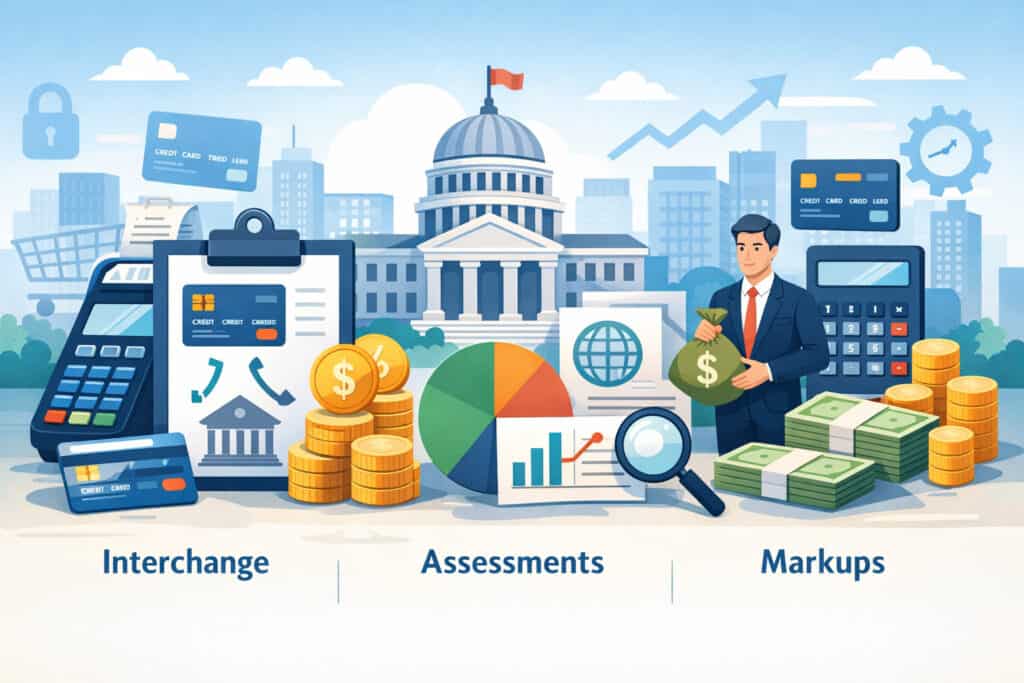
Most dealerships are told a single number—“your rate is 2.49%” or “2.9% + 30¢”—but that headline rate hides what you’re actually paying. Credit card fees are usually made up of three layers:
Interchange Fees: The Base Cost You Don’t Control (Much)
Interchange is set by the card brands’ ecosystems and paid to the customer’s issuing bank. It varies by:
- Card type (debit vs credit, rewards vs non-rewards)
- Acceptance method (EMV card-present vs keyed/card-not-present)
- Data quality (AVS, CVV, Level 2/Level 3 where applicable)
- Merchant category and transaction context
For dealerships, interchange tends to run higher when:
- Customers use premium rewards cards
- Payments are keyed in (especially in F&I or remote payments)
- Transactions are treated as card-not-present
This is why interchange rates for auto dealerships matter so much: interchange is usually the largest portion of the fee stack, and it scales with ticket size.
Assessment Fees: Small Percentages That Still Add Up
Assessments (sometimes called network fees) are charged by the card brands (Visa, Mastercard, etc.). They’re typically smaller than interchange, but on large tickets they become real money. Think of them as “tolls” for using the network.
Even if you negotiate the processor markup down, assessments still apply—so you need to manage them indirectly by steering payment method and transaction type.
Processor Markups: The Part You Can Negotiate
This is where your provider earns revenue. Markup can show up as:
- A percentage over interchange
- Per-transaction fees
- Monthly fees (statement, PCI, gateway, platform)
- Miscellaneous line items (batch fees, regulatory, network pass-through)
The simplest way to evaluate markup is to separate:
- what is pass-through (interchange + assessments)
- what is provider-added (your negotiated markup and any junk fees)
If you want to reduce credit card fees for car dealerships, you need clarity on all three layers—and you need a pricing model that doesn’t disguise the markup.
Pricing Models Dealers See: Flat Rate, Tiered, and Interchange-Plus
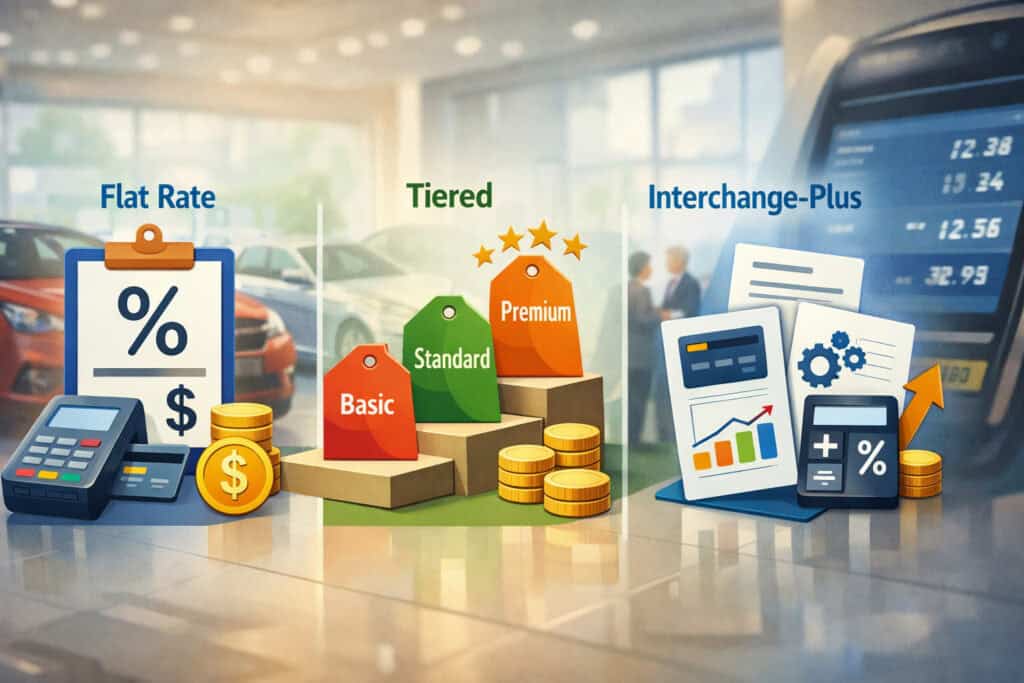
Dealerships are often pitched “simple” pricing, but simplicity can cost more at high tickets. Here’s how the common models behave for large ticket transaction fees.
Flat Rate Pricing: Easy to Understand, Often Costly at High Tickets
Flat rate means one blended percentage (sometimes plus a fixed per-transaction fee). It’s convenient, but the provider builds in buffers to protect themselves against expensive card types. For dealerships, that buffer can be expensive because so many customers use rewards cards.
Flat rate is usually best suited to:
- Low average tickets
- Low variability in card mix
- Businesses that value predictability more than optimization
For high-ticket auto retail, flat rate can be a margin leak.
Tiered Pricing: The “Qualified vs Non-Qualified” Trap
Tiered pricing groups transactions into buckets like “qualified,” “mid-qualified,” and “non-qualified.” This is where terms like qualified vs non-qualified rates show up—and it often creates confusion.
Dealers frequently discover that:
- Rewards cards land in more expensive tiers
- Keyed transactions land in more expensive tiers
- Downgraded transactions occur due to data or settlement timing
Tiered pricing makes it hard to audit true cost, which is why many operators switch away from it once they start reviewing statements closely.
Interchange-Plus Pricing: Most Transparent for Dealerships
Interchange-plus pricing means you pay:
- actual interchange
- actual assessments
- plus a clearly defined provider markup (e.g., interchange + 0.20% + $0.10)
It’s not always the cheapest in every scenario, but it is usually the most auditable and scalable for high-ticket businesses—especially when you’re trying to lower Credit Card Processing Fees on Large Vehicle Sales without surprises.
If you want to negotiate effectively with dealership merchant services, interchange-plus is typically the place to start because it separates controllable vs uncontrollable costs.
Cost Breakdown Example: What a 2%–3% Fee Really Means on $25,000–$60,000
Dealership teams often underestimate how fast fees compound on big numbers. Let’s put clean math on the table. These are simplified examples to illustrate the impact of Credit Card Processing Fees on Large Vehicle Sales, not a promise of any specific rate.
Sample Fee Math on a $25,000 Vehicle Sale
If a customer pays $25,000 on a credit card:
- At 2.0%: $25,000 × 0.020 = $500
- At 2.5%: $25,000 × 0.025 = $625
- At 3.0%: $25,000 × 0.030 = $750
That’s a $250 difference between 2.0% and 3.0% on a single deal.
Sample Fee Math on a $60,000 Vehicle Sale
If a customer pays $60,000 on a credit card:
- At 2.0%: $60,000 × 0.020 = $1,200
- At 2.5%: $60,000 × 0.025 = $1,500
- At 3.0%: $60,000 × 0.030 = $1,800
That’s a $600 swing from 2.0% to 3.0%—on one transaction.
Cost Comparison Table: Fees by Ticket Size and Effective Rate
| Sale Amount | 2.0% Fee | 2.5% Fee | 3.0% Fee |
|---|---|---|---|
| $25,000 | $500 | $625 | $750 |
| $35,000 | $700 | $875 | $1,050 |
| $45,000 | $900 | $1,125 | $1,350 |
| $60,000 | $1,200 | $1,500 | $1,800 |
Why “A Few Tenths of a Percent” Matters
Dealers sometimes focus only on the headline discount rate, but on high tickets:
- A 0.20% improvement on $50,000 is $100
- A 0.40% improvement on $50,000 is $200
That’s why negotiating markup, reducing downgrades, steering to lower-cost rails, and tightening operations can be more valuable than chasing gimmicky “ultra-low rates.” Your goal is to lower the effective cost of acceptance while protecting customer experience and compliance.
Strategy 1: Negotiate Interchange-Plus Pricing and Audit the Markup
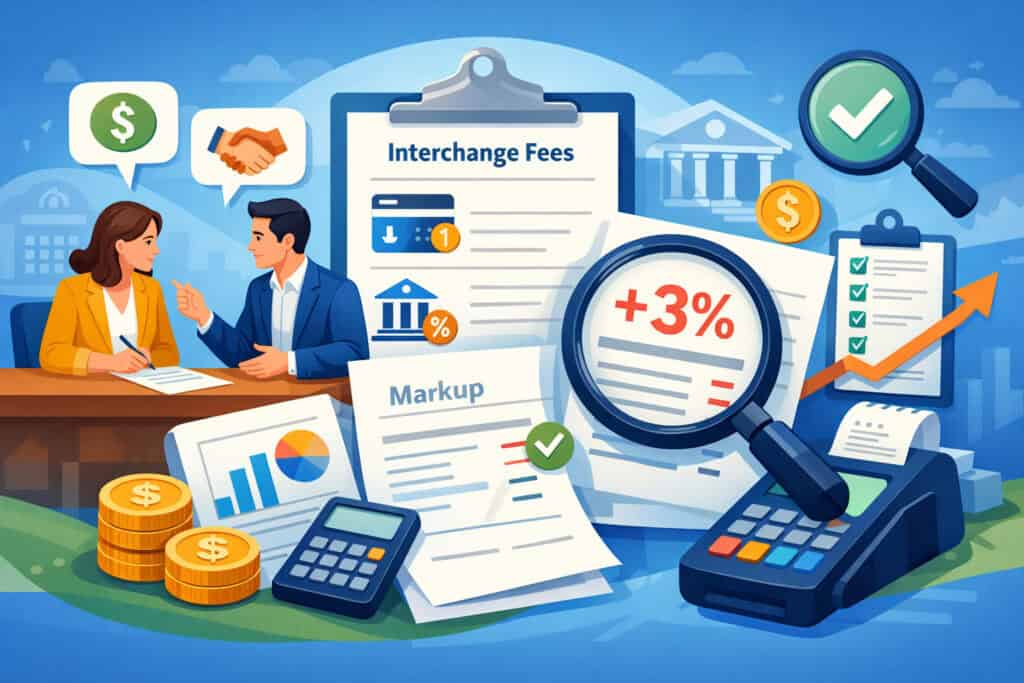
If you’re currently on tiered pricing or a flat rate model, one of the most practical ways to lower merchant fees on high-ticket auto sales is negotiating a clean, transparent interchange-plus structure—then confirming that your statement actually matches what was promised.
What to Ask For (In Plain Language)
When negotiating, ask your provider to quote:
- Interchange + % + $ per transaction
- Assessments passed through at cost
- A clear list of monthly fees (gateway, PCI, statement, platform)
- No “non-qualified” tiers and no inflated “bundled” rates
- Clear chargeback and retrieval fees
Then ask for a side-by-side comparison using your last 2–3 months of processing data. A reputable provider should be able to model cost using your actual volume and card mix.
Hidden Fee Categories to Watch Closely
Even with interchange-plus, cost can creep in through “extras.” Review for:
- Monthly minimums (and how they’re calculated)
- Batch settlement fees (per batch, per day)
- PCI fees that don’t match your compliance status
- “Regulatory,” “network,” “service,” or “non-transaction” fees without clear definitions
- Equipment leases with long-term commitments
Real-World Dealership Example (Negotiation Outcome)
Example: A multi-rooftop used car group was on tiered pricing and saw frequent “non-qualified” lines when F&I keyed deposits over the phone.
After switching to interchange-plus and tightening the acceptance method (favoring EMV in-store and secure pay links for remote deposits), they reduced downgrades and gained statement clarity.
The biggest improvement wasn’t a magical base rate—it was eliminating avoidable “expensive tier” outcomes and reducing provider-added junk fees.
Practical Tip: Make Markup a KPI
To keep costs under control, track:
- Provider markup cost per $10,000 processed
- Effective rate by department (sales vs service vs parts)
- Keyed vs EMV volume (especially for deposits)
This turns payment processing into an operational metric, not a mysterious monthly bill.
Strategy 2: Use Cash Discount or Surcharge Programs Carefully (Where Allowed)
Two common methods dealerships use to offset card costs are credit card surcharge programs and cash discount programs. They’re not the same thing—and they carry real compliance obligations.
Cash Discount Program for Auto Dealers (Conceptual Overview)
A cash discount program typically posts a “standard” price that includes the cost of card acceptance, and then offers a discount to customers who pay with cash-equivalent methods (cash, debit, ACH, etc.). The implementation details matter a lot, including signage, receipts, and how the discount is presented.
This approach can be attractive for high-ticket payment processing because it aligns the cost to the payment method chosen. But it must be executed properly to avoid customer confusion and compliance issues.
Credit Card Surcharging: More Regulated, More Sensitive
A surcharge adds an extra fee for paying with a credit card (and typically must not apply to debit in many contexts). Surcharging rules can involve:
- Card network rules (notice periods, caps, disclosures)
- State-specific restrictions or requirements
- Receipt and signage disclosures
- Treatment of debit vs credit and card-present vs card-not-present
When These Programs Work Best in Dealerships
These programs tend to work better when:
- The dealership has a consistent disclosure process
- The POS and terminal can correctly identify debit vs credit
- Staff are trained to explain options without confrontation
- There is a clear fallback option (ACH/wire/certified check)
Real-World Example (Customer Experience Focus)
Example: An RV dealer implemented a compliant disclosure process and trained sales + F&I to present payment choices early: “To keep pricing fair, we offer multiple ways to pay.
ACH/wire is the lowest cost, debit is next, and credit cards may include an additional cost depending on card type.” The result was not simply “charging more.” It was steering customers to lower-cost rails while keeping transparency high.
Bottom Line
Surcharging and cash discounting can help Lower Credit Card Processing Fees on Large Vehicle Sales, but only when aligned with:
- applicable state rules
- card network requirements
- a customer-friendly script and signage process
Treat these as operational programs—not quick fixes.
Strategy 3: Encourage ACH or Wire Transfers Without Slowing the Deal
One of the highest-leverage moves for large tickets is shifting as much as possible to bank-based rails. Comparing wire transfer vs credit card for vehicle purchase is often eye-opening for customers—especially when you explain it in practical terms.
Why ACH and Wires Are Often Lower Cost
- ACH payments for car sales typically cost a flat fee or low capped pricing through many platforms, rather than a percentage of the ticket.
- Bank wires are usually higher than ACH but still often cheaper than paying a 2%–3% card fee of $40,000+.
- Both reduce exposure to certain card chargeback scenarios (though they have their own dispute considerations).
How to Present It to Customers (People-First Script)
Keep it simple and customer-centered:
- “For large purchases, many customers prefer ACH or wire because it’s secure and can avoid the card costs tied to rewards programs.”
- “If you want to put part of it on a card for points, we can do that for the deposit/down payment and use ACH for the remaining balance.”
Operational Best Practices for ACH/Wire Adoption
- Provide a printed and digital set of wire/ACH instructions
- Use dual control for bank details (to reduce fraud)
- Verify customer identity in F&I workflows
- Confirm cleared funds before delivery when needed
- Train staff on timing expectations (same-day vs next-day)
Real-World Example (Reducing Friction)
Example: A powersports dealer lost deals when customers were asked to “go to the bank” at the last minute. They added an e-sign “payment options” step earlier in the process. Customers could choose ACH via a secure portal in advance of pickup. The store saw fewer last-minute delays and reduced reliance on large card transactions.
Encouraging bank rails isn’t about being inflexible—it’s about building a process where lower-cost payment is the easiest option.
Strategy 4: Cap Credit Card Amounts to Deposits or Down Payments Only
Many high-ticket automotive retailers reduce exposure by limiting credit card usage to:
- refundable deposits
- down payments up to a set limit
- accessories/service contracts under a threshold
This can materially reduce fees because you’re no longer paying percentage-based processing on the entire vehicle price.
Why Dealers Use Caps
- Protect margins from large percentage fees
- Reduce fraud risk on full-ticket card purchases
- Limit chargeback exposure on large amounts
- Encourage bank rails for the remainder
Implementation Considerations
If you adopt a cap:
- Put it in writing (policy and customer-facing disclosure)
- Train the desk and F&I on consistent language
- Ensure it’s applied consistently to avoid confusion or perceived unfairness
- Align the policy with your provider’s guidance and applicable rules
Real-World Example (Policy That Protects CSI)
Example: A used dealership allowed up to $5,000 on credit cards for down payments, with the remainder via ACH or cashier’s check. Staff presented it as a security and cost-control policy that helps keep vehicle pricing competitive. Because they set expectations early—before paperwork—the policy didn’t create end-of-deal friction.
Capping cards won’t fit every store or every customer, but it’s one of the most direct ways to lower merchant fees on high-ticket auto sales without changing your pricing model.
Strategy 5: Implement Convenience Fees Correctly (Where Permitted)
“Convenience fee” is one of the most misunderstood terms in dealership payments. In many contexts, convenience fees are allowed only under specific conditions and channels, and they must follow card network rules and applicable laws.
What a Convenience Fee Typically Means
A convenience fee is often tied to:
- an alternative payment channel (e.g., online, phone)
- a non-standard method that provides convenience beyond normal in-person payment
In practice, the rules can be strict about:
- where the fee can be applied
- how it must be disclosed
- whether it can apply to card-present transactions
- how debit vs credit is treated
Dealership Use Case Where It Sometimes Fits
- Remote deposit payments for out-of-state buyers
- Online portal payments for accessories or service packages
- Documented non-standard channels that meet program criteria
The Operational Risk
Misapplied fees can:
- trigger disputes and customer dissatisfaction
- create compliance issues with networks
- increase chargebacks (“fee not authorized”)
If you’re considering convenience fees, treat them like a compliance project: align with your payments provider’s written guidance and verify local requirements. This is one area where doing it “almost right” can be worse than not doing it at all.
Strategy 6: Batch Settlements Properly to Avoid Downgrades and Extra Costs
Batching seems like a back-office detail—until you see how it impacts real fees. Some transactions can “downgrade” into more expensive categories if they’re not settled within required time windows or if data is incomplete.
Why Batching Matters in Dealership Operations
Dealerships often:
- run deposits at odd hours
- hold tickets open until delivery
- process multiple adjustments and partial payments
That can accidentally cause:
- delayed settlement
- mismatched transaction data
- higher-cost processing outcomes
Practical Batching Best Practices
- Set a consistent daily settlement time
- Train managers on “close and batch” steps for the POS/terminal
- Avoid keeping card authorizations open unnecessarily
- For delayed delivery, consider capturing deposits and using bank rails for the balance rather than re-authorizing large card amounts
Real-World Example (Fixing a Silent Leak)
Example: A dealer discovered that weekend transactions weren’t settling until Monday due to staffing patterns. After changing procedures and enabling automated batching, they reduced downgrades and improved reconciliation. No negotiation required—just tighter process.
Batch hygiene won’t cut costs as dramatically as moving away from full-ticket card acceptance, but it’s a real lever—especially in multi-rooftop groups where small inefficiencies multiply.
Strategy 7: Optimize Card-Present EMV Processing and Reduce Keyed Transactions
If you accept cards in person, EMV card-present transactions generally produce better risk outcomes than keyed/card-not-present transactions. They can also help reduce fraud disputes and certain cost escalations.
Why EMV Discipline Matters in F&I
F&I often handles:
- deposits for ordered units
- last-minute balance payments
- accessory and warranty add-ons
If those payments are keyed, the transaction is more likely to be treated as card-not-present, which can carry higher cost and higher dispute risk.
Ways to Increase EMV Usage Without Slowing the Close
- Ensure terminals are available in F&I offices (not just at the front desk)
- Use integrated dealership POS systems that support EMV and tokenization
- Standardize “tap/insert” as the default, and use keyed only when unavoidable
- If remote payment is needed, use secure hosted payment links rather than reading card numbers over the phone
Real-World Example (Remote Buyer Workflow)
Example: A dealership selling vehicles to out-of-state buyers used to key cards for deposits, leading to higher costs and occasional fraud disputes. They switched to secure payment links, which improved authorization quality, reduced exposure, and made reconciliation easier for accounting.
EMV optimization won’t make card fees disappear, but it supports both cost control and fraud reduction—especially when combined with caps and alternative rails.
Alternative Payment Options for Large Vehicle Sales (And When to Use Each)
Dealership payment strategy shouldn’t be “credit card vs not.” It should be a menu of options that match customer needs and protect dealership economics.
ACH Payments for Car Sales
ACH is often one of the most cost-effective options for large payments, especially when supported by a secure portal.
Best for:
- full balance payments
- large down payments
- remote buyers who want convenience without card fees
Operational tips:
- confirm identity and bank ownership steps
- communicate funding timelines clearly
- use clear remittance references for accounting
Bank Wires
Wires are fast and final, often used for very large amounts and time-sensitive deliveries.
Best for:
- high-dollar RV and luxury vehicle purchases
- urgent same-day funding
- out-of-state or international scenarios (where applicable)
Operational tips:
- use verified wiring instructions and dual approval
- educate customers about wire fraud prevention
- confirm receipt before delivery
Certified Checks / Cashier’s Checks
These remain common in automotive, but they can create verification steps.
Best for:
- customers who prefer traditional methods
- in-person delivery where verification is easy
Operational tips:
- verify authenticity and issuing bank details
- document receipt and handle holds consistently
Real-Time Payments (RTP) and Instant Bank Transfers
Real-time rails can be attractive where available, but adoption varies by bank and platform. If your provider supports instant bank transfer options, they can bridge the gap between ACH speed and wire convenience.
Best for:
- customers who want speed similar to cards
- scenarios where delivery timing is tight
Operational tips:
- confirm limits and bank availability
- keep a backup option ready (wire/ACH)
Financing Portals and Digital Payment Requests
Many dealerships use financing portals or integrated payment requests that streamline customer completion and reduce manual handling.
Best for:
- reducing staff time on payment collection
- improving audit trails
- supporting remote buyers
A well-designed payment menu reduces friction and gives you leverage to Lower Credit Card Processing Fees on Large Vehicle Sales without harming customer experience.
Reducing Chargebacks and Fraud Costs (Because Fees Aren’t the Only Expense)
Processing cost isn’t just the discount rate. Fraud, chargebacks, and internal time costs can quietly exceed the savings from a small rate reduction.
EMV Compliance and Liability Shifts
Using EMV correctly (dip/tap) can reduce counterfeit fraud exposure compared to swipe or manual entry. It also strengthens your representation position in disputes.
Signed Authorization Forms and Documented Consent
For deposits and partial payments, especially in F&I:
- capture signed authorization for amount, date, and purpose
- document what is refundable and under what conditions
- store the paperwork where it can be retrieved quickly
Clear Refund and Cancellation Policies
Many chargebacks start as “I didn’t recognize the charge” or “I didn’t agree to the terms.” Reduce that by:
- making refund policy visible
- aligning it with buyer’s order language
- ensuring staff explains it consistently
AVS and CVV Best Practices
For card-not-present scenarios:
- use AVS and CVV whenever possible
- match billing address details accurately
- avoid accepting “no match” responses for large amounts without verification
Real-World Example (Dispute Prevention)
Example: An RV dealer saw disputes spike on deposits taken over the phone. By moving to a secure payment link with customer-entered billing data, adding a deposit authorization form, and improving disclosures, they reduced dispute frequency and reduced time spent gathering documents after the fact.
Fraud reduction is a fee strategy. Every avoided chargeback protects both revenue and staff time.
Common Mistakes Dealers Make (And What to Do Instead)
Even well-run stores make avoidable mistakes when it comes to F&I payment processing and large-ticket acceptance.
Mistake 1: Accepting the Full Vehicle Price on Rewards Cards by Default
Why it hurts:
- highest possible percentage fees
- higher dispute exposure on large amounts
- encourages customers to optimize points at your expense
What to do instead:
- set a clear policy (deposit/down payment cap)
- offer ACH/wire as default for balance payments
- train staff to present options early
Mistake 2: Ignoring Tiered Pricing and “Qualified vs Non-Qualified” Structures
Why it hurts:
- costs become unpredictable
- expensive tiers become common with rewards and keyed payments
- hard to audit markup vs base cost
What to do instead:
- request interchange-plus quotes
- compare using your real processing data
- eliminate pricing models that hide margin in tiers
Mistake 3: Not Reviewing Monthly Statements in Detail
Why it hurts:
- junk fees persist for years
- rate increases go unnoticed
- departments cross-subsidize inefficient workflows
What to do instead:
- assign a monthly statement owner
- track effective rate and markup trends
- spot-check line items and request explanations in writing
Mistake 4: Failing to Renegotiate Contracts as Volume Grows
Why it hurts:
- you pay “starter pricing” even after scaling
- new fees appear after promotions end
- equipment leases lock you in
What to do instead:
- renegotiate annually or at volume milestones
- avoid long-term leases
- insist on transparent fee schedules
These are operational issues, not mysteries. Fixing them can be more impactful than chasing a “better rate” headline.
Legal and Compliance Considerations (Surcharges, State Rules, Network Requirements)
When you explore surcharges, cash discounts, convenience fees, or payment limits, compliance is not optional—it’s risk management.
Surcharge Regulations and State-Specific Rules
Surcharging can be regulated differently by jurisdiction. Requirements may involve:
- caps on surcharge amounts
- required disclosures at point of entry and point of sale
- special rules for how prices are displayed
- different treatment of debit vs credit
Because this changes over time and can be state-specific, verify current rules before launching any program.
Card Network Compliance
Even where state law permits, card networks may require:
- advance notice or registration for surcharging
- clear signage and receipt disclosures
- restrictions on applying fees to debit
- consistent application rules
Disclosure Requirements (What “Good” Looks Like)
A compliant approach typically includes:
- signage at entrance and at the point of transaction
- a clear written explanation of payment options
- receipts that label fees correctly
- staff scripts that avoid misleading statements
Practical Advice (Non-Legal)
Treat changes to payment policy like you’d treat a compliance update:
- get written guidance from your provider
- document training
- do a small pilot first
- monitor customer feedback and disputes
This is one area where “close enough” can become expensive, so build it carefully.
How to Evaluate a Merchant Services Provider for Dealership Operations
Choosing dealership merchant services is not just about rate. It’s about pricing transparency, operational fit, and risk support.
Questions to Ask (And Why They Matter)
Ask your provider:
- Are you quoting interchange-plus, and what exactly is your markup?
You want clean separation of pass-through vs provider margin. - Which fees are fixed monthly vs variable by volume?
Helps model your total cost under different sales patterns. - What is your policy on surcharging/cash discounting support?
You need tools, signage guidance, and correct debit/credit handling. - Do you support secure payment links and tokenization?
Reduces keyed entry, improves audit trails. - How do you support chargebacks and retrievals?
The best providers help you respond quickly with the right documents. - What are the contract terms and exit conditions?
Avoid long-term traps, liquidated damages, and surprise renewals.
Hidden Fees to Watch For
- Equipment leases (multi-year, non-cancelable)
- “Program” fees with vague descriptions
- PCI non-compliance fees even when compliant
- High gateway fees if you use multiple systems
- Excessive batch fees for multiple departments
Long-Term Contract Risks
Dealers often regret:
- auto-renewing contracts with 1–3 year terms
- early termination penalties tied to projected volume
- bundled “free” terminals that require expensive processing rates
A provider should earn retention through performance and transparency—not contractual friction.
Cost Comparison Tables: When Alternative Rails Beat Credit Cards
Here are practical, simplified comparisons to help teams understand why steering matters. Actual costs vary by provider and bank.
Table: Illustrative Cost of Collecting a $30,000 Payment
| Payment Method | Typical Cost Structure (Illustrative) | Estimated Cost on $30,000 |
|---|---|---|
| Credit Card | 2.0%–3.0% effective | $600–$900 |
| ACH | Flat / low capped fee | Often far less than cards |
| Wire | Bank fee per wire | Often far less than cards |
| Certified Check | Handling/verification time | Low direct cost |
Table: Illustrative Cost of Collecting a $60,000 Payment
| Payment Method | Typical Cost Structure (Illustrative) | Estimated Cost on $60,000 |
|---|---|---|
| Credit Card | 2.0%–3.0% effective | $1,200–$1,800 |
| ACH | Flat / low capped fee | Often far less than cards |
| Wire | Bank fee per wire | Often far less than cards |
| Certified Check | Handling/verification time | Low direct cost |
These tables aren’t saying “never accept cards.” They show why many stores cap card amounts and guide customers toward bank rails for the balance.
Practical Cost-Saving Checklist: A Step-by-Step Dealership Action Plan
This section is designed to be used as an internal playbook. If you do nothing else, follow these steps in order. Each step builds on the last.
Step 1: Get Your Real Processing Cost Baseline
- Pull the last 3 months of processing statements
- Calculate:
- total processing fees / total volume = effective rate
- keyed vs EMV percentage (by department)
- Identify your top 10 fee line items by dollar amount
Step 2: Identify High-Leak Transactions
Look for:
- full-ticket card payments
- large keyed entries
- weekend batching delays
- frequent downgrades or tiered “non-qualified” lines
Step 3: Move to Transparent Pricing (If Needed)
If you’re on tiered pricing:
- request an interchange-plus quote
- demand a modeled comparison using your real data
- remove or cap junk fees where possible
Step 4: Redesign Payment Options for High-Ticket Sales
Implement a menu:
- ACH/wire as default for balance payments
- credit card allowed for deposit/down payment up to policy cap
- certified check as a backup option
Step 5: Train Sales and F&I Scripts
Create a short script that:
- explains options early
- frames bank rails as secure and common
- avoids confrontational “we don’t take cards” language
Step 6: Tighten EMV and Remote Payment Handling
- ensure EMV terminals in F&I
- use secure payment links for remote buyers
- reduce manual card entry wherever possible
Step 7: Fix Batching and Reconciliation
- set consistent settlement timing
- enable auto-batch where appropriate
- assign daily ownership (manager checklist)
Step 8: Strengthen Dispute Prevention
- deposit authorization forms
- clear refund policies
- AVS/CVV for remote payments
- document retention workflow for quick responses
Step 9: Review Provider Performance Quarterly
Every quarter:
- compare effective rate trends
- audit the top fee lines
- request written explanations for new charges
- renegotiate if volume grew or card mix changed
Step 10: Pilot Any Fee Program Carefully
If considering:
- surcharge
- cash discount
- convenience fees
Pilot first, validate disclosures, and verify compliance guidance before rollout.
This checklist is how you consistently Lower Credit Card Processing Fees on Large Vehicle Sales without betting the store on a single tactic.
FAQs
Q1) Why are credit card fees so high on car sales?
Answer: Because fees are generally percentage-based and vehicle tickets are large. Interchange and assessments scale with the transaction amount, and premium rewards cards often carry higher interchange. A “normal” effective rate becomes a major expense when applied to $25,000–$60,000.
Q2) Can dealerships surcharge credit card payments?
Answer: In many cases, surcharging is allowed under specific rules, but it can depend on state requirements and card network compliance obligations. You typically need clear disclosures and correct handling of debit vs credit. Confirm current requirements before implementing.
Q3) Is it legal to limit credit card payments on vehicles?
Answer: Many dealerships set policies limiting credit card amounts (often to deposits or down payments). Whether and how you do it can involve contract and compliance considerations. Implement a consistent written policy and confirm it aligns with applicable rules.
Q4) What’s the cheapest way to accept large payments?
Answer: Often, bank-based rails such as ACH or wire are lower cost than credit cards for large amounts. The best choice depends on customer timing needs, funding speed, and your internal verification process.
Q5) Should dealerships accept full vehicle payments on credit cards?
Answer: It depends. Some dealers accept full payments as a customer service strategy, but it can be expensive—especially on premium rewards cards. Many dealers cap card acceptance and use ACH/wire for the remaining balance.
Q6) How much can dealerships realistically save?
Answer: Savings vary based on your current pricing model, card mix, and operational habits. Common improvements come from reducing keyed transactions, eliminating tiered pricing surprises, lowering provider markup and junk fees, and steering large balances to ACH/wire—not from unrealistic “cut your fees in half” claims.
Q7) Is ACH better than credit cards for car sales?
Answer: For large balances, ACH is often more cost-effective. Credit cards may still make sense for deposits or smaller portions of the deal, especially when speed and convenience matter.
Q8) What’s the difference between flat rate vs interchange-plus pricing?
Answer: Flat rate blends costs into a single percentage. Interchange-plus passes through interchange/assessments and adds a transparent markup. For high-ticket dealers, interchange-plus often provides better auditability and can reduce hidden costs.
Q9) What causes “qualified vs non-qualified” rates?
Answer: That language usually comes from tiered pricing models. Transactions can land in more expensive tiers based on card type (rewards), transaction method (keyed), settlement timing, or missing data. Many dealers move away from tiered pricing to reduce surprises.
Q10) Do EMV card-present transactions reduce fees?
Answer: EMV mainly improves security and can reduce certain fraud exposures. It can also help avoid higher-risk, higher-cost outcomes that sometimes come with keyed or card-not-present transactions. It’s a best practice even if it doesn’t “guarantee” lower interchange.
Q11) Can we charge a convenience fee for paying by card?
Answer: Sometimes, but convenience fee rules can be strict and context-specific. They often depend on the payment channel and require clear disclosure. Misapplication can create customer disputes and compliance risk.
Q12) How do we reduce chargebacks on deposits?
Answer: Use secure payment links, collect signed authorization forms that spell out amount and refundability, retain documentation, and ensure customer disclosures are consistent. AVS/CVV for remote payments and clear refund policies also help.
Q13) What should we look for in dealership merchant services statements?
Answer: Focus on:
- effective rate trend
- provider markup clarity
- unexpected monthly fees
- batch fees
- PCI charges
- chargeback/retrieval fees
If you can’t explain a fee line item, ask for it in writing.
Q14) Are debit cards cheaper than credit cards for large tickets?
Answer: Often, yes—especially PIN debit in some environments—but it depends on routing, acceptance method, and the specific network. Make sure your setup correctly distinguishes debit vs credit to avoid compliance and disclosure issues.
Q15) How do we get customers to choose ACH or wire without losing the deal?
Answer: Present payment options early, explain benefits in plain language (security, simplicity, avoiding card costs), and make bank payments easy through secure portals and clear instructions. Customers resist friction more than they resist the concept.
Conclusion
To Lower Credit Card Processing Fees on Large Vehicle Sales, the winning strategy is rarely a single “better rate.” It’s a system:
- Understand your true cost structure (interchange, assessments, markup)
- Move to transparent pricing where you can audit and negotiate
- Reduce full-ticket card usage by steering balance payments to ACH or wire
- Cap credit card amounts to deposits/down payments when appropriate
- Optimize acceptance methods (EMV, secure links, fewer keyed entries)
- Tighten batching and reduce downgrades
- Prevent chargebacks with documentation and clear disclosures
- Treat compliance (surcharge/cash discount/convenience fees) as a real program, not a shortcut
- Review statements and renegotiate as your volume evolves
Actionable Next Steps (Do These This Month)
- Pull the last 90 days of statements and calculate your effective rate.
- Identify how often you accept large card payments (and why).
- Request an interchange-plus proposal modeled on your real data.
- Implement an ACH/wire-first payment menu for high-ticket balances.
- Train sales and F&I on a simple, consistent payment-options script.
- Audit batching and reduce keyed entry through EMV and secure links.