Auto businesses live at the intersection of high-ticket transactions, tight margins, complex workflows, and constant customer pressure for speed and convenience.
Whether you run a dealership, repair shop, collision center, parts store, towing operation, detailing studio, tire shop, or rental fleet, payment friction shows up everywhere: phones ringing, bays filling, service advisors writing estimates, parts arriving late, and customers wanting to get back on the road fast.
That’s exactly why secure payment solutions matter so much in the auto industry. A single weak link—an exposed card number, a tampered terminal, a rushed keyed-in payment, a sketchy payment link, a spoofed “invoice paid” email—can lead to fraud losses, chargebacks, downtime, reputation damage, and even compliance headaches.
When your average ticket can jump from a $79 oil change to a $4,900 transmission repair (or a $39,000 vehicle sale), the impact of a payment incident scales instantly.
In this guide, you’ll learn what “secure” actually means for auto payments, where fraud and disputes really come from, how to design safer workflows in the lane and online, what compliance and data-protection rules are most relevant, and how to choose secure payment solutions that protect revenue without slowing your team down.
We’ll also cover future trends that are reshaping auto commerce—from tap-to-pay and network tokenization to connected-car payments and instant bank transfers.
The Auto Payment Landscape Is Uniquely Risky and Operationally Complex
Auto businesses process a mix of transaction types that many other industries rarely face in the same week: deposits, partial payments, split tenders, card-present in a noisy service lane, card-not-present over the phone, pay-by-link for approvals, financing down payments, recurring billing for maintenance plans, and large parts orders that may not ship for days. That variety creates “gaps” where fraud can hide and where disputes can be difficult to defend.
Operationally, many payments happen under time pressure. A customer is waiting at the counter. A tow driver needs authorization. A service advisor is juggling estimates. A parts manager is trying to release an order.
These moments encourage shortcuts—keying card numbers, texting invoices, reusing old authorizations, storing card data “temporarily,” or letting staff override declined transactions. Those shortcuts are where risk piles up.
Auto businesses also rely on third parties: DMS tools, service scheduling apps, shop management systems, CRMs, warranty administrators, and marketing platforms.
Every integration can expand the attack surface if it touches payment pages, customer data, or staff credentials. That’s why secure payment solutions for auto operations must include not only safe card acceptance, but also safer user access, device controls, logging, and vendor oversight.
Finally, customer expectations are rising. People increasingly want contactless payments, mobile wallets, digital invoices, instant receipts, and financing-friendly checkout. Security cannot be “a separate step.”
The most successful auto operators adopt secure payment solutions that blend security into the flow—so protection improves while checkout stays fast.
Fraud and Disputes Hit Auto Businesses Hard—And the Patterns Are Predictable
Auto payment fraud rarely looks like a movie plot. It’s usually simple and repetitive, which is good news: the most common attacks can be reduced with well-chosen secure payment solutions and consistent processes.
One high-frequency risk is card-not-present fraud. Auto businesses take phone payments for deposits, parts, and emergency services. Fraudsters love phone payments because the card is not physically present, and staff may feel pressured to “just run it.”
Another common pattern is invoice manipulation: a criminal spoofs an email or text with altered payment instructions, or sends a fake “paid” confirmation. If your workflow accepts screenshots as proof of payment, you’re exposed.
Then come chargebacks, which can be financially brutal in auto. Disputes often stem from misunderstandings: scope-of-work confusion, warranty expectations, “I didn’t approve that,” “delayed delivery, “the car wasn’t fixed,” “the deposit should be refundable,” or “my card was charged twice.”
Collision and repair fraud is also a known issue in the broader ecosystem, with scams ranging from inflated estimates to dishonest repair practices, which can increase dispute likelihood and insurance friction.
What makes disputes harder in auto is documentation complexity. The best defense usually requires signed estimates, proof of authorization, service notes, photos, VIN details, parts invoices, and clear policy language.
Secure payment solutions that automatically attach receipts, customer confirmations, and metadata (device, time, method, signature/verification) make disputes easier to fight—without forcing your team to build a manual paper trail.
Compliance and Data-Protection Expectations Are Rising for Payment Security
Auto businesses are increasingly expected to treat payment security as a program, not a product. Two compliance realities matter most.
First, PCI DSS expectations continue to evolve. The PCI Security Standards Council has emphasized that “future-dated” PCI DSS v4.x requirements become effective on March 31, 2025, pushing organizations to adopt stronger controls like improved authentication, better visibility into card data flows, and more disciplined security practices.
Even if you outsource most card processing, your business still benefits from aligning with PCI-minded practices—especially around devices, access control, and not storing card data.
Second, auto dealers and some auto-related finance activities can fall under customer information safeguarding expectations.
The Federal Trade Commission has issued guidance noting that the Safeguards Rule requires covered non-banking financial institutions—including motor vehicle dealers—to develop and maintain a comprehensive information security program.
The FTC also finalized amendments that include breach reporting requirements becoming effective May 13, 2024 for certain notification events involving 500 or more consumers.
The practical takeaway is straightforward: secure payment solutions should reduce the amount of sensitive data your team touches, limit where customer data lives, and provide audit-friendly controls (roles, logs, device management, and vendor oversight). Security is no longer only about “the terminal.” It’s about the ecosystem around the terminal.
What “Secure Payment Solutions” Really Mean in Auto—Beyond a Basic Card Reader
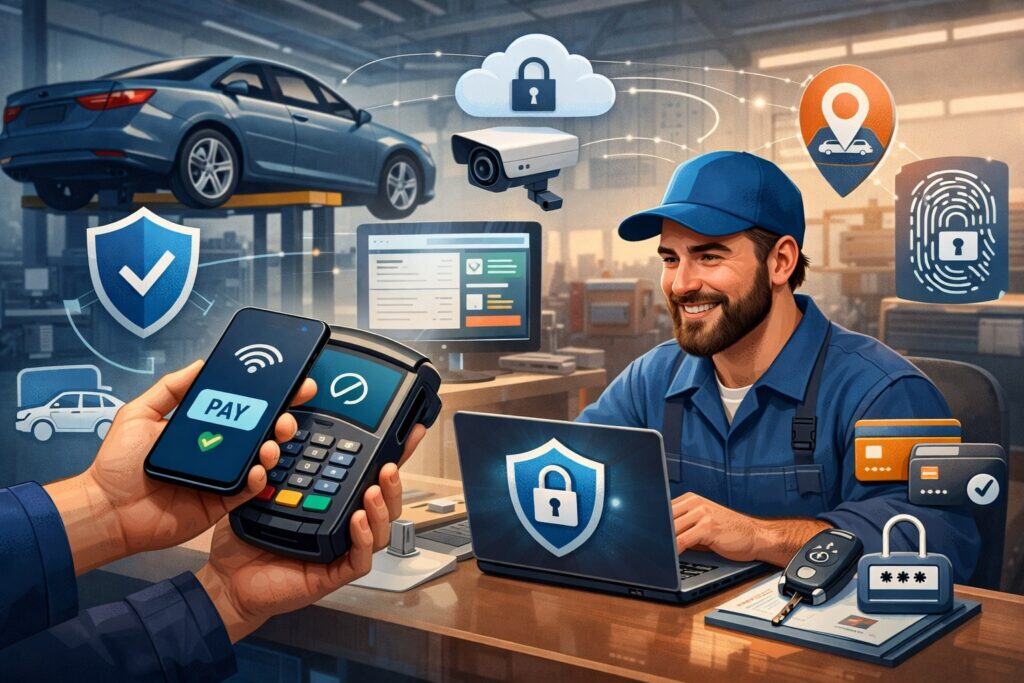
Many auto businesses think security equals “chip cards” or “a reputable processor.” That’s a start, but modern secure payment solutions combine technology, process, and verification. The goal is to reduce three things at the same time:
- Exposure (how often sensitive data is handled or stored)
- Fraud success rate (how often criminals get paid)
- Dispute loss rate (how often you lose chargebacks or refunds you shouldn’t)
Strong secure payment solutions typically include: EMV chip acceptance, contactless and mobile wallets, tokenization, safer recurring billing controls, protected payment links, real-time transaction alerts, and smart rules for high-risk transactions.
They also include business-side controls: role-based access, device and location restrictions, and secure integrations with your shop or dealership software.
Just as important, security should fit auto workflows. For example, the “service lane” use case benefits from mobile tap-to-pay and instant receipts, while a parts department benefits from invoice-based payments with strong customer verification.
Towing and roadside services often need a fast authorization flow with minimal data handling. Dealership F&I offices need safer ways to collect down payments without storing card numbers or relying on emailed forms.
When secure payment solutions are designed around how auto businesses actually operate, staff follow the process naturally—because it’s easier than the risky workaround.
Card-Present Protection: EMV, Contactless, and Device-Level Controls
In-person payments are still the backbone of many auto businesses, but the details matter. Accepting EMV chip cards properly reduces counterfeit-card fraud exposure compared to magnetic stripe transactions, and contactless payments can further lower risk by using cryptographic protections.
The key is consistency: always dip or tap when available, avoid fallback unless you have a defined procedure, and train staff not to “force” approvals.
A surprisingly common weak point is the device itself. If a terminal is outdated, unmanaged, or physically accessible to the public, it can be tampered with. Secure payment solutions should support tamper detection, device inventory, and simple replacement procedures.
If you operate multiple lanes or locations, you also want centralized visibility: which devices are active, which firmware versions are running, and whether any device behavior looks abnormal.
Auto businesses should also think about the “edge cases”: service writers taking payments at the vehicle, technicians collecting a final balance after-hours, or a parts counter running transactions all day.
A modern approach is to use mobile or countertop devices that support contactless, enforce staff logins, and minimize shared credentials. Those controls reduce “friendly fraud” too—situations where an internal mistake becomes an expensive dispute.
Finally, card-present security must connect to documentation. When a customer pays after an estimate approval, your secure payment solutions should help tie the payment record to the estimate, invoice number, and customer acknowledgment. That linkage becomes invaluable when a dispute arrives weeks later.
Card-Not-Present Safety: AVS, CVV, Payment Links, and Stronger Authorization
Phone payments and remote approvals are normal in auto—but they’re also where fraud thrives. This is where secure payment solutions must include layered verification.
At a minimum, card-not-present workflows should support AVS (Address Verification Service) and CVV checks to reduce fraud and improve your ability to contest disputes. The point isn’t to decline every mismatch; it’s to route risk.
For example, a partial AVS match might trigger a follow-up question, while a CVV mismatch might require an alternate payment method or an in-person chip read.
Next, use secure payment links instead of collecting card numbers by phone whenever possible. A well-designed pay-by-link flow moves card entry to a hosted payment page, reducing your exposure and making compliance easier.
It also creates cleaner evidence: timestamped customer completion, IP/device signals, and confirmation messages. For high-ticket repairs, payment links can be combined with digital estimate approval, making disputes much easier to defend.
For recurring or stored payments (maintenance plans, storage fees, subscriptions), tokenization is critical. You want secure payment solutions that store tokens—not raw card numbers—and that can re-authenticate customers when payment methods change. The result is fewer declines, fewer fraud approvals, and less sensitive data risk.
The best remote-payment setups also include staff guardrails: limits on keyed transactions, alerts for unusually large tickets, rules for multiple attempts, and escalation steps when a customer can’t validate identity. These rules protect your team from social engineering, not just from stolen cards.
Bank-Based Payments and High-Ticket Transactions: Safer ACH and Faster Transfer Options
Auto businesses often prefer bank-based payments for large amounts: down payments, fleet service invoices, wholesale parts, or commercial repair accounts. But “take an ACH” is not automatically secure. You want secure payment solutions that include bank verification, clear authorization language, and a clean audit trail.
For consumer down payments and service balances, a safer approach is bank transfer acceptance through verified channels (rather than emailed routing numbers).
For B2B accounts, you want invoice workflows that include approval controls, payer verification, and automated reconciliation. The core idea is the same: reduce manual handling of sensitive information and reduce the chance of misapplied funds.
Instant or near-instant bank transfer methods are also expanding, and customer expectations are shifting toward “pay now, confirm now.”
As these options grow, auto businesses should look for secure payment solutions that can support faster settlement, reduce returned payments, and automate notifications when funds are confirmed. That matters operationally: you can release a vehicle, ship parts, or close an RO with confidence.
Just as important is policy alignment. If you accept bank transfers for deposits, your refund and cancellation policy must match the payment method realities. Disputes look different for cards versus bank payments, so your team should know when to use which method and how to document authorization in each case.
Industry-Specific Use Cases: Dealerships, Repair Shops, Parts, Towing, and Mobile Service
Different auto businesses need secure payment solutions for different moments.
Dealerships often need secure ways to take deposits online, collect down payments, and handle accessories or service add-ons. The riskiest areas are remote deposits and rushed F&I payments.
Secure hosted pages, tokenized card storage (when appropriate), and strong customer verification reduce both fraud and refund conflicts. Dealers also face customer information safeguarding expectations; selecting vendors with strong security programs and clear roles helps reduce exposure.
Repair and collision shops live in estimate approvals, supplements, and high-emotion customer interactions. Disputes often come from “I didn’t approve that” or “the work wasn’t authorized.”
Secure payment solutions that combine digital approvals, signed estimates, and payment metadata reduce chargeback losses and speed up closeout.
Parts departments see a lot of phone orders and repeat customers. This is where AVS/CVV routing, pay-by-link, and account-based invoicing can reduce fraud while keeping regular customers happy. Towing and roadside services need speed and mobility; tap-to-pay, device controls, and real-time confirmation are essential.
Mobile detailers and field technicians benefit from contactless acceptance, digital receipts, and fewer “I’ll pay later” scenarios. Secure payment solutions that support instant invoicing and tokenized tips (without storing card data) can raise close rates while reducing risk.
Across all these use cases, the theme is the same: make the secure path the easy path.
How to Choose Secure Payment Solutions for Your Auto Business
Choosing secure payment solutions is partly about features and partly about operational fit. Start with the non-negotiables:
- Modern acceptance: EMV + contactless + mobile wallets, with support for mobile devices if you collect payments at the vehicle.
- Tokenization by default: Reduce data exposure and simplify recurring or stored payments.
- Hosted payment pages and links: For estimates, deposits, and phone-driven approvals.
- Fraud controls: AVS/CVV support, velocity rules, and risk review tools.
- Documentation and receipts: Digital receipts, invoice references, and customer confirmation steps that help win disputes.
Then evaluate the “auto-specific” questions: Does it integrate with your shop management system, DMS, CRM, or accounting tools? Can you tie payments to ROs and invoices cleanly? Does it support split payments, partial captures, or deposits? Can you restrict staff permissions and track which employee ran which transaction?
Finally, evaluate the vendor’s security posture. Ask about device management, incident handling, support responsiveness, and how they help you reduce PCI scope. PCI DSS v4.x expectations are pushing stronger, more consistent security practices across the ecosystem, and vendors should be able to explain how their approach supports that direction.
The “best” secure payment solutions are the ones your staff will actually use correctly—because they match your workflow and remove temptation for shortcuts.
Implementation Roadmap: Rolling Out Secure Payment Solutions Without Slowing Down Sales or Service
Rolling out secure payment solutions works best as a staged operational project rather than a sudden switch.
Start by mapping payment moments: deposits, approvals, final balance, parts orders, phone payments, refunds, tips, and recurring charges. Identify where card data is being handled manually, where receipts are inconsistent, and where approvals are happening outside your system (texts, emails, verbal agreements). Those are your priority fixes.
Next, standardize workflows. For example: “Phone orders always use pay-by-link.” “Keyed transactions over a set amount require manager approval.” “Estimate approvals require a digital signature before payment capture.” These rules don’t need to be complicated. They need to be consistent.
Then, train for behavior, not theory. Teach staff what to do when AVS partially matches, when a customer insists on reading a card number, or when someone requests unusual payment splitting. Give scripts for sensitive situations.
If you handle warranty or service contract conversations, keep an eye on scam patterns and customer confusion; the FTC continues to warn consumers about extended warranty scams, and confusion can spill into disputes.
Finally, measure outcomes: chargeback rate, keyed transaction rate, refund reasons, time-to-close, and customer satisfaction. Secure payment solutions should reduce risk and improve the customer experience—both.
Future Predictions: Where Auto Payments and Payment Security Are Headed Next
Auto commerce is changing fast, and secure payment solutions will evolve in a few predictable directions.
First, expect more tap-to-pay and mobile acceptance across service lanes and field service. Customers increasingly prefer contactless experiences, and businesses prefer reduced checkout time. Alongside that, network tokenization and improved device security will reduce raw card exposure even further.
Second, expect more instant bank transfer adoption for high-ticket payments and B2B service invoices. Faster confirmation reduces release risk (handing over keys or shipping parts before funds settle). The winning platforms will blend speed with strong authorization records and reconciliation.
Third, security will become more identity-driven. Instead of relying only on CVV and AVS, businesses will lean on verified customer profiles, passkeys, device signals, and risk scoring. That shift helps reduce both fraud and false declines.
Fourth, connected vehicles and subscription-based ownership models will expand “in-car” and account-based payments. Over time, some service payments may be initiated from OEM apps or driver profiles.
Auto businesses should prepare by using secure payment solutions that can support digital invoices, tokenized profiles, and clean customer consent records.
Finally, compliance expectations will keep rising. PCI DSS v4.x future-dated requirements already signal a move toward stronger authentication and more disciplined security programs. Auto businesses that adopt modern secure payment solutions now will be better positioned as requirements, customer expectations, and fraud tactics evolve.
FAQs
Q1) What are the biggest payment security mistakes auto businesses make?
Answer: The most common mistakes are rarely “high-tech.” They’re workflow shortcuts that create predictable risk. A big one is taking card numbers over the phone and writing them down “just for a minute.”
That single habit increases exposure dramatically because it creates uncontrolled card data storage—on paper, in notes, in screenshots, or in unsecured systems. Another common mistake is accepting proof-of-payment screenshots for bank transfers or payment apps without verifying settlement inside a trusted system.
Auto businesses also get hurt by inconsistent documentation. A dispute is easier to win when the payment is tied to a signed estimate, an invoice number, and clear service notes.
When a customer claims “I didn’t authorize this,” your defense depends on evidence. Secure payment solutions help by creating consistent receipts and metadata, but your process must ensure the payment is connected to the authorization step.
Finally, many operators overlook staff access controls. Shared logins, weak passwords, and “everyone is an admin” setups create internal risk and make investigations harder. A modern approach is role-based permissions and activity logs so you can see exactly who ran a transaction and why.
If you fix only three things, fix these: stop manual card capture, standardize approvals + receipts, and implement staff/device controls. Those changes alone dramatically strengthen secure payment solutions in real-world auto environments.
Q2) How do secure payment solutions reduce chargebacks for repair shops and dealerships?
Answer: Chargebacks are often less about “fraud” and more about confusion, miscommunication, and missing documentation. Secure payment solutions reduce chargebacks by making authorization clearer and evidence stronger.
For example, digital payment links can require customer confirmation and can be paired with estimate approvals. That creates a timeline: estimate presented, customer approved, payment completed, receipt delivered. It’s much easier to defend than “we took the card over the phone.”
Secure payment solutions also reduce chargebacks by limiting risky transaction types. If your business relies heavily on keyed-in transactions, your dispute and fraud exposure typically rises. Moving customers to chip/tap or hosted payment pages lowers that exposure and reduces the chance of “I didn’t do this” claims.
Verification tools matter too. AVS and CVV checks help flag suspicious remote transactions and can strengthen your position in disputes when used appropriately.
The goal is not to decline every imperfect match, but to identify when you need an extra step: confirm identity, use a different payment method, or require in-person payment for high tickets.
The best results come when your payment tools and your service workflow work together: clear scopes, clear policies, clear approvals, and a payment trail that matches the paperwork.
Q3) Are payment links safe for deposits, estimates, and parts orders?
Answer: Yes—when they’re implemented correctly. In many cases, payment links are safer than phone payments because they shift sensitive card entries away from your staff and into a controlled checkout page.
That reduces accidental card storage and lowers your PCI exposure. Payment links can also produce strong records: the customer completed payment themselves, at a specific time, from a device, with a confirmation message and receipt.
But not all links are equal. Secure payment solutions should generate links from a trusted system, use encryption, and support fraud controls like velocity limits and verification steps. You also want links that expire, can be reissued safely, and clearly show what the customer is paying for (invoice number, deposit description, policy acknowledgments).
Operationally, payment links shine in auto because they match real workflows: “Approve this estimate, then pay the deposit.” “Pay for parts before we order.” “Settle the final balance before pickup.” When your links are tied to invoices and approvals, disputes become easier to handle because your records stay consistent.
A best practice is to avoid sending links from personal numbers or untracked messaging. Use a system that logs delivery and payment status. That keeps your secure payment solutions clean and defensible.
Q4) What security features matter most for phone payments?
Answer: If you must take phone payments, layer your controls. First, use AVS and CVV checks and define what happens in mismatched scenarios.
Second, reduce manual entry by using payment links as the default even when the customer is on the phone—walk them through completing the link while you stay on the call. That keeps your staff from hearing or storing card details.
Third, implement transaction rules: limits on keyed tickets, limits on repeat attempts, and flags for high-risk patterns like multiple cards tried in a short window. Fraud often looks like “rapid trial and error,” and good secure payment solutions can detect that.
Fourth, improve your authorization record. For higher tickets, confirm identity with basic cross-checks (billing zip, last name spelling, phone callback to a known number, or customer account verification). Keep notes inside the customer record or invoice, not in personal notebooks or texts.
Finally, train staff against social engineering. Fraudsters often sound confident and urgent—exactly the tone that triggers “just run it.” Give staff permission to slow down and escalate. Secure payment solutions work best when your team knows the safe process and feels supported using it.
Q5) Do auto businesses need to worry about broader information security rules beyond payment security?
Answer: Often, yes—especially if your operations involve customer financing, leasing workflows, or dealership activities that include sensitive customer information.
The FTC has made clear that the Safeguards Rule applies to covered non-banking financial institutions and has specifically referenced motor vehicle dealers in its guidance. Separately, FTC amendments effective May 13, 2024 add breach reporting requirements for certain large notification events, which reinforces the need for structured security programs.
Even if your exact business isn’t covered in every scenario, the direction is unmistakable: regulators and customers expect tighter controls over customer data and vendor relationships. That includes staff access controls, secure storage practices, vendor oversight, incident response planning, and training.
This is where secure payment solutions help indirectly. When you reduce the amount of sensitive data your team handles—by using hosted pages, tokenization, and controlled integrations—you reduce your overall risk footprint. The result is fewer places data can leak, fewer systems to audit, and fewer “unknown unknowns” when something goes wrong.
Treat payments as the entry point to better data discipline. It’s one of the fastest ways for auto businesses to improve both security and operational reliability.
Q6) What’s the smartest “next step” if my shop already accepts chip cards?
Answer: If you already accept chip cards, your next best step is usually to secure the remote and edge-case payments—the ones that create outsized risk. That typically means migrating phone payments to pay-by-link, tightening rules around keyed transactions, and ensuring your receipts and approvals are consistent.
From there, improve staff/device controls: unique logins, role-based permissions, and an audit trail. Then, review your refund and deposit policies and make sure your invoice language matches your real practices. Disputes often come from policy confusion, not malice.
Finally, align with the direction of modern standards. PCI’s roadmap has pushed stronger practices, with PCI DSS v4.x future-dated requirements becoming effective March 31, 2025.
You don’t need to become a security expert overnight, but you do want secure payment solutions that reduce data handling, strengthen authentication, and create consistent documentation.
In practical terms: make it easy for customers to pay securely, make it hard for fraud to succeed, and make it simple for your team to prove authorization when disputes happen. That combination is where real payment security lives.
Conclusion
Auto businesses don’t just “process transactions.” They manage trust at high stakes: expensive repairs, major purchases, urgent towing situations, and emotionally charged customer moments. That’s why secure payment solutions are not optional infrastructure—they’re a core profit-protection system.
The most effective approach is not adding friction. It redesigns workflows so secure behavior is the default: chip/tap in person, pay-by-link for remote approvals, tokenization for stored credentials, strong receipts and invoice linkage, and staff/device controls that prevent mistakes.
Along the way, you also prepare for rising expectations around PCI-aligned practices and broader customer information safeguarding, which are moving toward more structured security programs and clearer accountability.
Looking ahead, payments will get faster (contactless and instant bank transfers), more identity-driven (risk scoring, verified profiles), and more embedded into digital auto experiences (subscriptions and connected services).
Auto operators who choose modern secure payment solutions now will reduce fraud, lower chargebacks, streamline operations, and build customer confidence—without sacrificing speed in the lane or at the desk.