
Automotive businesses don’t all process payments the same way. A tire shop that charges $89 for a rotation is worlds apart from a dealer collecting $9,000 down payments, a broker taking deposits for shipped vehicles, or a repair network selling high-ticket warranties online.
Processors and banks price that difference as risk—and in payments, “risk” usually means disputes, fraud exposure, regulatory scrutiny, and loss potential.
That’s where high-risk automotive merchant accounts come in. A high-risk setup is not a badge of dishonor. It’s a specialized underwriting and processing arrangement designed for automotive models with higher average tickets, higher chargeback sensitivity, more complex fulfillment, or higher fraud pressure.
The goal is simple: keep approvals strong while reducing the odds of sudden holds, rolling reserves, or account termination.
This guide breaks down how high-risk automotive merchant accounts work, why some automotive verticals are flagged as high risk, what you’ll pay (and why), and how to build a processing profile that can scale.
You’ll also see practical compliance and chargeback controls you can implement immediately, plus forward-looking predictions about where automotive payments are heading—especially around disputes, fraud monitoring, and tighter underwriting.
Throughout this article, you’ll see the phrase high-risk automotive merchant accounts frequently because that’s the core topic—and because searchers use it when they need a realistic, operator-friendly explanation.
What “High-Risk” Means in Automotive Payment Processing
In card processing, “high-risk” is primarily an underwriting label. It means the processor and sponsoring bank expect a higher probability of loss than average.
For automotive, that risk can come from large ticket sizes, deposit-based sales, delayed fulfillment, remote transactions, complex refund terms, or customer dissatisfaction that turns into disputes.
For example, a dealership might process large down payments and add-on products like GAP, service contracts, accessories, and delivery fees. If a customer later claims misrepresentation, a dispute can pull multiple line items into a single chargeback.
Similarly, a vehicle transport company may take deposits weeks before delivery, which expands the dispute window and increases “services not rendered” claims.
High-risk automotive merchant accounts exist because standard, low-risk pricing assumes tighter controls: quick fulfillment, smaller tickets, low dispute rates, and simple returns. Automotive can break those assumptions—especially when sales happen online, over the phone, or with “card-not-present” payments.
Card networks and acquirers also evaluate fraud and dispute monitoring programs more aggressively than in the past. Visa has been consolidating fraud and dispute monitoring into an updated Visa Acquirer Monitoring Program (VAMP) structure with updated thresholds effective in 2025.
When monitoring becomes stricter, automotive businesses that operate on deposits, high tickets, or remote channels often get categorized into high-risk automotive merchant accounts earlier in the relationship.
Why Automotive Businesses Get Classified as High Risk
Automotive is a broad category. Some segments run clean with low disputes, while others are naturally dispute-prone. Underwriters typically look at patterns that statistically drive losses:
- High average ticket and high variance: A repair shop might run $200–$800 tickets, while a dealer or broker might process $5,000–$20,000 down payments. Higher tickets increase the financial impact of a single dispute, which matters when banks model worst-case scenarios.
- Deposits and delayed fulfillment: Deposits are common for custom work, vehicle holds, and transport scheduling. When fulfillment is delayed, customers have more time to change their minds or question charges. That fuels disputes.
- Card-not-present exposure: Phone orders for parts, online sales of accessories, remote service bookings, and emailed invoices increase fraud risk. Fraud increases both chargebacks and underwriting concerns.
- Complex terms: Automotive invoices often include labor, parts, diagnostic fees, restocking fees, and special-order policies. If these are not clearly disclosed and acknowledged, disputes go up.
- Complaint risk and reputation signals: Underwriters may review online complaints, refund disputes, or patterns in customer feedback. High complaint density can push you toward high-risk automotive merchant accounts even if your internal operations are solid.
- Industry classification and MCC: Merchant Category Codes help networks and banks categorize the business. MCC assignment can affect monitoring assumptions and even interchange behavior, because MCCs are used to classify industries for processing and risk programs. If your automotive model is misclassified, you can get priced or monitored incorrectly—often in the most conservative way.
These factors don’t automatically mean you’re “bad.” They mean you need stronger documentation and controls to make high-risk automotive merchant accounts stable and scalable.
Types of High-Risk Automotive Merchant Accounts
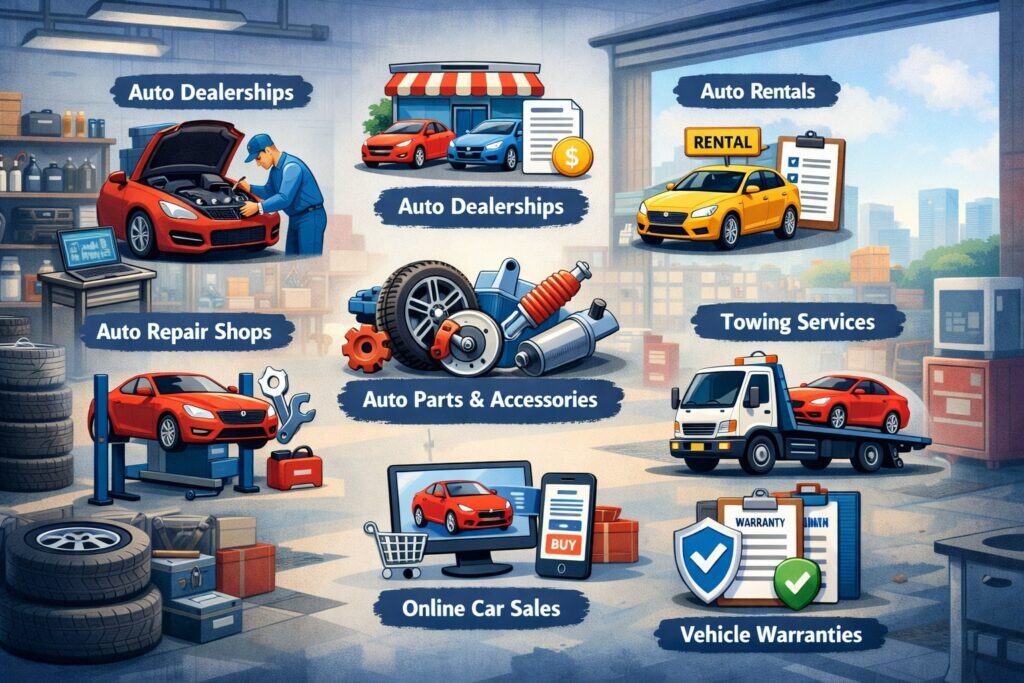
Not all high-risk automotive merchant accounts look alike. The best setup depends on what you sell, how you sell it, and your fulfillment timeline. Below are the common automotive models that tend to need high-risk underwriting.
Dealerships, Down Payments, and Add-Ons
Dealerships process a mix of down payments, document fees, accessories, and aftermarket products. Disputes can happen when customers later claim they didn’t authorize add-ons or they misunderstand what was included in financing. The operational fix is stronger line-item clarity, signed acknowledgments, and consistent descriptor use.
Another risk driver is volume spikes—special promotions, seasonal sales, or inventory liquidation. When volume jumps suddenly, processors may place holds unless the account is structured as one of the high-risk automotive merchant accounts built for scale.
Auto Repair, Collision, and Diagnostic Services
Repair shops can be low risk when they serve local repeat customers and use chip/tap in-store. They become at higher risk when they take phone payments, store cards on file, charge large repair tickets, or face insurance-related billing disputes.
Collision work can also involve long timelines, supplements, and customer frustration—an environment where chargebacks happen even when the work was legitimate.
Auto Parts, Accessories, and Performance Products
Parts businesses get flagged when they sell high-demand items (fraud targets), accept online orders, or have strict restocking rules. A common dispute trigger is “not as described” or “didn’t fit my vehicle.” Better fitment disclosure, VIN-based validation, and simpler returns reduce the need for a more expensive high-risk automotive merchant accounts structure.
Vehicle Transport, Logistics, and Shipping-Related Fees
Transport companies often take deposits and final payments at delivery milestones. Customer disputes commonly cite delays, rescheduling, damages, or “services not rendered.” The strongest mitigation is milestone-based billing with written acceptance at each step.
Brokers, Marketplaces, and Consignment Auto Sales
Brokerage models often attract risk labels because the merchant is not always the final deliverer. Underwriters worry about “third-party fulfillment” and unclear liability.
If you’re operating as an intermediary, you’ll usually need one of the more specialized high-risk automotive merchant accounts with clear contractual terms, proof of authorization, and verifiable delivery evidence.
How Underwriting Works for High-Risk Automotive Merchant Accounts

Underwriting is a financial and compliance risk assessment. For high-risk automotive merchant accounts, it is deeper, more document-heavy, and more sensitive to operational details. Underwriters generally want to answer three questions:
1) Is the business real and stable?
They verify entity formation, ownership, address, phone, web presence, and banking history. They look for consistency between your public claims and what you actually sell.
2) Can the business fulfill what it sells?
They examine your supply chain, fulfillment process, and refund policies. For automotive, they often ask how you handle deposits, cancellations, special orders, and timeline changes.
3) What is the expected dispute and fraud profile?
This is where your processing history matters most. If you have prior statements, chargeback ratios, or refund patterns, underwriters will price the account accordingly.
It’s also normal to see underwriting focus on your disclosure controls: invoices, estimates, signed work authorizations, and terms acceptance. In high-ticket automotive, strong paperwork is not “red tape.” It’s what protects you when a dispute happens.
Network monitoring pressure reinforces this. Visa’s updated monitoring program structure emphasizes consolidated dispute and fraud measurement in the ecosystem, which increases the importance of keeping disputes low and well-documented.
That’s why high-risk automotive merchant accounts often require operational playbooks—not just a payment gateway.
Pricing, Fees, and Reserves: What You’ll Really Pay and Why
Pricing for high-risk automotive merchant accounts can feel confusing because it bundles multiple cost drivers: interchange, processor markup, risk buffers, and sometimes reserves. Instead of chasing the “lowest rate,” focus on the total cost of stability.
The Core Components of High-Risk Pricing
Interchange and assessments. These are baseline network costs that apply across most merchants.
Processor markup. High-risk underwriting adds margin because the processor’s loss exposure is higher, support needs are higher, and fraud tooling may be bundled.
Reserve structures. Many high-risk automotive merchant accounts include either:
- Rolling reserve (a percentage held for a set period),
- Capped reserve (held until a threshold), or
- Upfront reserve (rare, but possible for brand-new, high-ticket models).
Reserves exist to protect against chargebacks and refund surges. In automotive, a single dispute can be large, and a cluster of disputes can trigger monitoring programs quickly. That’s why underwriters lean conservative.
Why “Cheap” Processing Often Becomes Expensive
A low upfront rate can hide:
- aggressive funding holds,
- sudden account termination after a volume spike,
- poor dispute support, or
- misaligned MCC/risk settings that cause declines.
A properly designed high-risk automotive merchant accounts setup may cost more per transaction but save you far more by reducing downtime and preserving cash flow predictability.
Chargebacks and Disputes in Automotive: Root Causes and Prevention
If you want high-risk automotive merchant accounts that last, your top priority is dispute control. Automotive disputes tend to come from a few repeat patterns:
- Authorization confusion: Customers claim they didn’t approve a deposit, add-on, or second charge. This is common when invoices are explained verbally but not signed digitally or physically.
- Timeline and fulfillment disputes: Delays, backorders, and “I expected it sooner” claims can lead to chargebacks even when you delivered later.
- Quality or fitment disputes: Parts that don’t fit, repairs that don’t solve the issue, or dissatisfaction with cosmetic outcomes can trigger “not as described” disputes.
- Refund misunderstandings: Restocking fees, diagnostic fees, or non-refundable deposits often cause conflict if they weren’t clearly disclosed and acknowledged.
Network programs reinforce why this matters. Mastercard publishes merchant-facing guidance on disputes and chargebacks and expects merchants to retain compelling evidence and follow correct processes.
When disputes rise, the consequences escalate from fees to monitoring status and, eventually, account shutdown risk.
Practical Dispute Controls That Actually Work
- Use a two-step authorization for deposits: Have the customer approve the amount and the policy (cancellation/refund terms) separately. This reduces “I didn’t know” claims.
- Make invoices line-item clear: Don’t bury add-ons. Make each product/service explicit.
- Always capture delivery evidence: For parts: delivery confirmation, signature when possible, photos of packaging labels, and tracking. For services: signed work order, before/after photos, and completion acknowledgment.
- Use consistent descriptors: Customers dispute what they don’t recognize. Your descriptor should match your brand name, not a parent company name they’ve never heard.
These steps make high-risk automotive merchant accounts cheaper over time because your risk profile improves and reserves can often be reduced.
Fraud Risk in Automotive and How to Reduce Declines
Fraud prevention is a balancing act. Too little screening increases chargebacks. Too much screening increases declines and loses revenue. High-risk automotive merchant accounts should be configured to match how your customers buy.
Fraud Patterns Common in Automotive
- Card testing and enumeration: Fraudsters may test stolen card data on businesses with weak controls. Visa explicitly calls out enumeration as a risk area in the ecosystem. This is especially relevant for parts websites with many small “test” transactions.
- High-ticket remote orders: Performance parts, specialty wheels, or large repair deposits paid over the phone are attractive targets.
- Mismatched delivery and billing: Shipping expensive items to a new address is a common red flag.
Controls That Help Without Killing Conversions
- Use AVS and CVV intelligently: Require CVV for card-not-present. For AVS, avoid rigid rules that reject legitimate customers who abbreviate address formats. Use a risk-scoring approach.
- 3DS where appropriate: If you sell online and see fraud, selective 3DS can shift liability in some scenarios and deter fraud.
- Velocity limits and bot controls: Limit multiple attempts per card/IP/device. Add CAPTCHA and bot detection to checkout.
- Manual review for high tickets: A structured “review queue” for orders above a threshold is often worth it in high-risk automotive merchant accounts.
Good fraud controls lower chargebacks, which supports better pricing and reduces the odds of monitoring program consequences.
Contracts, Disclosures, and Policies That Underwriters Want to See
Underwriters don’t just price risk—they look for proof you can manage it. For high-risk automotive merchant accounts, your website and paperwork are part of your underwriting file.
The Non-Negotiables
- Clear refund and cancellation policy: Explain deposits, diagnostic fees, special orders, restocking fees, and cancellation windows in plain language.
- Shipping and delivery timelines: If there are delays, say so. Underwriters prefer honest timelines over optimistic promises.
- Terms acceptance records: For online sales, use checkbox acceptance with timestamp and IP logging. For in-person, store signed copies.
- Complaint handling workflow: Show you can resolve issues before they become disputes: fast customer response, escalation path, and documented outcomes.
Where This Becomes Regulatory (and Why It Matters)
Automotive sales and financing practices can attract consumer protection scrutiny. The Federal Trade Commission has been active around auto retail practices, and the proposed CARS Rule went through legal challenges, including a Fifth Circuit decision vacating it before it took effect.
Even when specific rules change, the broader theme remains: clear disclosures and fair practices reduce complaints, disputes, and processing risk.
Well-built policies aren’t just “for compliance.” They directly improve the stability of high-risk automotive merchant accounts.
Payment Methods and Tech Stack for Automotive Businesses
A modern automotive payments setup is rarely “just a terminal.” High-risk automotive merchant accounts often work best with a layered stack that supports documentation, recurring billing (where legitimate), invoicing, and risk controls.
Card-Present vs Card-Not-Present Strategy
Card-present (chip/tap) typically has lower fraud risk and better approvals. If your business can shift more volume to in-person payments, your profile improves.
Card-not-present (online, phone, invoices) needs stronger controls: identity checks, signature capture, evidence retention, and fraud tooling.
A common strategy is to separate flows:
- In-store terminal for standard service tickets
- Invoicing system for deposits and remote approvals
- E-commerce gateway for parts/accessories
This segmentation helps you keep high-risk automotive merchant accounts stable because a fraud spike in one channel doesn’t automatically contaminate every transaction type.
ACH, Bank Transfer, and Alternative Payments
For larger tickets, bank payments reduce chargeback exposure compared to cards. Many automotive operators use ACH for large invoices or final balances. The key is customer experience: clear instructions, confirmation receipts, and accounting reconciliation.
Recurring Billing and Subscriptions (Use Carefully)
Membership maintenance plans and service subscriptions can work well, but only if disclosures are strong and cancellation is easy. Subscriptions that frustrate customers are chargeback magnets, which can destabilize high-risk automotive merchant accounts quickly.
Steps to Get Approved for High-Risk Automotive Merchant Accounts
Approval is faster when you anticipate underwriting questions. Here’s what most providers want to see.
Business and Identity Documents
- Entity registration and ownership verification
- Business bank account details and voided check
- Processing history (if available)
- Website that matches your products/services
Operational Proof
- Sample invoices, estimates, and work orders
- Refund/cancellation policy and customer communications templates
- Shipping and delivery workflow (if relevant)
Processing Plan
- Expected monthly volume, average ticket, and peak scenarios
- Payment channels (in-store, online, phone, invoices)
- Fraud and dispute controls you will use
The more professional your package, the more likely you’ll receive terms that are workable—lower reserves, fewer holds, and smoother scaling. That’s the difference between “having an account” and having high-risk automotive merchant accounts you can actually build a business on.
How to Scale Without Getting Funds Held or the Account Shut Down
Many automotive merchants get approved, then run into trouble during growth. Sudden volume changes, big-ticket spikes, or new sales channels can trigger risk systems. Scaling high-risk automotive merchant accounts safely means acting like an underwriter before the underwriter forces the issue.
The Rules of Stable Growth
- Ramp volume gradually: If you expect a major promotion, notify your processor and provide context.
- Keep tickets consistent with your model: If your average ticket is $400 and you suddenly run $12,000, expect a review.
- Avoid “surprise” fulfillment shifts: Switching from in-store to online, or adding shipping, changes risk. Update underwriting.
- Control refunds proactively: Refunding quickly can reduce chargebacks, but excessive refunds can also look like instability. Track the reasons and fix root causes.
Build a Dispute-Ready Evidence System
Winning disputes is easier when evidence is standardized:
- Signed authorization
- Clear invoice
- Proof of delivery/completion
- Communication logs
Because network monitoring is getting more structured, documentation is becoming more valuable. Visa’s monitoring updates and consolidated measurement approach signal the direction: less tolerance for messy dispute patterns.
When you treat your operations like a risk-managed system, high-risk automotive merchant accounts become a growth tool instead of a fragile dependency.
Common Mistakes That Make Automotive Merchants “High Risk” Forever
Some merchants stay expensive and unstable because they repeat avoidable mistakes.
“One-Size-Fits-All” Checkout and Policies
If your checkout doesn’t match your business model—deposits, custom work, backorders—customers feel misled and disputes rise.
Weak Descriptors and Customer Recognition
Customers dispute unfamiliar descriptors. A clean descriptor and consistent receipts reduce “friendly fraud.”
Over-Reliance on Phone Payments
Phone payments can be legitimate, but they need stronger controls: recorded authorization language (where legally allowed), emailed invoices, signed approvals, and identity checks.
Ignoring MCC and Business Classification
MCC classification is part of how transactions are categorized and interpreted. MCCs are established by card brands and assigned by acquirers/processors when accounts are issued. If you’re misclassified, you may be treated like a different risk category than your actual model—often with worse pricing and monitoring.
Fixing these issues can move you from “permanent high risk” to “managed risk,” where your high-risk automotive merchant accounts become cheaper and more resilient.
Future Predictions: Where High-Risk Automotive Merchant Accounts Are Heading
Automotive payments are shifting fast, and risk systems are evolving with them. Here are the most likely trends shaping high-risk automotive merchant accounts over the next few years.
Dispute Monitoring Will Stay Tighter
Visa has been consolidating monitoring approaches and updating thresholds in 2025, signaling ongoing emphasis on dispute and fraud measurement. The practical outcome: merchants will need better evidence, cleaner policies, and more proactive customer communication.
Fraud Tooling Will Become More Standard
Expect more merchants to adopt:
- risk scoring,
- bot mitigation,
- selective 3DS,
- device intelligence,
- smarter velocity controls.
These tools will increasingly be “table stakes” for high-risk automotive merchant accounts that process online.
More Split-Tender and Bank Payments for Big Tickets
As tickets rise, merchants will push customers toward bank payments for final balances, with cards used for smaller deposits. That reduces chargeback exposure while keeping checkout flexible.
Underwriting Will Get More Data-Driven
Providers will look beyond basic docs and analyze:
- fulfillment timelines,
- complaint ratios,
- refund timing,
- shipment patterns,
- identity signals.
If you build your operations to produce clean data, you’ll benefit as underwriting becomes more automated.
Frequently Asked Questions
Q.1: What qualifies as high-risk automotive merchant accounts?
Answer: High-risk automotive merchant accounts are typically assigned when your business model has higher dispute or fraud exposure than average. Common triggers include high ticket sizes, deposits, delayed fulfillment, remote transactions, complex refund terms, or elevated complaint signals.
Automotive models that combine multiple risk factors—like online parts sales with high fraud attempts or transport deposits with long delivery timelines—are especially likely to need high-risk automotive merchant accounts.
The key is that “high risk” is not a moral judgment. It is a pricing and monitoring category based on expected loss probability. If you can show strong documentation, clear policies, and stable processing behavior, you can often secure better terms over time, even within a high-risk classification.
Q.2: Are reserves always required for high-risk automotive merchant accounts?
Answer: Not always, but reserves are common. Underwriters use reserves to protect against chargebacks and refund surges. In automotive, where tickets can be large, reserves are a rational safety measure. The structure varies—rolling reserve, capped reserve, or sometimes none if you have strong history and low disputes.
If you want to reduce reserve requirements, focus on lowering disputes, improving documentation, and keeping volume predictable. As your risk profile improves, many providers will consider adjusting terms on high-risk automotive merchant accounts.
Q.3: Can automotive businesses process down payments with cards safely?
Answer: Yes, but it must be done carefully. Down payments are dispute-sensitive because customers may later claim they didn’t authorize the charge or they misunderstood the terms. The best practice is a clear, signed deposit authorization that includes refund/cancellation policy, timeline expectations, and what the deposit applies to.
For high-risk automotive merchant accounts, down payment controls are one of the biggest levers for stability. When you can prove informed consent and provide supporting documentation, disputes drop dramatically.
Q.4: How do I reduce chargebacks in an automotive repair or parts business?
Answer: Start with the top drivers:
- Make invoices and estimates line-item clear
- Capture signed authorization before work begins
- Use before/after photos and completion sign-off
- Provide receipts that match the descriptor customers will see
- Communicate delays and backorders proactively
- Make refund and restocking rules obvious and acknowledged
Then add fraud controls for online/phone orders. Chargeback prevention is a system, not a single trick. The stronger your evidence and communication, the more durable your high-risk automotive merchant accounts become.
Q.5: Will dispute monitoring programs impact automotive merchants more in the future?
Answer: Very likely. Visa has already been updating and consolidating monitoring approaches in 2025, emphasizing ecosystem-wide fraud and dispute reduction. That direction suggests continued pressure on merchants to manage disputes tightly.
For automotive, the best future-proofing is operational: clean authorizations, clear policies, proof of delivery/completion, and fast customer service. Those fundamentals will matter regardless of which monitoring framework is in place.
Conclusion
High-risk automotive merchant accounts exist because automotive payments involve unique realities: bigger tickets, deposits, delayed fulfillment, complex service outcomes, and higher dispute sensitivity.
The right approach is not to “fight” the high-risk label—it’s to manage risk so well that high-risk automotive merchant accounts become stable, scalable, and cost-effective.
If you take one lesson from this guide, make it this: payment stability is built in operations. Clear policies, strong authorization, evidence retention, thoughtful fraud controls, and predictable growth do more for your approval rates and funding reliability than any rate negotiation ever will.
As dispute monitoring and fraud measurement keep tightening—signaled by ongoing network program updates—automotive merchants that treat payments like a risk-managed process will win.
High-risk automotive merchant accounts can absolutely support serious growth, but only when the business is engineered to prevent disputes, document fulfillment, and protect customer trust at every step.