By Rachel Dunn January 14, 2026
Mobile mechanics live in the real world: driveways, parking lots, fleet yards, and roadside calls where the customer wants the job done fast—and wants to pay just as fast. That’s why automotive merchant accounts for mobile mechanics have become less of a “nice-to-have” and more of a competitive edge.
When you can take a card, a digital wallet tap, or a keyed invoice payment on the spot, you shorten your cash cycle, reduce no-shows, and look more professional than the “cash-only” competitor.
But mobile automotive work creates unique payment challenges. Your average ticket can swing from a $79 diagnostic to a $2,200 brake-and-rotor job. You may take deposits for parts, run a second payment after labor, or bill fleets on net terms.
You might charge in a low-signal area, take payments after-hours, or invoice remotely. Those are exactly the situations that can trigger chargebacks, “high-risk” flags, or funding holds if your setup isn’t built for the way you work.
This guide breaks down how automotive merchant accounts for mobile mechanics work, what processors look for, how to keep approval easy, how to price your services without margin leaks, and how to future-proof your payments as more customers move to contactless and instant options.
What an Automotive Merchant Account Really Is (and Why Mobile Mechanics Need One)

An automotive merchant account is the core payment relationship that allows a business to accept card payments and settle funds into a bank account. For mobile mechanics, that’s not just “swipe a card.”
It includes your processing profile, underwriting rules, risk settings, payment hardware or Tap-to-Pay setup, fraud tools, dispute workflows, and how your transactions are coded and authorized.
A lot of mobile businesses start with a simple card reader and a generic app. That can work for very small volumes, but it often breaks when you scale. The moment you start taking larger tickets, doing deposits, selling parts, or billing commercial accounts, you need a setup designed for automotive workflows.
That’s where automotive merchant accounts for mobile mechanics matter: they’re optimized for your real transaction patterns rather than treating you like a coffee cart or a general contractor.
The biggest difference comes down to how your payments are classified and managed. Mechanics frequently deal with “card-not-present” scenarios (invoicing, keyed payments, pay-by-link), mixed tender (partial cash plus card), and delayed completion (diagnosis today, parts tomorrow, final payment later).
Those patterns can look risky to a processor if your account is not configured correctly. A true automotive merchant account helps align your operations with what banks and card networks expect to see, which improves approval odds, reduces random holds, and keeps your funding predictable.
Why Mobile Mechanic Payments Get Flagged (and How to Avoid Funding Holds)

Mobile mechanics are not inherently “high risk,” but the way mobile automotive payments behave can raise risk signals. Common triggers include: big ticket jumps, frequent manual entry, taking deposits without clear documentation, customer claims about “unauthorized” transactions, and inconsistent location data (because you’re mobile).
Even your schedule can be a factor—if most of your payments happen evenings and weekends, some processors see that as “unusual” compared to a brick-and-mortar shop.
The good news is that most of these issues are preventable. Start with clean operational habits. Always use written estimates, obtain approval (text or email counts), and document any changes mid-repair.
Capture a signature or digital acceptance for each transaction. Add photos of parts, VIN, and completed work to the job record. When your payment system can attach receipts and notes to transactions, disputes become far easier to win.
Funding also happens when processors don’t understand your normal cash flow. For example, you might collect $600 deposits for parts, then settle the final balance a week later. If underwriting expects “same-day services,” deposits can look like “unfulfilled goods.”
The fix is simple: your account setup should match your real workflow. A properly underwritten automotive merchant account can be configured for deposits, split payments, and invoicing without alarming risk controls.
Also pay attention to compliance changes. Payment security standards have tightened with PCI DSS 4.0 requirements becoming mandatory after March 31, 2025, increasing expectations around authentication, access controls, and secure payment handling.
A provider that supports tokenization, secure mobile acceptance, and strong account controls is no longer optional—it’s how you stay stable and fund reliably.
Choosing the Right Payment Mix: In-Person, Tap-to-Pay, Invoicing, and Remote Pay Links
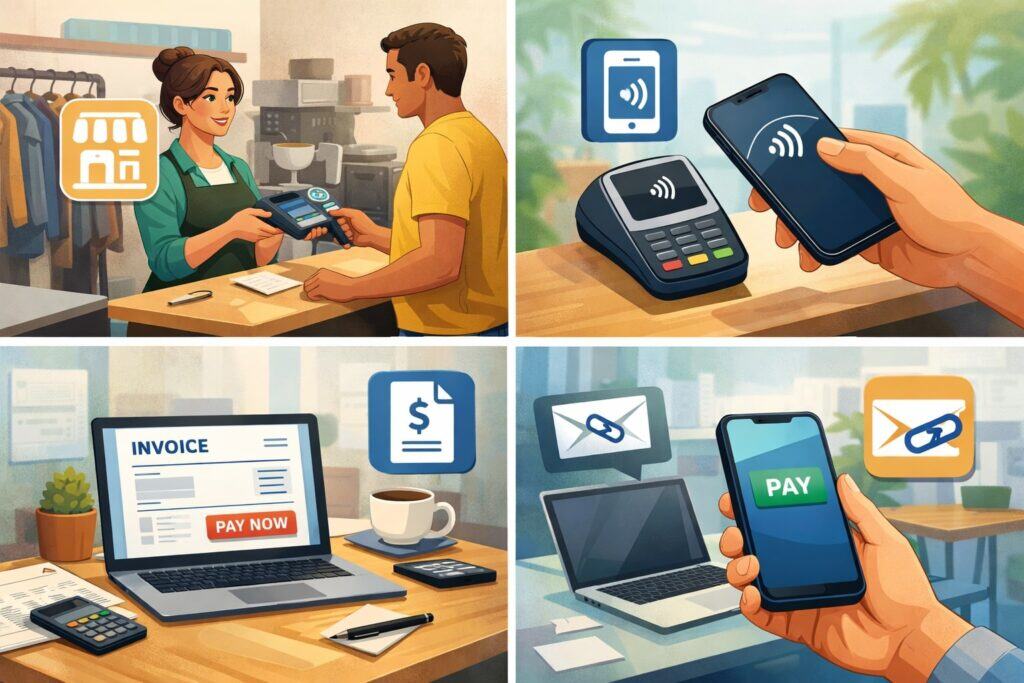
Mobile mechanics need a flexible “payment stack,” not a single method. The best setups combine:
- In-person card acceptance for customers who want to pay immediately at the vehicle.
- Contactless acceptance for speed and modern preferences.
- Invoicing / pay-by-link for fleets, repeat clients, or customers who aren’t present.
- Deposits and partial payments for parts-heavy jobs.
Contactless is especially important now because customers increasingly expect to tap their phone or card. Tap-to-Pay on smartphones has expanded through multiple providers, letting merchants accept contactless payments directly on a compatible phone without extra hardware in some setups.
For a mobile mechanic, that can mean fewer devices to charge, fewer things to lose, and a faster checkout in tight spaces like driveways.
That said, you still want redundancy. Phones die. Signals drop. Some customers want chip insertion for higher tickets. A reliable mobile card reader plus Tap-to-Pay capability plus invoicing gives you “always able to take payment,” which directly reduces canceled jobs and awkward payment delays.
When evaluating automotive merchant accounts for mobile mechanics, look for a system that supports:
- Quick estimates + invoices from the field
- Text-to-pay or email pay links
- Partial payments and deposits
- Tips (optional) and custom line items
- Digital receipts and job notes
- Tokenization so repeat customers can pay faster (with permission)
This mix is what makes your payments feel effortless for the customer while keeping your backend organized.
How Pricing Works: Interchange, Markup, and What “Good Rates” Mean for Mechanics
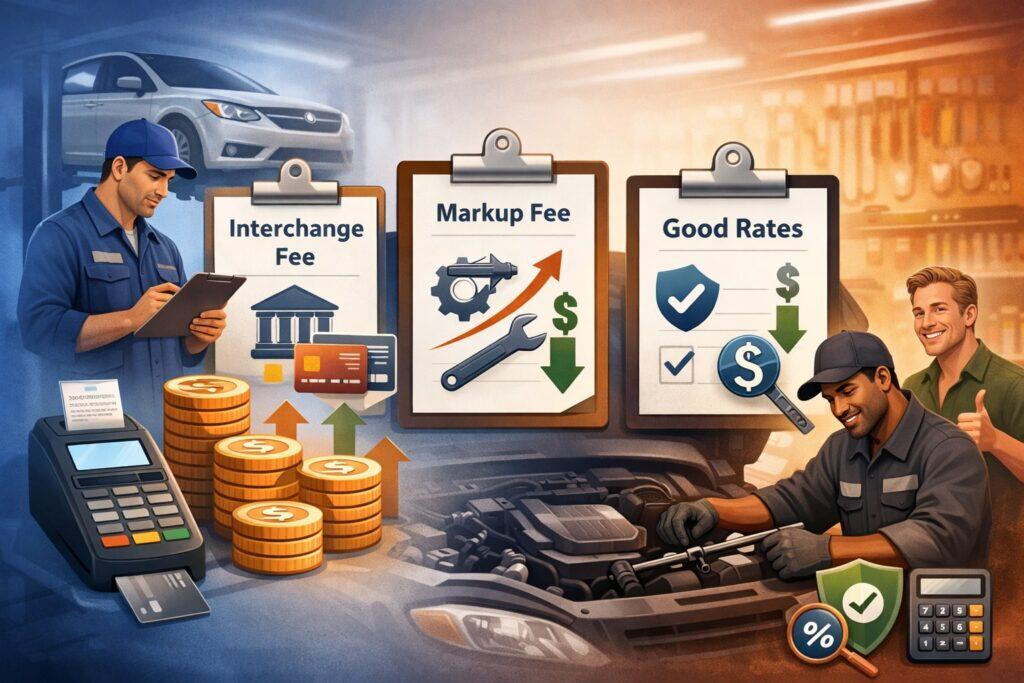
Pricing is where many mechanics lose money without noticing. A processor might advertise a low rate, but your actual cost depends on the type of card, how it’s accepted, and your pricing model. The two most common models are:
- Interchange-plus: You pay the card network’s base costs (interchange and assessments) plus a transparent processor markup. This is often best for growing mobile mechanics because it scales fairly, and you can see what you’re actually paying.
- Flat-rate: One blended rate for most transactions. This is simple, but it can become expensive for higher average tickets, especially when customers use premium rewards cards.
For mobile mechanic businesses, your acceptance method matters. Keyed transactions and remote invoices generally cost more than tap/chip in-person because they carry higher risk. If you invoice frequently, a “low swipe rate” doesn’t help you; you need competitive card-not-present pricing and tools that reduce disputes.
A strong automotive merchant account provider will help you lower true cost by improving your transaction quality:
- Encouraging chip/tap when available
- Using AVS (address verification) for keyed payments
- Requiring CVV on remote transactions
- Using customer authentication flows for invoices
- Keeping chargebacks low through better receipts and policies
“Good rates” for mobile mechanics aren’t just a number—they’re a combination of transparent pricing, stable funding, and low operational friction. The cheapest rate in the world is a bad deal if your funds get held whenever you have a strong week.
Underwriting Requirements: What You Need to Get Approved Faster
Approval is easiest when you prepare like an underwriter. The bank wants to know: Who are you? What do you sell? What’s your refund policy? How do customers contact you? And do you have a history of disputes?
To speed approval for automotive merchant accounts for mobile mechanics, have these ready:
- Business formation details (LLC or sole prop info)
- EIN (or SSN for sole proprietor setups)
- Business bank account
- Driver’s license or owner verification
- Website or service page (even a simple one)
- Service list with typical price ranges
- Photos of your van/truck branding (helps legitimacy)
- Policies: refunds, cancellations, warranties, dispute contact
Underwriters like consistency. If your website says “diagnostics $99+” and your ticket history shows $1,800 repairs, that mismatch can trigger questions. It’s better to present a realistic range: “Most repairs $150–$2,500 depending on parts and labor.”
If you take deposits, say so. If you do fleets, say so. If you do emergency roadside calls, say so. The goal is to match your merchant profile to your real revenue patterns so your account doesn’t get “surprised” later.
Also, make your customer communications professional. A clear invoice, a clear receipt, and a clear way to reach you reduces chargeback risk dramatically—and that’s a top underwriting concern.
Chargebacks and Disputes: The Mobile Mechanic Playbook to Win More Cases
Chargebacks are a reality in automotive services because customers sometimes dispute based on misunderstanding, buyer’s remorse, or frustration when a repair doesn’t solve an underlying problem. Mobile mechanics can win more disputes by building a paper trail from the start.
Your dispute-proof workflow should include:
- A written estimate before work begins
- Customer approval captured by signature, text, or email
- Photos/video evidence (VIN, odometer, parts replaced)
- Clear line-item invoices (labor, parts, disposal fees, etc.)
- A warranty statement (what’s covered, what’s not)
- A “diagnosis fee” explanation if applicable
- A final completion confirmation
When a chargeback happens, the card network will look for evidence that the customer authorized the charge and received the service described. Mobile mechanics often lose disputes because they have the evidence—but it’s scattered in texts, photos, and notes instead of attached to the transaction record. Choose tools that let you store documentation alongside invoices and receipts.
Also reduce “friendly fraud” by using:
- Chip/tap acceptance when possible
- Customer-present verification for big tickets
- Clear descriptors on statements (your business name should be recognizable)
- Follow-up messages summarizing work done
The result: fewer disputes, better win rates, and a healthier processing profile—which helps keep your automotive merchant account stable long-term.
Managing Deposits, Parts Purchases, and Split Payments Without Risk Spikes
Many mobile mechanics operate with thin cash buffers because parts are expensive. Deposits are common and often necessary. The challenge is structuring deposits in a way that’s fair to the customer and acceptable to payment risk controls.
A strong approach is:
- Collect a parts deposit only after diagnosis is approved
- Document the purpose (“Deposit for parts ordering”)
- Provide an expected timeline and cancellation policy
- Send a deposit receipt immediately
- Apply the deposit as a credit on the final invoice
Split payments are also common. A customer might pay half today, half on payday, or pay parts now and labor later. Your automotive merchant account should support multiple payments per invoice and maintain a clean record.
Avoid risky patterns like:
- Charging a deposit without a written estimate
- Charging multiple incremental transactions without documentation
- Completing the work but delaying settlement for long periods
- Taking “off-the-books” payments that make your processing look inconsistent
If you do fleet work, consider invoicing terms while still accepting cards for faster settlement. Some platforms let fleets pay by ACH or card; others offer pay links with stored payment credentials for repeat clients (with permission). The key is to have a consistent process that your customers and your processor can understand.
Compliance and Security: PCI, Mobile Devices, and Safer Payment Handling
Security is not just for big retailers. Mobile mechanics are prime targets for device theft, phishing, and account takeover because work happens in the field and devices travel everywhere. That’s why PCI compliance and strong account controls matter.
PCI DSS 4.0 introduced new requirements that became mandatory after March 31, 2025, raising the bar on authentication, access, and secure handling of payment data. For mobile mechanics, the practical takeaway is: avoid storing card data yourself, use tokenization, lock down device access, and keep payment apps updated.
Best practices:
- Use a PCI-compliant payment app that never exposes full card numbers
- Turn on device passcodes/biometrics and auto-lock
- Use role-based access if you have technicians
- Don’t accept card numbers by text message
- Use secure pay links for remote payments
- Train your team on phishing and fake “processor” calls
If your provider supports Tap-to-Pay and modern tokenization, you reduce card-data exposure because the phone becomes a secure acceptance point. Tap-to-Pay availability has expanded through multiple providers and integrations, making it increasingly realistic for field services.
A secure setup protects your customers, protects your business, and reduces the chances of costly account interruptions.
Cash Discount vs Surcharging: How Mobile Mechanics Can Recover Costs Legally
Processing fees add up. Many mechanics look for ways to recover costs, but doing it incorrectly can create compliance problems or upset customers.
Two common strategies are:
Cash discount: You set a standard (higher) price and offer a discount for cash.
Surcharging: You add a fee when a customer pays with a credit card (not debit), subject to rules and disclosure requirements.
Card network rules limit surcharges. Visa generally caps surcharges to the lesser of 3% or the merchant’s average effective rate, while Mastercard caps surcharges to the lesser of 4% or the merchant’s average effective rate. Rules can vary by state and require specific disclosures, so it’s important to implement this through a compliant program rather than improvising at the point of sale.
For mobile mechanics, the customer experience matters. Surprise fees in a driveway create tension. If you recover costs, do it transparently:
- Show it on the estimate
- Display it on the invoice before payment
- Use the processor’s compliant surcharge/cash-discount tools
- Train staff on how to explain it calmly
Many mobile mechanics choose cash discount programs because they’re simpler to present as a “discount,” but the best option depends on your market, ticket size, and customer base.
Fleet and Commercial Accounts: Invoicing, Net Terms, and Recurring Work
Fleet work can be a growth engine for mobile mechanics: repeat volume, predictable demand, and higher-ticket repairs. But fleet customers often pay differently than consumers. They may want invoices, net terms, and consolidated monthly billing.
Your automotive merchant account setup should support:
- Customer profiles for fleets
- Purchase order fields and job references
- Itemized invoices with parts and labor breakdown
- Multiple authorized contacts per account
- ACH options (for cost control)
- Card options (for speed)
Fleets also care about documentation. They want service reports, preventive maintenance notes, and proof that work was completed. When your payment system is connected to invoicing and documentation, you reduce payment delays and disputes.
If you offer net terms, manage risk by:
- Setting credit limits
- Starting new fleet accounts on shorter terms (Net 7/Net 15)
- Offering card payments as a “fast-pay” alternative
- Automating reminders and statements
A professional billing experience makes you easier to work with than competitors—and often matters as much as your wrench skills when fleets choose vendors.
Tax and Reporting Considerations for Card Payments and Payment Apps
Mobile mechanics often use a mix of card payments, invoicing, and payment apps. Keeping clean records protects you at tax time and helps you prove income and expenses for financing, vehicles, or business growth.
For reporting, pay attention to Form 1099-K rules if you accept payments through third-party settlement organizations and marketplaces.
The IRS issued updated guidance in October 2025 indicating the threshold reverts to $20,000 and 200 transactions under newer changes discussed in its FAQs. (Always confirm with your tax professional for your specific situation, especially if you use multiple platforms.)
The practical strategy is simple:
- Use one primary payment platform where possible
- Categorize income by service type (diagnostics, labor, parts)
- Track refunds separately
- Keep digital copies of invoices and receipts
- Reconcile deposits and split payments so totals match jobs
Also be careful with “friends and family” style payments. Those tools are not built for business disputes and can complicate accounting. A true automotive merchant account gives you professional receipts, clearer reporting, and better protection when a customer claims a payment issue.
Future Trends and Predictions: Where Payments for Mobile Mechanics Are Headed
Payments are changing quickly, and mobile mechanics are positioned to benefit because field service is one of the fastest-growing segments for modern acceptance tools.
Here are the trends most likely to shape automotive merchant accounts for mobile mechanics over the next few years:
1) Tap-to-Pay becomes standard for field service: As smartphone-based acceptance expands across providers and ecosystems, more mobile businesses will accept contactless without dedicated hardware, especially for smaller teams.
2) Faster funding expectations rise: Customers want instant confirmation, and businesses want quicker access to cash. Same-day or next-day funding options will become more common, but they’ll also come with stricter risk monitoring. That means clean documentation and stable processing patterns will matter even more.
3) Smarter fraud controls with less friction: Expect more behind-the-scenes identity and device checks that reduce chargebacks without adding steps for honest customers. Providers that integrate better invoice trails and digital proof-of-work will improve dispute outcomes.
4) More blended payment options for fleets: Fleets will push for ACH, card, and digital wallet options within the same portal, along with automated approvals and service reporting.
5) Compliance continues tightening: With PCI DSS 4.0 requirements now in effect, secure device practices and strong authentication will be the baseline, not a premium add-on.
Mobile mechanics who modernize early will look more credible, collect faster, and run smoother operations—while those who stay “cash-only” will increasingly feel outdated.
FAQs
Q.1: What’s the difference between a standard merchant account and an automotive merchant account for mobile mechanics?
Answer: A standard account may approve you, but it might not be optimized for automotive workflows like deposits for parts, split payments, invoicing, and mixed in-person/card-not-present transactions.
Automotive merchant accounts for mobile mechanics are typically set up with underwriting and tools that match your ticket sizes, documentation needs, and mobile acceptance patterns, which helps reduce funding holds and disputes.
Q.2: Do mobile mechanics need a card reader, or can they accept payments on a phone?
Answer: Many mobile mechanics use both. A card reader is great for chip acceptance and reliability. Tap-to-Pay on smartphones is expanding and can allow contactless acceptance without extra hardware in some setups. The best approach is redundancy: have at least two ways to accept payment.
Q.3: Why do keyed transactions cost more?
Answer: Keyed or invoiced payments are generally considered higher risk than chip/tap because the card isn’t physically verified the same way. That higher risk often means higher processing costs. You can reduce risk by using AVS and CVV for remote payments and by sending professional invoices with clear documentation.
Q.4: Can I charge customers extra to cover processing fees?
Answer: In many places, it’s possible through compliant surcharging or cash discount programs, but rules and disclosures apply. Card networks also set limits—Visa and Mastercard have different caps and requirements. The safest path is to use a processor-supported compliant program rather than adding a surprise fee manually.
Q.5: What documents should I keep to prevent chargebacks?
Answer: Keep estimates, approvals, invoices, receipts, photos of work, VIN/odometer notes, and warranty/cancellation policies. The goal is to prove the customer authorized the work and received what was billed. A system that ties documents to each invoice or transaction makes this much easier.
Q.6: Will my account get shut down if I have one big week?
Answer: Not if your account is correctly underwritten and your processing pattern is consistent with what you disclosed. Sudden spikes can trigger reviews if the processor expects smaller tickets or lower volume. When you apply, be honest about maximum ticket size, average ticket, and whether you take deposits and invoice fleets.
Q.7: How do PCI requirements affect mobile mechanics?
Answer: PCI is about protecting card data and using secure payment handling practices. With PCI DSS 4.0 requirements becoming mandatory after March 31, 2025, businesses are expected to maintain stronger authentication and secure processes. Practically: use compliant apps, don’t store card numbers, secure your devices, and keep software updated.
Conclusion
The best automotive merchant accounts for mobile mechanics don’t just “process cards.” They stabilize your cash flow, reduce friction at checkout, protect you from disputes, and support the real-world mechanics of your business: deposits for parts, split payments, invoicing, fleet billing, and payments in unpredictable environments.
If you want an account that stays healthy as you grow, focus on alignment. Align your underwriting profile with your real tickets and services. Align your tools with how customers want to pay today—especially contactless and remote payments.
Align your documentation with chargeback-proof habits. And align your security practices with modern expectations shaped by PCI DSS 4.0 and tighter payment risk controls.
Mobile mechanics who treat payments like a core business system—not an afterthought—collect faster, look more professional, and scale with fewer interruptions. And as Tap-to-Pay, faster funding, and smarter invoicing tools become standard, the gap between “modern operator” and “cash-only competitor” will keep widening.