
Auto dealers accept credit card payments to make it easier for customers to complete a purchase, reserve a vehicle, pay a down payment, cover service and parts, and handle accessories or add-ons without friction.
When done correctly, auto dealer credit card payments can shorten the sales cycle, improve customer experience, and reduce the operational drag of chasing checks.
But dealership card acceptance isn’t “just swipe a card.” Auto dealers typically have higher ticket sizes, multiple departments (sales, service, parts, finance), frequent split tenders (card + cashier’s check + ACH), and compliance needs that differ from a standard retail store.
That means the dealership payment setup has to match real workflows: quoting, invoicing, deposits, refunds, chargebacks, and reconciliation.
This guide walks through how auto dealers accept credit card payments in day-to-day operations, what the right payment stack looks like, how to manage risk and chargebacks, and how to stay aligned with card brand rules—especially if you consider surcharging or cash-discount programs. It’s written to be practical, easy to implement, and structured for both users and search engines.
Why Auto Dealer Credit Card Payments Matter for Modern Dealerships

Accepting credit card payments at an auto dealership is no longer just a convenience—it’s an expectation. Customers are used to paying by card for large purchases like travel, home improvement, and medical bills. Dealerships that support modern payment options reduce buyer anxiety and keep deals moving.
Auto dealer credit card payments matter because they reduce “payment friction” at key moments: when a customer wants to lock in a vehicle before someone else buys it, when a service customer needs to pay after hours, or when a parts buyer wants to order remotely.
These are moments where delays can cost revenue. A fast, secure card payment flow keeps the transaction alive.
Card acceptance also supports better cash-flow timing. While settlement isn’t always instantaneous, card payments are typically faster and more predictable than mailed checks. When paired with clean reporting, the dealership can reconcile deposits, repair orders, and invoices without turning the back office into a daily puzzle.
Just as important: the right card processing setup helps manage disputes. Dealership disputes often come from miscommunication—refund timelines, deposits, cancellation terms, or documentation gaps.
A structured payment workflow, with itemized receipts and consistent policies, lowers chargeback exposure and improves representation outcomes.
From sales floors to service drive lanes, dealerships that treat payments as a designed system—not an afterthought—build a smoother buying experience and protect margins.
Where Dealerships Use Card Payments: Sales, Service, Parts, and Digital Channels
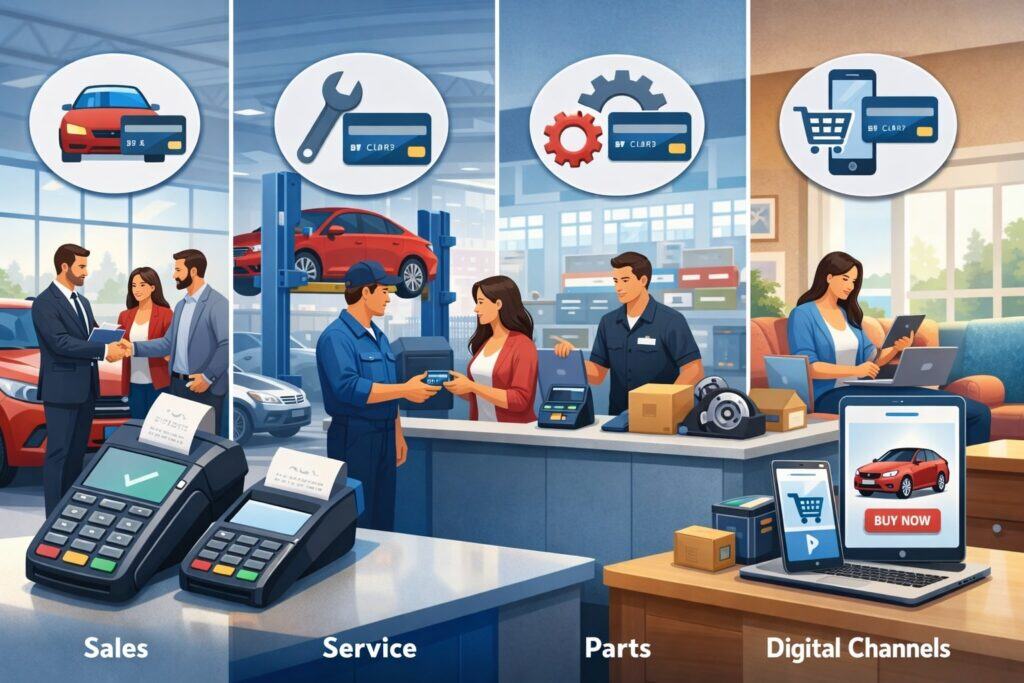
Auto dealers accept credit card payments across several “mini-businesses” inside the same operation. Each area has different payment behaviors, risk profiles, and operational needs.
Sales department card payments often include: vehicle deposits to hold inventory, partial down payments, add-on products, doc-related fees (where allowed), and sometimes delivery fees.
Many dealerships set internal limits for how much of a vehicle transaction can be paid via card due to processing costs and risk. Even when a full purchase isn’t paid on card, deposits and partial payments are common and profitable when handled properly.
Service and repair is one of the strongest use cases for auto dealer credit card payments. Repair orders can be high-ticket and unexpected, so customers appreciate the ability to tap, insert, or pay by wallet.
Service also benefits from tools like text-to-pay, payment links, and card-on-file (with proper authorization) for repeat customers and fleet accounts.
Parts department payments include in-person purchases, phone orders, and online orders. Parts often involve card-not-present payments, which are higher risk than chip transactions. That increases the need for fraud controls, address verification, and good documentation.
Online and remote payments are now standard: deposits via a website form, invoices sent by email, service payments by SMS, and even QR code payments in-store. A dealership that supports both in-person and remote card acceptance creates a consistent experience and captures revenue that might otherwise stall.
When dealerships map payment types to each department—rather than using one generic terminal for everything—the result is better approval rates, fewer disputes, and cleaner reconciliation.
Choosing the Right Merchant Account for an Auto Dealership

To accept auto dealer credit card payments reliably, dealerships typically need a merchant account structure that matches their business model. A common mistake is selecting the cheapest advertised rate without considering ticket size, fraud exposure, dispute handling, and integrations.
A dealership merchant account should support:
- High-ticket processing without sudden funding holds.
- Multiple locations or departments (sales, service, parts) with separated reporting.
- Card-present and card-not-present acceptance under appropriate settings.
- Strong chargeback tools (alerts, representation support, evidence templates).
- Clear underwriting aligned to dealership volume and average ticket.
Underwriting matters more in automotive than many industries. Dealerships may see larger transactions and more “complex receipts” that combine products, deposits, and cancellation terms.
Processors and banks want to understand your typical payment types (deposits vs. repair orders), refund practices, and how you document authorization.
Dealerships also benefit from features like:
- Level 2/Level 3 data support for certain commercial or fleet transactions (where applicable).
- Tokenization for repeat customers and secure stored credentials.
- User permissions (so not every employee can key in large transactions or issue refunds).
- Batch and settlement reporting that matches accounting workflows.
When a dealership’s merchant account is built for automotive reality, approval rates improve, unexpected account reviews become less likely, and payments stop being the bottleneck in the customer journey.
Hardware Options: Terminals, PIN Pads, Tap-to-Pay, and Mobile Checkout
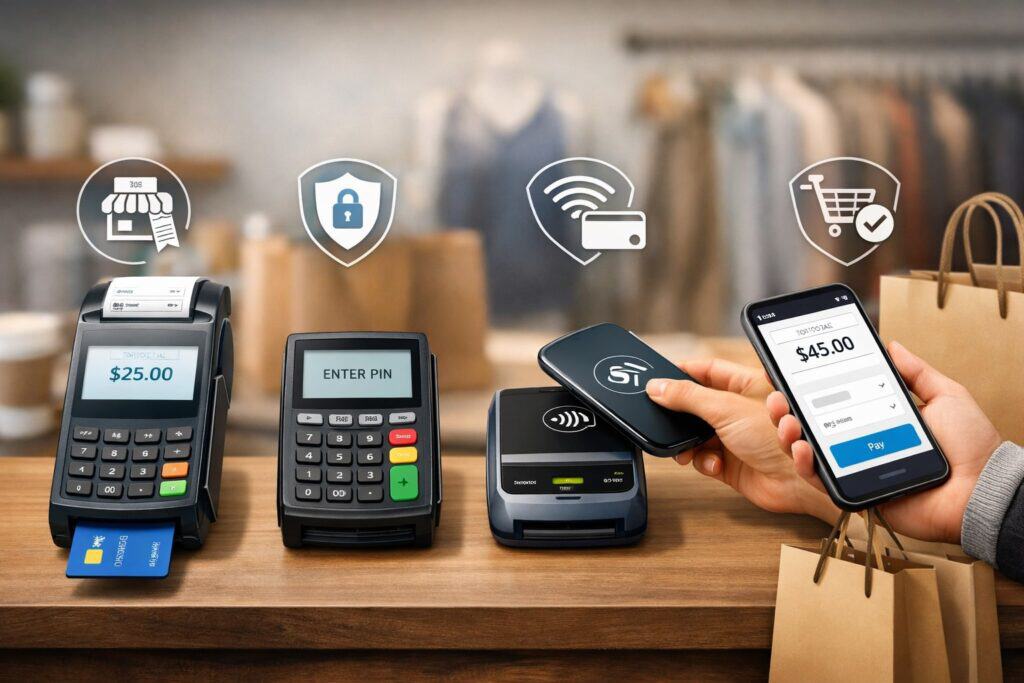
Hardware is where auto dealer credit card payments become “real” for staff and customers. The right setup reduces mistakes, speeds checkout, and improves security.
EMV chip terminals remain the standard for counter payments, especially in service and parts. Chip transactions shift more fraud liability away from the merchant compared with older swipe methods. Adding NFC (contactless) support is equally important because customers increasingly use mobile wallets and tap cards.
PIN pads and customer-facing devices can improve trust and reduce disputes. Customers see what they’re paying, confirm amounts, and receive a clear receipt. This is especially useful when service advisors are busy and customers are trying to leave quickly.
Mobile card readers help sales teams take deposits on the lot, support curbside service, and handle payments during vehicle delivery. These tools should still support chip and contactless, not just swipe. A swipe-only reader is a risk upgrade you don’t want.
Tap-to-pay on phone solutions are increasingly relevant for dealerships with mobile workflows. They can reduce hardware overhead and allow “anywhere checkout,” but the dealership still needs a processor that supports stable settlement and correct reporting.
Hardware choice should match each department:
- Sales: mobile + front desk options for deposits
- Service: fast chip/tap at advisor desks + after-hours options
- Parts: counter terminals + tools for phone/online orders
Good hardware reduces transaction time, boosts customer confidence, and helps your team consistently capture the evidence you’ll want if a dispute happens later.
Software Options: POS, Virtual Terminal, Invoicing, and Payment Links
Auto dealers accept credit card payments through software as much as through terminals. In many dealerships, a “payment” begins as a quote, repair order, invoice, or deposit request—then becomes a transaction through a connected tool.
Virtual terminals are used for keyed-in payments, phone payments, and taking deposits remotely. Because card-not-present transactions carry higher dispute and fraud risk, the virtual terminal should support:
- Address verification (AVS) and CVV prompts (where permitted)
- Role-based access
- Transaction notes and customer data fields
- Receipt delivery by email/SMS
Invoicing and payment links are powerful for service and remote deposits. A payment link can be sent via email or text, letting the customer pay from their phone. This reduces time on the phone, lowers keying errors, and provides a consistent record.
Recurring or card-on-file workflows can help with fleet accounts, service memberships, and repeat customers. The key is proper authorization and secure storage. Tokenization (storing a token, not the actual card number) is the standard approach.
Integration with dealership systems (such as service management, accounting, CRM, or DMS connectors) can dramatically reduce reconciliation time. Even if you don’t fully integrate on day one, choose a payments platform that can export clean reports and supports department-level tracking.
For dealerships aiming to scale, software-based payments are often the fastest win. They add convenience without forcing major operational changes, and they create better documentation—one of the most underrated tools for reducing chargebacks.
How a Dealership Payment Flow Works: From Authorization to Settlement
Understanding the payment lifecycle helps dealerships reduce errors and prevent disputes. Auto dealer credit card payments typically move through four phases: authorization, capture, batching, and settlement.
Authorization is when the cardholder’s bank approves the transaction amount and places a hold on available funds. Dealerships should ensure the authorized amount matches what the customer expects. Surprises are a top driver of complaints.
Capture is when the transaction is finalized. Some dealerships authorize a deposit first, then capture it when paperwork is signed. Service departments may capture once the repair order is closed and the customer approves final costs.
Batching is when the day’s transactions are closed out and submitted for processing. If staff forget to batch, funding can be delayed. Many systems support automatic batching, which reduces operational mistakes.
Settlement is when funds are deposited to the dealership’s bank account, minus processing fees. Funding timelines depend on the processor, risk settings, and whether the transaction was card-present or card-not-present.
A clean workflow includes:
- Written deposit and refund policies
- Itemized receipts (especially for add-ons)
- Consistent invoice descriptions
- Clear cancellation language (when relevant)
When dealerships treat payments like a controlled process—rather than a last-minute step—errors drop, accounting becomes easier, and customer disputes become less frequent.
Managing Processing Costs Without Killing the Deal
Dealerships often worry about card acceptance costs, especially for higher ticket amounts. The key is to manage cost strategically while still offering customer-friendly options.
Common cost levers include:
- Encouraging debit for service payments when practical (lower cost than credit in many cases)
- Using ACH for very large amounts (such as significant down payments or full purchase amounts), when the customer is comfortable
- Setting internal card limits for sales transactions, while still allowing deposits by card
- Optimizing interchange qualification by using modern terminals, correct entry modes, and complete transaction data
Some dealerships explore surcharging or cash discount programs to offset processing costs. If you consider this path, it must be implemented with careful compliance and customer communication, because pricing transparency is sensitive in automotive.
Card networks have specific rules for surcharging. Visa’s guidance for this market notes that surcharging is generally allowed in most states but is subject to limitations and compliance requirements.
Mastercard’s surcharge FAQ states merchants must provide at least 30 days advance notice to Mastercard and the acquirer before implementing a surcharge, and surcharge caps are tied to the merchant’s average discount rate for Mastercard credit acceptance.
Cost management should not be a “gotcha.” The dealerships that win long-term are transparent, consistent, and policy-driven—so customers understand the rules before they pay.
Surcharging, Cash Discount, and Convenience Fees: What Dealerships Must Get Right
This is one of the most misunderstood topics in auto dealer credit card payments. The terms sound similar, but they are not interchangeable—and mistakes can trigger customer complaints, network issues, or state-level compliance trouble.
Credit card surcharging means adding a fee when the customer pays with a credit card (not debit). Card networks limit how surcharging can be applied and how it must be disclosed.
Visa’s public guidance emphasizes that surcharging is allowed in many states but includes limitations, including compliance with card brand rules and applicable laws. Mastercard’s published guidance requires advance notice and sets caps based on the merchant’s average rate.
State rules matter. Even if card networks allow something, a state may impose extra disclosure requirements or restrictions. State-by-state surcharging guidance commonly notes that some states have specific caps or disclosure formats beyond general card-network rules.
Cash discounting typically means offering a discount for cash (or another lower-cost method), rather than adding a fee for cards. This is often simpler from a customer perception standpoint, but it must still be displayed honestly.
Convenience fees are typically associated with certain channels (like online bill pay) and may have their own rules depending on the card brand and merchant category. Dealerships should not assume they can label a surcharge as a convenience fee to “make it okay.”
Practical dealership guidance:
- Be crystal clear on signage and receipts.
- Never apply surcharges to debit cards.
- Train staff on how to explain pricing without conflict.
- Keep documentation of your network notifications and policies.
When dealers treat this as a compliance project—not a quick workaround—they reduce risk and protect reputation.
Fraud Prevention and Chargeback Control for Auto Dealer Credit Card Payments
Chargebacks can cost a dealership far more than the original sale. They take time, create stress, and may raise processing risk. Fraud and disputes are not the same—so dealerships need a plan for both.
Fraud prevention best practices:
- Prefer chip/tap (card-present) whenever possible
- Use AVS and CVV prompts for card-not-present transactions
- Avoid taking card numbers via insecure channels
- Use payment links and hosted checkout pages rather than manual keying
- Require manager approval for unusually large keyed transactions
Dispute prevention best practices:
- Use clear deposit terms (refundable vs. non-refundable) and get signatures
- Itemize add-ons and document customer consent
- Keep repair order approvals, inspection notes, and customer communications
- Provide precise refund timelines and follow them
Because automotive sales can involve complicated pricing and add-ons, transparency is a recurring regulatory theme.
Recent legal coverage notes that the FTC’s Combating Auto Retail Scams (CARS) Rule was vacated by the Fifth Circuit on January 27, 2025, and commentary indicates that as of late April 2025 the FTC had not filed for further review at that time.
Regardless of specific rule status, the direction of travel is clear: clearer pricing, clearer consent, and better documentation reduce risk.
A dealership that builds “evidence by default” (receipts, signatures, disclosures, communication logs) wins more disputes and reduces the number of disputes that ever get filed.
Compliance Basics: PCI DSS, Data Security, Receipts, and Recordkeeping
Dealerships handle sensitive information—customer identity details, financing documents, and payment credentials. That makes security non-negotiable.
PCI DSS (Payment Card Industry Data Security Standard) is the baseline security framework for any business that stores, processes, or transmits card data. Most dealerships should avoid storing raw card numbers entirely. Instead, use tokenization and approved payment tools that keep card data out of dealership systems.
Operational best practices:
- Use EMV-capable, PCI-approved terminals
- Keep devices updated and physically secured
- Restrict who can key in transactions
- Never store card numbers in notes, spreadsheets, or DMS comments
- Use secure payment links for remote collection
Receipts and documentation should include:
- Business name and location
- Date/time
- Amount and payment method
- Clear description (deposit, repair order, parts invoice)
- Refund/cancellation terms where relevant
Recordkeeping is a business advantage, not just a compliance task. Clean records support accounting, improve customer support, and increase chargeback win rates.
If you implement surcharging or cash discounting, documentation becomes even more important—because disclosure timing and formatting can be a compliance issue. Card network guidance and state-level requirements frequently emphasize notice and disclosure.
The dealerships that treat security and compliance as part of customer experience—rather than a back-office chore—build trust and reduce risk across every department.
Best Practices for Customer Experience: Transparency, Speed, and Payment Choice
Auto dealer credit card payments should feel simple to customers even if the back-end is complex. The most successful dealerships engineer payment experience around three goals: transparency, speed, and choice.
Transparency means the customer knows what they’re paying and why. If you require a deposit, explain whether it’s refundable, what it applies to, and under what conditions it can be returned. If service costs changed during diagnosis, document approvals clearly.
Speed matters in service and delivery. Make it easy to pay at the advisor desk, by QR code, or by text link. Long waits at checkout reduce satisfaction and create complaints that can later turn into disputes.
Choice means offering multiple ways to pay depending on amount and customer preference:
- Credit card payments for deposits, service, parts
- Debit and wallet options for quick checkout
- ACH for very large amounts
- Payment links for remote customers
If you do implement a surcharge or cash discount model, communicate it early—before the customer is emotionally invested at checkout. Network guidance often requires disclosure at the point of entry and point of sale, and state-level rules may add specific formatting expectations.
Customer experience is a ranking factor in real life: reviews, referrals, repeat service, and reduced complaints. Payments are one of the last steps customers remember—so make it clean.
Future Predictions: Where Dealership Payments Are Headed Next
Dealership payments are moving toward faster settlement, more embedded workflows, and less manual handling of card data. The next few years will likely reshape how auto dealer credit card payments are collected, verified, and reconciled.
Embedded payments inside dealership software will expand. Instead of jumping between a DMS, invoicing system, and terminal, dealerships will increasingly use payments that are integrated into service write-up, parts invoicing, and customer communication tools. That reduces keying errors and builds stronger audit trails.
Tokenization and network credentials will continue to grow. Storing “payment tokens” for repeat customers enables faster checkout while reducing exposure to sensitive data. Expect more frictionless payments for service customers who authorize card-on-file for future work.
Tap-to-pay and wallet dominance will increase in service and parts. Contactless is already normalized for consumers. As tap-to-pay on phones becomes more common for staff devices, the need for dedicated hardware may drop for some workflows.
Account-to-account and instant payments will become more popular for very large transactions. As real-time bank payment options expand, dealerships may offer “pay-by-bank” flows for down payments and big invoices, reducing card processing costs while providing faster confirmation than traditional checks.
Smarter fraud prevention will become standard, using AI-driven risk signals, better verification flows, and automated chargeback alerts. This won’t eliminate disputes, but it can reduce preventable losses.
In short, auto dealer credit card payments will remain essential, but the winning dealerships will use a blended approach: cards for convenience, bank payments for high-dollar efficiency, and integrated software for clean operations.
FAQs
Q.1: Can an auto dealer accept credit card payments for the full vehicle purchase?
Answer: Many dealers accept credit card payments for deposits and partial amounts, but some limit how much of the vehicle price can be charged to a card due to processing costs and risk. A practical approach is to accept a card deposit and then use a lower-cost method (like cashier’s check or ACH) for the remaining balance.
The best policy depends on your margins, typical ticket size, and processor risk settings. If you want to allow large card payments, ensure your merchant account is underwritten for high tickets and that staff follow strict documentation rules.
Q.2: Are auto dealer credit card payments considered high risk?
Answer: Not automatically, but dealerships often process higher average tickets and more complex transactions (deposits, refunds, add-ons). Those factors can increase dispute exposure compared with basic retail.
The “risk level” depends on chargeback history, how deposits are handled, and how well the dealership documents customer authorization. If the dealership uses secure tools, maintains clear policies, and keeps clean receipts, approval and funding stability usually improve.
Q.3: Can a dealership add a surcharge to credit card payments?
Answer: In many states it may be allowed, but it must follow card network rules and applicable state requirements. Visa’s guidance notes surcharging is generally permitted in most states, subject to limitations and compliance rules.
Mastercard’s published materials require at least 30 days’ notice to Mastercard and the acquirer before starting a surcharge, and caps are tied to the merchant’s average rate. State rules may add extra disclosure requirements or caps. Always implement surcharging through a compliant program and train staff on how to disclose it.
Q.4: What is the safest way to take card payments over the phone?
Answer: Phone payments are card-not-present and higher risk, so minimize manual handling. Use a secure virtual terminal with AVS/CVV prompts where appropriate, or better, send a payment link so the customer enters their own card data on a hosted checkout page.
Avoid writing down card numbers or storing them in dealership notes. Use tokenization if the customer authorizes card-on-file for future transactions.
Q.5: How do dealerships reduce chargebacks on deposits?
Answer: The biggest improvement comes from documentation and clarity. Provide written deposit terms before taking payment, specify whether it’s refundable, and capture the customer’s signature or explicit consent.
Issue a receipt that states “vehicle deposit” and includes stock/VIN details when possible. If the deposit is tied to conditions (inspection, financing approval, delivery timeline), document those conditions clearly. When disputes happen, well-organized evidence is what wins.
Q.6: Do online payments help service departments?
Answer: Yes. Payment links and text-to-pay reduce checkout congestion, eliminate keying errors, and create better transaction records. They also allow after-hours payments or “pay before pickup” workflows.
The service department is often the highest-frequency payment area in a dealership, so improving service payments can have an outsized impact on customer satisfaction and back-office reconciliation.
Conclusion
Auto dealers accept credit card payments to make buying and servicing vehicles faster, easier, and more customer-friendly. The strongest dealership payment setups recognize that sales deposits, service invoices, and parts orders are different workflows—and they configure merchant accounts, hardware, and software accordingly.
To succeed with auto dealer credit card payments, focus on: secure acceptance methods (chip/tap and hosted links), strong documentation (clear receipts, approvals, and deposit terms), smart cost controls (limits, debit/ACH options, interchange optimization), and compliance-minded policies (especially if you consider surcharging). Card network rules and state-specific requirements make transparency and correct disclosures essential.
Looking ahead, dealership payments will become more integrated, more tokenized, and more flexible—blending cards, wallets, and bank-based instant payment options. Dealerships that modernize now will close deals faster, reduce disputes, and deliver the kind of checkout experience customers remember for the right reasons.