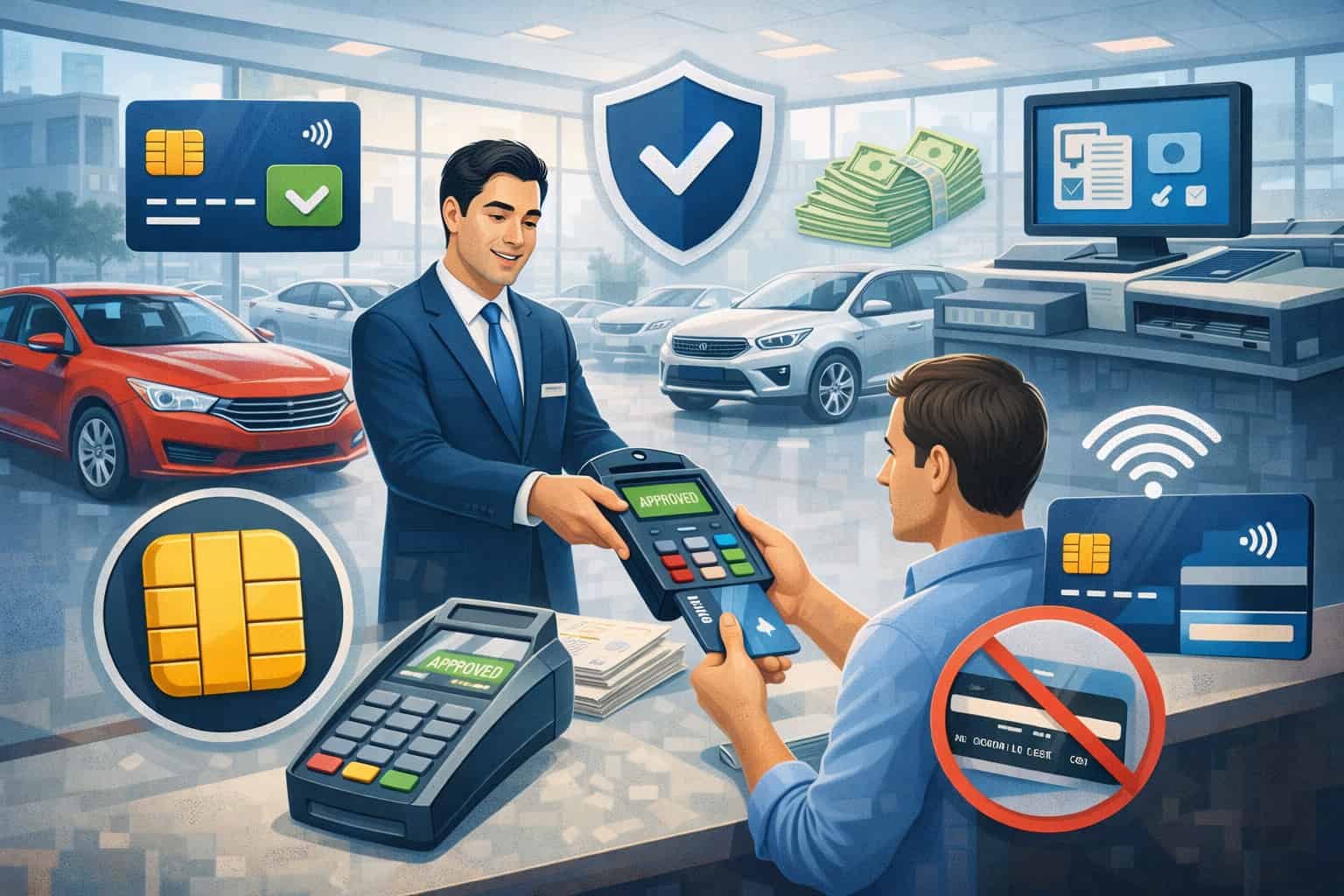
Car dealerships run some of the most complex payment environments in retail. You may take a small deposit on a vehicle today, a larger down payment tomorrow, a service ticket in the lane every hour, and parts orders over the phone—all while juggling multiple locations, rotating staff, and high-dollar transactions.
That mix is exactly why EMV Compliance for Car Dealership POS Systems matters. EMV chip card technology is designed to reduce counterfeit card fraud in card-present transactions, and the U.S. EMV liability shift created a clear financial incentive for merchants to accept chip and contactless payments correctly.
When a dealership’s checkout flow relies on swipes, “fallback” swipes, or misconfigured terminals, it can increase chargeback liability and expose the store to preventable losses.
This guide explains EMV requirements for auto dealerships in practical terms—what you actually need at the terminal, in your POS software, and in daily operations to support Car dealership POS EMV compliance.
It also clarifies how EMV fits alongside PCI DSS compliance, plus department-specific scenarios for sales, F&I, service, and mobile payments.
Why EMV compliance matters in modern car dealerships
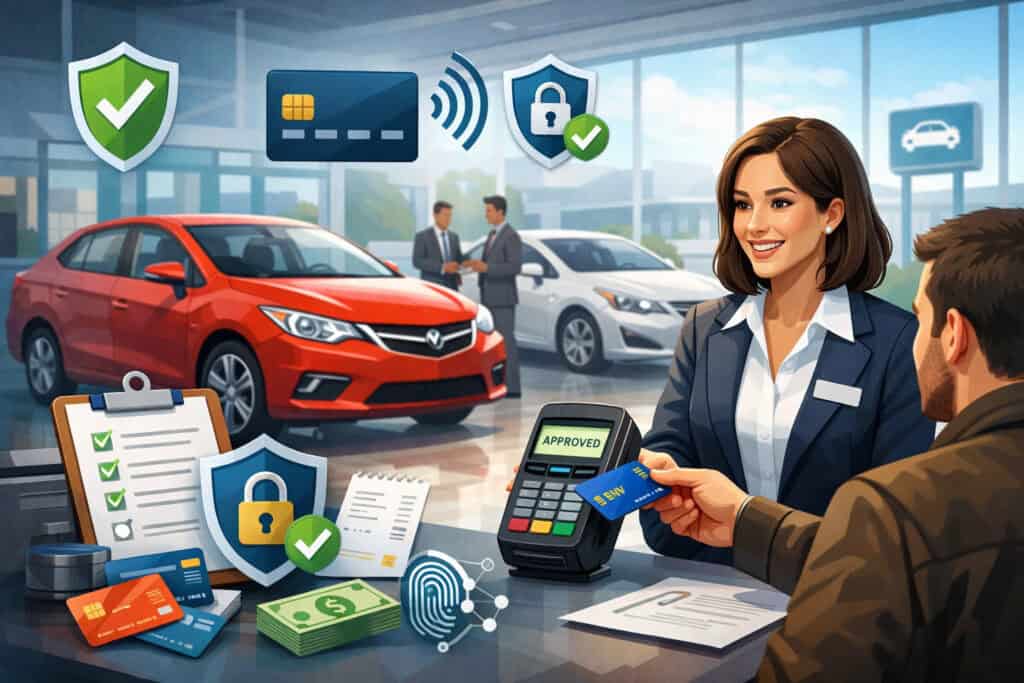
If you accept credit and debit cards in your dealership, you’re operating inside a fraud landscape that looks very different from a coffee shop or a typical boutique retailer.
Dealership payments are attractive targets because transaction amounts can be high, staff may rotate often, and multiple departments may accept payments in different ways (front desk, service advisor tablets, cashier stations, F&I, and parts counters).
When fraud does happen, the downstream impact can be bigger than the immediate loss: it can trigger chargebacks, fee assessments, time-consuming disputes, and even processor scrutiny.
EMV compliance helps reduce a specific category of fraud—counterfeit card fraud at the point of sale—by using chip-based authentication rather than the older magnetic stripe. EMV specifications were created to enable secure interoperability between chip payment applications and payment terminals.
In the U.S., the practical “why now” is the liability shift. For certain scenarios involving in-person counterfeit card fraud, card brands moved liability to the party that hasn’t adopted chip technology.
Visa, for example, explains that counterfeit fraud liability can shift to the issuer or merchant depending on who has not adopted chip acceptance.
For dealerships, that means EMV is not just a “payments feature.” It’s a risk control that directly affects:
- Fraud prevention for dealerships (especially counterfeit card attempts)
- Chargeback liability and dispute workload
- Customer trust during high-ticket purchases and service visits
- The consistency of acceptance across departments and locations
What is EMV?
EMV stands for Europay, Mastercard, and Visa—the organizations that developed the original specification. Today, EMV specifications are maintained by EMVCo, which publishes standards and approval/evaluation processes that support secure and interoperable payments.
At the dealership level, “EMV” usually means your payment devices and POS flow can properly handle:
- Chip (contact) transactions where the card is inserted (“dipped”) into a reader
- Contactless payments (NFC) like tap-to-pay cards and mobile wallets, using EMV Contactless specifications
- Cardholder verification methods such as signature, PIN, or “no CVM” for some low-value transactions (rules vary by brand, issuer, and transaction type)
How EMV chip card technology works
Magnetic stripe cards store static data that can be copied relatively easily. EMV chip transactions add dynamic elements that make “cloning” significantly harder in a card-present environment.
In a typical chip transaction:
- The customer inserts the card into the terminal.
- The terminal and chip communicate to identify the payment application and required processing steps.
- The chip generates a transaction-specific cryptographic value (often described as a dynamic cryptogram) and the transaction is authorized online (in most U.S. retail settings).
- The cardholder completes verification (signature, PIN, or sometimes none), and the terminal finalizes the transaction.
What matters operationally is this: the chip is designed so the data used to authorize this transaction is not the same reusable data an attacker would need to create a working counterfeit card for future transactions.
For dealerships, this has two practical implications:
- You must accept the chip correctly (insert/tap instead of swipe) to get the benefit.
- Your environment must be configured to reduce risky behaviors like unnecessary “fallback” swipes.
Magnetic stripe vs chip: what actually changes at the POS
The best way to think about it is “static vs dynamic.”
- Magnetic stripe (swipe): reads data that is largely static; easier to copy and reuse in counterfeit fraud attempts.
- EMV chip (dip): uses chip-based processing designed to support stronger authentication between the card and terminal.
- Contactless (tap): uses NFC with EMV contactless specifications; from a risk standpoint, it’s typically treated as EMV-capable acceptance when properly implemented.
In the dealership context, the difference shows up in chargeback outcomes. If a counterfeit card dispute comes in, the question often becomes: Did the transaction use EMV when it could have? If not, liability may shift.
EMV requirements for auto dealerships
“EMV compliance” isn’t a single checkbox. It’s the combination of EMV-capable hardware, certified and correctly integrated software, and day-to-day procedures that ensure chip and contactless transactions are actually used.
Below are the most common EMV requirements for auto dealerships from an operational standpoint.
EMV-certified payment terminals and terminal testing
At a minimum, dealerships need terminals that support EMV contact transactions (chip insert). Many dealerships also need contactless acceptance (tap), especially in service lanes where speed matters.
EMV acceptance devices often go through Level 1 (L1) and Level 2 (L2) testing:
- L1 focuses on the physical/electrical interface and basic communication.
- L2 focuses on payment application processing and transaction flows.
Your dealership may not personally run these tests, but you should ensure your device models are approved and supported by your processor/acquirer and POS provider.
Practical dealership takeaway:
- Use device models your processor supports for your POS integration.
- Avoid gray-market terminals or “unlocked” devices that aren’t supported for your processing setup.
Software integration and processor certification
Hardware alone is not enough. Many EMV failures happen because the POS software integration is incomplete or the processor certification isn’t finished for the exact combination of:
- POS application/version
- Terminal model and firmware
- Gateway or processor configuration
- EMV contact and/or contactless kernels used
Card brands and processors publish terminal testing requirements and toolkits to help ensure correct configuration and integration testing for EMV contact and contactless devices.
In dealership terms, “certified” means:
- Your integrated POS flow has been validated with your processor so chip and contactless transactions process correctly.
- Your system supports the right cardholder verification methods (signature/PIN/no-CVM as applicable).
- Your receipts, prompts, and settlement data align with what the processor expects.
Secure POS configuration and point-of-sale (POS) security
EMV reduces counterfeit card risk, but it doesn’t magically secure everything. You still need strong point-of-sale (POS) security controls because criminals may target other weak points—like staff procedures, remote access, or payment data exposure.
Strong dealership-aligned practices include:
- Locking down admin access to POS/terminal settings
- Enforcing unique user IDs for staff (no shared “cashier” logins)
- Disabling unnecessary features (e.g., manual key entry where not needed)
- Monitoring for terminal tampering and keeping devices in controlled locations
- Coordinating updates with your POS vendor so patches don’t break EMV flows
Support for contactless payments (NFC)
In most dealerships, contactless isn’t just a convenience feature. It can reduce friction at:
- Service cashier stations (high volume)
- Parts counters
- Quick-pay situations (oil change, tire rotations, accessories)
EMVCo describes EMV Contactless Chip as supported by EMV Chip and EMV Contactless specifications that define requirements for processing contact and contactless transactions seamlessly.
If you enable contactless, make sure you do it intentionally:
- Confirm the terminal supports contactless in your processing environment
- Confirm your POS screens and receipts handle contactless correctly
- Train staff not to “force swipe” when tap is available
PIN pad requirements and chip-and-PIN vs chip-and-signature
In the U.S., chip transactions can use different verification methods. Visa notes that EMV chip can be used with signature, PIN, or sometimes “no signature required,” depending on the program and transaction context.
For dealerships, the practical question is: Does your acceptance setup support the cardholder verification methods your customers’ cards will request?
- If your environment frequently processes debit, you may see more PIN-related flows.
- If your process involves tips (less common in dealerships), flows can differ.
- Some low-dollar transactions may not require signature.
Make sure your PIN pad and prompts are consistent and clear—especially in service lanes where customers expect speed.
Understanding the EMV liability shift
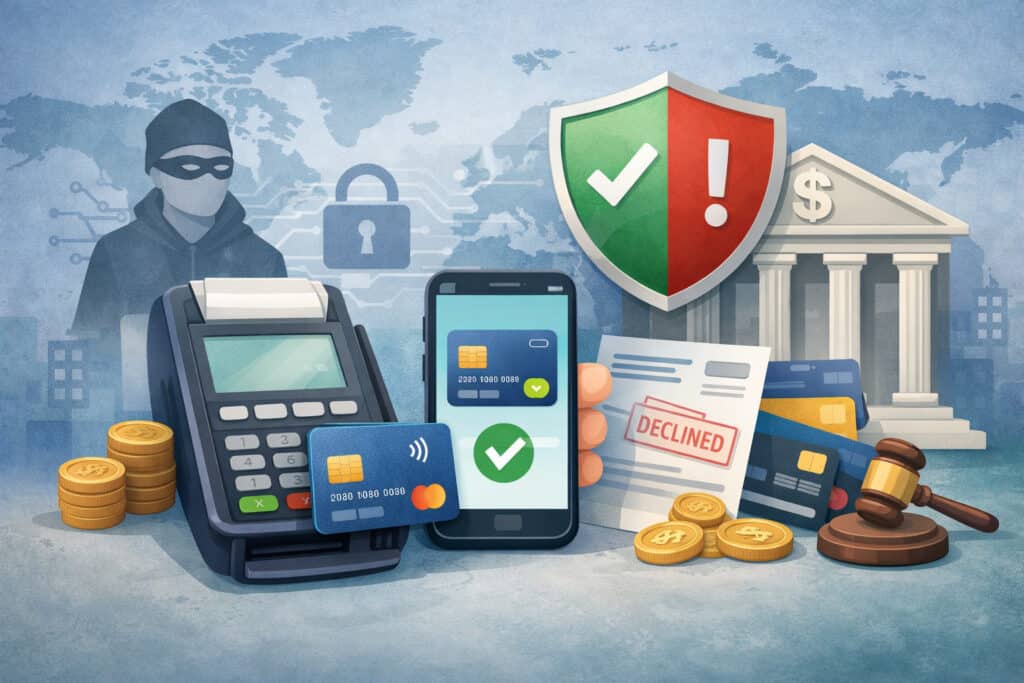
The liability shift is one of the biggest reasons dealerships prioritize EMV upgrades. It’s not about “being modern.” It’s about who pays when counterfeit fraud occurs in card-present environments.
What changed in 2015 and what it means today
In the U.S., major card networks implemented fraud liability shifts starting in October 2015. Visa’s materials explain that for certain in-store counterfeit fraud scenarios, liability can shift to the party—issuer or merchant—that has not adopted chip technology.
Operationally, the idea is simple:
- If the card is chip-enabled and the merchant could have processed it as EMV, but instead processes it as mag-stripe (swipe), the merchant may be exposed to counterfeit fraud chargebacks.
- If the merchant is EMV-capable and processes the chip properly, liability for counterfeit card fraud is more likely to remain with the issuer (depending on rules and circumstances).
This doesn’t mean “chip = no fraud.” It means the party not using the more secure method may be financially responsible when a counterfeit card is involved.
Who is liable for counterfeit fraud in card-present transactions?
While exact outcomes can vary by brand and dispute reason code, the practical lens for dealerships is:
- Was the transaction EMV-capable?
- Was the chip (or contactless EMV) used properly?
- Was there a fallback swipe, and was it legitimate?
Dealerships should be especially careful with “fallback.” If a chip card fails to read, staff may be tempted to swipe to keep the line moving. But repeated fallback swipes can look suspicious and may weaken your dispute position.
Key risk flags in a dealership environment:
- A high-dollar parts order paid via swipe when the card is chip-enabled
- A service advisor taking a swipe on a mobile reader with chip disabled
- A cashier using manual key entry without proper controls or verification
Real-world dealership examples of liability outcomes
Scenario 1: Service lane rush + swipe habit
A customer pays $1,950 for a transmission repair. The cashier swipes the card out of habit even though the terminal has a chip reader. The transaction later comes back as counterfeit fraud. If the card was chip-enabled and the merchant didn’t process it via chip, the dealership could be on the hook due to the liability shift concept.
Scenario 2: Chip read attempted + proper EMV completion
A customer pays a $3,000 deposit in the showroom. The card is inserted, EMV completes, and the receipt reflects a chip transaction. If a counterfeit card dispute occurs, the dealership generally has a stronger position than it would with a swipe, because it used the chip acceptance method.
Scenario 3: Legitimate chip failure + controlled fallback
A chip fails after multiple insert attempts and the terminal requests fallback. The cashier follows policy: documents the event, checks ID if required by policy, and completes the transaction with a fallback swipe. This is still higher risk than a successful chip read, but the controlled process reduces operational exposure.
EMV vs PCI DSS: how they differ and why dealerships need both
A common misconception is that upgrading to EMV “handles compliance.” In reality, EMV and PCI DSS solve different problems.
EMV is focused on making card-present transactions more resistant to counterfeit fraud by using chip-based processing rather than magnetic stripe. PCI DSS is a broader security standard focused on protecting cardholder data across your entire environment—systems, networks, access controls, monitoring, and more.
How EMV and PCI DSS differ
Think of it like this:
- EMV: helps authenticate the card at the terminal to reduce counterfeit card fraud at the point of sale.
- PCI DSS compliance: helps protect card data and systems from breaches and broader payment security risks.
A dealership can be EMV-capable and still fail PCI expectations if, for example:
- POS systems are not patched
- Default passwords exist
- Remote access is poorly controlled
- Staff share logins
- Card data is stored improperly
Why PCI DSS is still required (and evolving)
PCI DSS requirements continue to evolve. The PCI Security Standards Council has emphasized adopting PCI DSS v4.x requirements and noted future-dated requirements that become effective on 31 March 2025.
For dealerships, the practical point is not memorizing every PCI requirement—it’s ensuring you have a program and partners (processor, POS vendor, IT/security provider) that keep your environment aligned with PCI expectations, especially if you have:
- Multiple locations
- Mixed POS types (fixed + mobile)
- Integrated DMS or service systems
- Remote access for support
How they work together: layered payment security
The best dealership setups treat EMV as one control in a layered security model that can include:
- EMV chip + contactless acceptance
- Tokenization and encryption to reduce exposure of sensitive data
- Network segmentation between payment systems and office networks
- Strong access controls and logging
- Staff training and clear procedures
EMV reduces a slice of fraud risk. PCI DSS helps you manage the broader security responsibilities around handling payment data and maintaining secure systems.
Step-by-step: how to achieve EMV compliance in a dealership
Dealerships often stumble on EMV projects because they treat it like a simple hardware swap. The reality is closer to an implementation rollout: devices, software, certification, training, and ongoing maintenance.
Step 1: Audit your existing POS system and payment flows
Start with a map of where payments happen today:
- Showroom desks (sales staff and managers)
- F&I office terminals
- Service cashier stations
- Service advisor stations/tablets (if they take payments)
- Parts counters
- Mobile POS for car dealerships (delivery, offsite events, mobile service)
- Any “backup” terminals used during outages
For each location, capture:
- Terminal model and connection type (IP, USB, Bluetooth)
- Whether chip insert works and is used
- Whether contactless is enabled
- Whether fallback swipes happen frequently
- Who supports it (POS vendor, IT, processor)
This audit often reveals the real issue: a dealership may be “EMV capable” at one counter and effectively “swipe-first” everywhere else.
Step 2: Upgrade terminals (and confirm supported models)
If your devices can’t properly accept chip and contactless, upgrading is unavoidable. However, don’t buy terminals in isolation.
Do this instead:
- Select devices recommended/supported by your processor and POS provider
- Confirm support for EMV chip and the contactless kernels you need
- Confirm you can manage firmware updates and device security
- Decide where you need PIN pads vs all-in-one devices
If you operate multiple rooftops, standardizing device models can simplify training and support.
Step 3: Confirm processor certification and integration readiness
This is where many “EMV failures” happen. A device might be EMV-capable, but the integrated POS flow isn’t properly certified for your processor environment.
Ask your provider:
- Is this POS version certified for EMV contact transactions with our processor?
- Is contactless certified and enabled?
- Are there specific configuration requirements or test scripts?
- Do we need to run pilot testing at one location first?
Visa publishes terminal testing requirements and guidance to help ensure correct configuration and integration testing for EMV contact and contactless devices.
Step 4: Train employees with dealership-specific scripts
Training is not optional. A single untrained employee can turn your EMV investment into a “swipe culture” again.
Training should cover:
- Insert vs swipe vs tap (and when each is appropriate)
- What to do when the chip fails
- When manual entry is allowed (and approvals needed)
- How to handle ID checks per dealership policy
- How to spot suspicious behavior without escalating unnecessarily
Keep scripts short and role-based:
- Cashier training is different from service advisor training.
- F&I workflows differ from parts counter workflows.
Step 5: Test real transactions before full rollout
Before you flip every lane and counter at once, test:
- Chip insert: credit + debit
- Contactless: tap card + mobile wallet
- Refunds and voids
- Tips (if applicable)
- Partial approvals (can occur with prepaid or limited funds)
- Receipt content and settlement reporting
If something fails, fix it before it becomes “the way we do things.”
Step 6: Maintain ongoing updates and controls
EMV isn’t “set it and forget it.” Ongoing actions include:
- Keeping POS and terminal firmware updated (in coordination with your vendor)
- Monitoring for unusually high fallback swipe rates
- Reviewing chargeback and fraud trends monthly
- Ensuring replacement devices are configured correctly
- Refreshing training for new hires and role changes
EMV in different dealership departments
The hardest part of EMV Compliance for Car Dealership POS Systems is consistency. A dealership can be compliant in the showroom and noncompliant in the service lane if different teams use different devices and habits.
Showroom sales: deposits, down payments, and speed vs security
Showroom payments often include:
- Reservation deposits
- Down payments
- Accessories or add-ons
- Split tenders (multiple cards)
Best practices:
- Make EMV the default: insert or tap first
- Avoid taking card details on paper or in unsecured notes
- Use clear prompts so customers know when to insert vs tap
- If taking deposits remotely, separate those processes from in-person EMV flows (and ensure they follow appropriate e-commerce/card-not-present controls)
Scenario: A customer wants to put $5,000 down quickly before the bank closes. If staff “just swipe it,” you may be creating unnecessary exposure. Train teams that chip/tap is part of the standard deal process.
F&I office: higher scrutiny, tighter processes, and fewer mistakes
F&I often handles:
- Larger amounts
- More sensitive customer interactions
- Longer dwell time (less rush than a cashier line)
This is a good place to enforce strict controls:
- Chip-only acceptance for card-present where possible
- Limited manual entry access (manager approval if used)
- Clear dispute documentation (signed receipts, deal paperwork aligned with the payment)
Scenario: A customer disputes a large add-on as unauthorized. Even if EMV reduces counterfeit risk, you still need clear documentation and alignment between the payment record and the signed agreement.
Service department payments: volume, speed, and real-world fallback risk
The service lane is where EMV either succeeds or fails.
Common risks:
- Busy hours lead to swiping “to move the line”
- Terminals are shared and settings get changed
- Mobile devices are used without consistent configuration
Service department best practices:
- Enable and promote contactless payments (NFC) for quick checkout
- Place terminals where customers can insert/tap easily
- Track and reduce fallback swipes
- Train cashiers and advisors on chip failure procedures
Scenario: A customer picks up a vehicle after hours and pays via a device that only supports swipe. That may be convenient, but it’s exactly the kind of inconsistency that can increase risk.
Parts department: mix of in-person and remote orders
Parts often includes:
- In-person counter sales (card-present)
- Phone orders for shops or repeat customers (card-not-present)
- Special orders and deposits
For in-person parts sales:
- Use chip/tap by default
- Keep terminals in controlled areas
- Monitor for suspicious high-dollar accessory purchases with swipes
For phone orders:
- Follow your processor’s rules and best practices for card-not-present acceptance
- Do not store card numbers in spreadsheets, email, or notes
- Consider payment links or invoicing tools that reduce staff handling of card data
Mobile service payments and mobile POS for car dealerships
Mobile service and delivery are growing. That introduces new requirements:
- Devices must support EMV chip and ideally contactless
- Connectivity must be reliable (or you risk staff forcing swipes/manual entry)
- Device security matters: PINs, encryption, and inventory control
Mobile best practices:
- Standardize on one approved mobile device model
- Use MDM (mobile device management) where feasible
- Train techs on “no swipe-first” behavior
Common mistakes dealerships make (and how to avoid them)
Most EMV “problems” are operational, not technical. Here are the issues that show up repeatedly across automotive retail environments.
Mistake 1: Using non-certified or unsupported terminals
Even if a terminal is EMV-capable, it may not be supported in your processing environment. That leads to:
- Inconsistent chip acceptance
- Failures that push staff back to swiping
- Increased support costs and downtime
Fix:
- Use terminals sourced and supported through your processor/POS partner.
- Standardize models to reduce training and maintenance complexity.
Mistake 2: Not enabling chip readers (or letting staff bypass them)
This is the “we bought the terminals, but we still swipe” problem.
Fix:
- Configure the POS so the chip is the default path.
- Coach staff to insert/tap first.
- Monitor swipe/fallback rates and address hotspots.
Mistake 3: Overusing fallback swipes
Fallback should be the exception, not the norm. If your fallback rate is high, it may indicate:
- Dirty or damaged chip readers
- Outdated firmware
- Poor training
- Customers being coached (by criminals) to “swipe instead”
Fix:
- Clean/maintain hardware.
- Replace failing devices quickly.
- Use a documented chip-failure procedure and require a second insert attempt before fallback.
Mistake 4: Skipping staff training (especially in service and parts)
Turnover is real in dealerships. Without training, habits return.
Fix:
- Create 1-page role-based training sheets
- Include “what to do if chip fails” and “when manual entry is allowed”
- Retrain during onboarding and quarterly refreshers
Mistake 5: Ignoring software and firmware updates
Outdated software can cause chip read failures, contactless issues, or security gaps.
Fix:
- Coordinate updates with your POS provider
- Keep a test plan for payment acceptance after updates
- Schedule updates during low-volume windows
Mistake 6: Assuming “processor compliance” without verifying it
Your processor relationship matters. Certification, configuration, and support processes vary.
Fix:
- Ask for written confirmation of EMV contact and contactless readiness
- Confirm the certified POS + terminal + processor combination
- Keep deployment notes so replacements are configured correctly
Costs and ROI of EMV upgrades for dealerships
Dealership leaders understandably ask, “What will this cost, and what do we get back?” EMV upgrades have both direct and indirect ROI. The best way to evaluate is to tie costs to specific risk reductions and operational improvements.
Typical cost areas to plan for
Common cost categories include:
- Terminal hardware (countertop, wireless, PIN pads)
- Installation and configuration
- POS integration and certification work (if applicable)
- Training time and materials
- Ongoing support or device management
- Replacement/refresh cycle planning
Your costs will vary based on:
- Number of lanes/counters
- Number of rooftops
- Whether you need mobile devices for service/delivery
- Whether your POS is integrated or semi-integrated
A useful budgeting approach is to plan in tiers:
- Must-have: service cashier, parts counter, primary showroom payments
- Next: secondary stations, backups, mobile service
- Optimize: standardization, device management, reporting
Where ROI shows up: fraud reduction and reduced chargebacks
EMV is strongly associated with reducing counterfeit card fraud in card-present environments. The core logic of the liability shift is to encourage adoption of chip acceptance by shifting counterfeit fraud exposure to the party not using chip when available.
For dealerships, ROI often comes from:
- Fewer counterfeit-related chargebacks (especially in service and parts)
- Less staff time spent on disputes
- Fewer “high-risk” payment behaviors (manual entry, swipe-first)
- More consistent customer experience at checkout
A practical way to measure:
- Track monthly chargebacks by department before and after EMV improvements
- Track fallback swipe rates by device/location
- Track payment acceptance issues (declines, retries, downtime)
Customer trust and checkout experience
EMV and contactless acceptance also influence perception:
- Customers expect tap-to-pay in 2026, especially in service lanes.
- A modern, consistent checkout experience reduces friction and boosts confidence during high-dollar transactions.
This isn’t about hype—it’s about removing avoidable moments where customers wonder if the process is outdated or insecure.
Practical compliance checklist: dealership-focused EMV readiness
Use the checklist below as a working document for Car dealership POS EMV compliance across departments.
EMV readiness checklist (implementation)
Hardware
- All payment acceptance points have EMV chip-capable terminals
- Contactless payments (NFC) are enabled where appropriate (service/parts recommended)
- Terminals are sourced/supported through your processor/POS partner
- Spare/backup terminals are also EMV-capable (no swipe-only backups)
Software & certification
- POS version is certified/configured for EMV with your processor
- EMV contact (chip) transactions process successfully end-to-end
- Contactless transactions process successfully end-to-end (if enabled)
- Refunds/voids work correctly for chip and contactless transactions
- Receipts and reporting correctly label chip/tap vs swipe
Security configuration
- POS admin access is restricted and logged
- Unique logins for staff (no shared cashier accounts)
- Remote access is controlled and approved
- Devices are physically secured and inspected for tampering
People & process
- Staff trained: insert/tap first, swipe only when appropriate
- Chip failure + fallback procedure documented and followed
- Manual entry policy defined (who can do it, when, approvals)
- New hire onboarding includes payment acceptance training
Ongoing operations checklist (monthly/quarterly)
- Review swipe/fallback rates by device and department
- Replace failing chip readers quickly
- Patch/upgrade POS and terminal firmware in a controlled schedule
- Review chargebacks and fraud patterns by department
- Refresh training for service, parts, and cashier teams
- Reconfirm PCI DSS responsibilities and validate vendor support as standards evolve
FAQs
Q1) Is EMV compliance mandatory for car dealerships?
Answer: EMV itself isn’t typically described as a government “mandate,” but it is effectively required if you want to reduce exposure under card brand liability rules. In practice, dealerships that continue to rely heavily on swipes may face higher counterfeit fraud liability and operational risk.
Q2) What happens if I don’t upgrade to EMV?
Answer: You may be more exposed to counterfeit card fraud chargebacks in card-present transactions, depending on the scenario and card brand rules. Visa explains that counterfeit fraud liability can shift to the party that hasn’t adopted chip technology.
Q3) Do I still need PCI compliance if I have EMV?
Answer: Yes. EMV helps reduce counterfeit fraud at the terminal, while PCI DSS is a broader security standard focused on protecting cardholder data and securing systems. PCI DSS v4.x requirements have future-dated items that became effective on 31 March 2025.
Q4) Are contactless payments part of EMV?
Answer: They can be. EMVCo maintains EMV contactless specifications that define how contactless chip transactions are processed.
Q5) Can I use older POS terminals if they have a chip slot?
Answer: Possibly, but the bigger question is whether the exact terminal model and your POS integration are supported and properly configured for EMV (and contactless, if needed). If chip reads fail often, staff will revert to swiping, which undermines your goals.
Q6) How does EMV reduce fraud in dealerships?
Answer: EMV chip transactions are designed to make counterfeit card fraud harder at the point of sale compared to magnetic stripe acceptance. The biggest visible effect for dealerships is reducing exposure to counterfeit-related disputes when chip/tap is used properly.
Q7) Does EMV eliminate chargebacks?
Answer: No. EMV mainly targets counterfeit card fraud in card-present settings. Chargebacks can still happen for customer disputes, service dissatisfaction, duplicate processing, no-shows, or authorization issues.
Q8) What is “fallback,” and why does it matter?
Answer: Fallback is when a chip card doesn’t read and the transaction is completed by swiping the magnetic stripe. Excessive fallback can increase risk and weaken your position in counterfeit fraud disputes.
Q9) Do service departments need different EMV setups than sales?
Answer: Often, yes. Service typically needs faster throughput and benefits from contactless enablement, clear customer-facing prompts, and consistent training across cashiers and advisors. Sales and F&I may prioritize documentation and tighter access controls.
Q10) Should our dealership accept tap-to-pay (NFC)?
Answer: In most cases, yes—especially in service and parts. EMV contactless specifications support secure contactless acceptance, and many customers expect it.
Q11) What is chip-and-PIN vs chip-and-signature?
Answer: They’re different cardholder verification methods used with EMV. In the U.S., signature and PIN (and sometimes no signature for low-value transactions) may be supported depending on the issuer and transaction context.
Q12) Do we need terminal “certification” for EMV?
Answer: Your dealership typically relies on your POS/processor/terminal vendors for certification, but you should verify your exact POS + terminal + processor combination is validated and configured correctly. EMVCo describes Level 1 and Level 2 testing as part of assessing device compatibility and performance.
Q13) What should we do if staff keep swiping out of habit?
Answer: Treat it as an operations issue: update training, adjust prompts, monitor swipe/fallback rates, and coach by department. If chip reads are failing, fix the hardware so staff aren’t “trained” by broken equipment.
Q14) How do we handle mobile service or offsite payments?
Answer: Use approved mobile devices that support chip (and ideally contactless), secure the devices, standardize training, and avoid manual entry unless absolutely necessary and controlled.
Q15) Can EMV help with fraud in phone orders for parts?
Answer: Not directly, because that’s usually card-not-present. For those, focus on secure payment acceptance methods (payment links/invoicing), avoiding storage of card data, and tighter internal controls.
Conclusion
EMV is one of the most practical fraud-reduction upgrades a dealership can implement—if it’s done end-to-end. Buying terminals is the easy part. The real work is ensuring every department accepts chip and contactless correctly, your POS integration is certified and stable, and your teams don’t fall back into swipe-first habits.
Here are the next steps to move from “we have chip readers” to true EMV Compliance for Car Dealership POS Systems:
- Audit every payment point (sales, F&I, service, parts, mobile) and identify where swipes or fallback are common.
- Standardize supported terminals and confirm your processor/POS certification status for chip and contactless flows.
- Train by role, especially in service and parts, with a clear chip-failure and fallback procedure.
- Test real transactions before full rollout, including refunds and edge cases.
- Maintain the program: updates, monitoring swipe/fallback rates, and monthly chargeback review.
- Keep PCI DSS in view, because EMV and PCI address different risks—and PCI requirements continue to evolve.